

Evolution has generated an immense variety of organisms. To make sense of this biodiversity, scientists use classification systems. Modern classification is dynamic, constantly updating as genomic and molecular technologies reveal the true evolutionary histories of organisms.
What you'll learn
By the end of these study notes, you will understand:
- How organisms are systematically named and grouped using the taxonomic hierarchy and the three-domain system.
- How to interpret phylogenetic trees to understand evolutionary relationships (phylogeny).
- The anatomical, physiological, and behavioural adaptations driven by natural selection, including convergent evolution.
- How selection pressures drive the evolution of resistance in microorganisms and insect pests.
Biological Classification and Taxonomy
Classification is the process of sorting living things into groups. The scientific study of these groups and the principles behind classification is known as taxonomy.
Historically, classification was based entirely on observable anatomical features. Today, we construct a taxonomic hierarchy using evolutionary relationships.
Taxonomic Hierarchy
A taxonomic hierarchy is a multi-level system of classification where organisms are placed into nested groups (taxa) that become progressively narrower and more specific.
The standard taxonomic ranks, from the largest and most inclusive to the smallest and most specific, are:
- Domain (the highest taxonomic rank)
- Kingdom
- Phylum
- Class
- Order
- Family
- Genus
- Species
Remembering the Order
Use a simple mnemonic to remember the sequence from Domain down to Species:
Dear King Philip Came Over For Good Spaghetti!
Species
A species is a group of organisms that are highly similar in anatomy, physiology, and biochemistry, and are capable of interbreeding to produce fertile offspring.
The Binomial Naming System
Before the binomial system, organisms had long, descriptive Latin names or localized common names, leading to massive scientific confusion. Devised by Carl Linnaeus, the binomial system gives every species a unique, two-part Latin name.
- The first name is the Genus (capitalized).
- The second name is the species (lowercase).
- It must always be written in italics (or underlined if handwritten). For example, humans are Homo sapiens.
Advantages of the Binomial System
- Universal language: It is recognized globally by all scientists, transcending local language barriers.
- Uniqueness: Avoids the confusion caused by common names (e.g., a "daddy longlegs" refers to completely different organisms in the UK vs. the US).
- Shows relationships: Species belonging to the same genus are closely related, instantly highlighting evolutionary links (e.g., Panthera leo (lion) and Panthera tigris (tiger)).
The Five Kingdoms vs. The Three Domains
Taxonomy is not static. Our classification models have shifted dramatically due to the arrival of advanced molecular biology techniques.
The Original Five-Kingdom System
In 1969, Robert Whittaker classified all life into five kingdoms based primarily on observable, phenotypic features (e.g., cell structure, nutrition, and body organization):
- Prokaryotae (Monera): Unicellular, prokaryotic (no nucleus), naked DNA, 70S ribosomes, peptidoglycan cell walls. E.g., Bacteria.
- Protoctista: Mainly unicellular, eukaryotic (possess a nucleus and membrane-bound organelles). E.g., Amoeba, algae.
- Fungi: Eukaryotic, chitin cell walls, saprotrophic nutrition (absorb nutrients externally via hyphae), single-celled or multicellular. E.g., Yeast, mushrooms.
- Plantae: Eukaryotic, multicellular, cellulose cell walls, autotrophic (photosynthetic, containing chlorophyll). E.g., Mosses, ferns, oak trees.
- Animalia: Eukaryotic, multicellular, no cell walls, heterotrophic (ingest food). E.g., Insects, fish, mammals.
Protoctista is a 'junk drawer'
Do not assume Protoctista is a closely related group. It is a highly diverse eukaryotic kingdom defined by exclusion—it contains organisms that do not comfortably fit into Fungi, Plantae, or Animalia.
The Shift to the Three-Domain System
In 1990, Carl Woese proposed the Three-Domain System after analyzing genetic and molecular evidence, particularly the nucleotide sequence of ribosomal RNA (rRNA).
Woese realized that the kingdom Prokaryotae actually contained two fundamentally different groups of organisms that were as different from each other as they were from eukaryotes. He divided life into three domains:
- Bacteria (True bacteria)
- Archaea (Extremophile prokaryotes)
- Eukaryota (All eukaryotic kingdoms: Protoctista, Fungi, Plantae, Animalia)
Molecular Evidence Supporting the Three-Domain System
The transition from five kingdoms to three domains represents a classic example of How Science Works (HSW): new technology provided new data, which forced scientific consensus to change. The key molecular differences that justify the three domains include:
- rRNA Structure: Archaea have a unique sequence of nucleotides in their rRNA that is significantly different from Bacteria, but shares similarities with Eukaryota.
- RNA Polymerase: Archaea have a complex RNA polymerase structure (with 8–10 subunits) that resembles eukaryotic RNA polymerase, whereas Bacteria have a simple RNA polymerase (with only 4 subunits).
- Cell Membrane Lipids: Archaea have unique membrane lipids with ether links between glycerol and fatty acid chains, making them exceptionally stable in extreme conditions. Bacteria and Eukaryota have ester links.
- Cell Wall Composition: Bacteria possess peptidoglycan cell walls, whereas Archaea and Eukaryota lack peptidoglycan.
Phylogeny: The Core of Evolutionary Classification
Modern taxonomy aims to make classification reflect phylogeny.
Phylogeny
Phylogeny is the study of the evolutionary history and relationships of a group of organisms. It determines how closely related species are by tracing them back to common ancestors.
If taxonomy is the practice of naming and grouping organisms, phylogeny is the evolutionary framework that dictates where those groups should be placed.
Understanding Phylogenetic Trees
A phylogenetic tree is a diagrammatic representation of evolutionary relationships.
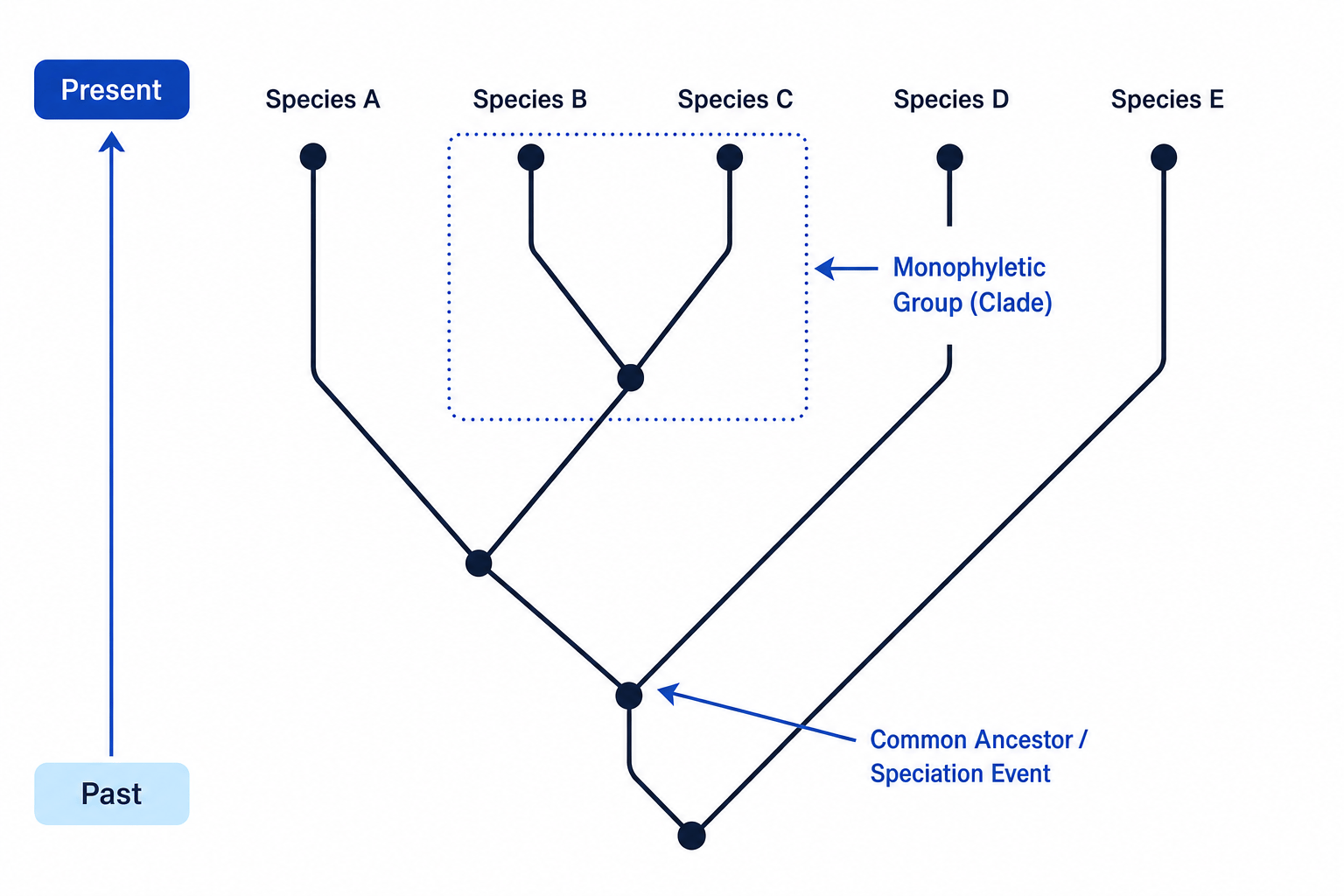
When interpreting a phylogenetic tree:
- The root at the bottom represents the common ancestor of all organisms in the tree.
- A branch point (node) represents a speciation event, where an ancestral species split into two or more descendant species.
- The closeness of branches represents how recently two species shared a common ancestor.
- A monophyletic group (clade) consists of an ancestral species and all of its descendants.
Advantages of Phylogeny over Pure Hierarchy
- It produces a continuous tree of life rather than forcing organisms into artificial, rigid hierarchical boxes.
- It prevents errors caused by grouping organisms purely on superficial anatomical traits that may have arisen through convergent evolution.
Evidence for Evolution by Natural Selection
The theory of evolution by natural selection was co-formulated by Charles Darwin and Alfred Russel Wallace in 1858. Today, it is supported by three major pillars of evidence:
- The Fossil Record: Fossils preserve structural changes in organisms over geological time. They demonstrate that simple organisms appear in older strata (rock layers), while complex organisms appear in newer strata, showing a clear progression.
- Genomic DNA Homology: By comparing the base sequences of genomic DNA from different species, we can determine how long ago they diverged. The higher the percentage of identical DNA bases, the more closely related the species and the more recently they shared a common ancestor.
- Molecular Evidence (Conserved Proteins): Proteins that perform essential cellular functions, such as cytochrome c (used in aerobic respiration), are highly conserved. By comparing the sequence of amino acids in cytochrome c across species, we can quantitatively measure evolutionary distance.
Calculating Percentage Sequence Homology
Suppose you are analyzing a highly conserved segment of the gene encoding cytochrome c in three species (Species A, B, and C) to determine which two are most closely related.
The nucleotide sequences of a 15-base region are:
- Species A:
T A C G G T A C A T T G C C C - Species B:
T A C G G G A C A T T G C C G - Species C:
T A C C G T A C A T C G C C C
Let's calculate the percentage sequence homology between Species A and B, and between Species A and C.
-
Count the number of nucleotide matches between Species A and Species B: Compare the bases at each of the 15 positions:
- Position 6 mismatch: Species A has
T, Species B hasG. - Position 15 mismatch: Species A has
C, Species B hasG. - Remaining 13 positions match perfectly.
- Total matches = 13.
- Position 6 mismatch: Species A has
-
Calculate the percentage homology for A and B: Apply the percentage formula:
-
Count the number of nucleotide matches between Species A and Species C: Compare the bases at each of the 15 positions:
- Position 4 mismatch: Species A has
G, Species C hasC. - Position 11 mismatch: Species A has
T, Species C characterised byC. - Remaining 13 positions match perfectly.
- Total matches = 13.
- Position 4 mismatch: Species A has
-
Calculate the percentage homology for A and C:
- Draw conclusions: Both Species B and Species C share 86.7%86.7\%86.7% sequence homology with Species A. To resolve the relationship definitively, you must sequence a longer portion of the genome or analyze amino acid differences in the translated proteins.
Variation: The Fuel of Natural Selection
No two individuals in a species are identical. This variation is key to survival in changing environments.
Variation
Variation refers to the differences in characteristics (phenotypes) between organisms.
- Interspecific variation: Differences between different species (e.g., a blue tit is smaller and has different plumage than a blackbird).
- Intraspecific variation: Differences within the same species (e.g., differences in height, hair colour, or blood group among humans).
Continuous vs. Discontinuous Variation
We categorize variation based on how the characteristics are distributed through a population:
| Feature | Continuous Variation | Discontinuous Variation |
|---|---|---|
| Definition | Traits can take any value within a continuous range. There are no distinct categories. | Traits fall into distinct, separate categories with no intermediates. |
| Control | Polygenic (controlled by many genes acting together). | Monogenic (controlled by a single gene or very few genes). |
| Environmental Influence | Heavily influenced by environmental factors. | Little to no environmental influence. |
| Graphical representation | Forms a normal distribution curve (bell-shaped curve). | Bar chart or pie chart. |
| Examples (Animals) | Mass, height, skin pigmentation. | ABO blood groups, sex. |
| Examples (Plants) | Leaf surface area, mass of seeds. | Seed shape (wrinkled vs. smooth), colour. |
| Examples (Microbes) | Width of bacterial cell, growth rate. | Antibiotic resistance status (resistant vs. susceptible), Gram-positive vs. Gram-negative. |
The Normal Distribution Curve
For characteristics showing continuous variation, a graph of frequency against the trait value produces a symmetric, bell-shaped normal distribution curve.
The mean, median, and mode all align at the centre of the curve.
Causes of Variation
- Genetic Causes: Random mutations (the source of brand new alleles), meiosis (crossing over in Prophase I, independent assortment in Metaphase I and II), and the random fusion of gametes during sexual reproduction.
- Environmental Causes: Availability of nutrients, light intensity (for plants), climate, and physical activity levels.
Types of Adaptations and Convergent Evolution
Natural selection shapes populations by favoring organisms with adaptations that make them suited to their specific ecological niche.
Adaptation
An adaptation is an anatomical, physiological, or behavioural characteristic of an organism that increases its chances of survival and reproduction in its environment.
There are three distinct categories of adaptations:
- Anatomical: Physical, structural features of the body.
Examples: Long roots in desert plants to reach deep water; oily, waterproof fur in seals to reduce heat loss. - Physiological: Internal biochemical processes or metabolic functions.
Examples: Yeast producing ethanol via anaerobic respiration when oxygen is depleted; concentrated urine in desert mammals to conserve water. - Behavioural: The way an organism acts, either instinctively or through learning.
Examples: Huddling in penguins to conserve heat; nocturnal activity in desert rodents to avoid the midday sun.
Convergent Evolution
Sometimes, completely unrelated organisms show remarkably similar anatomical features. This is known as convergent evolution.
Convergent Evolution
Convergent evolution occurs when unrelated species evolve similar adaptations because they occupy similar ecological niches and are subjected to identical selection pressures.
The classic example of this is the comparison between the Placental Mole (Europe) and the Marsupial Mole (Australia):
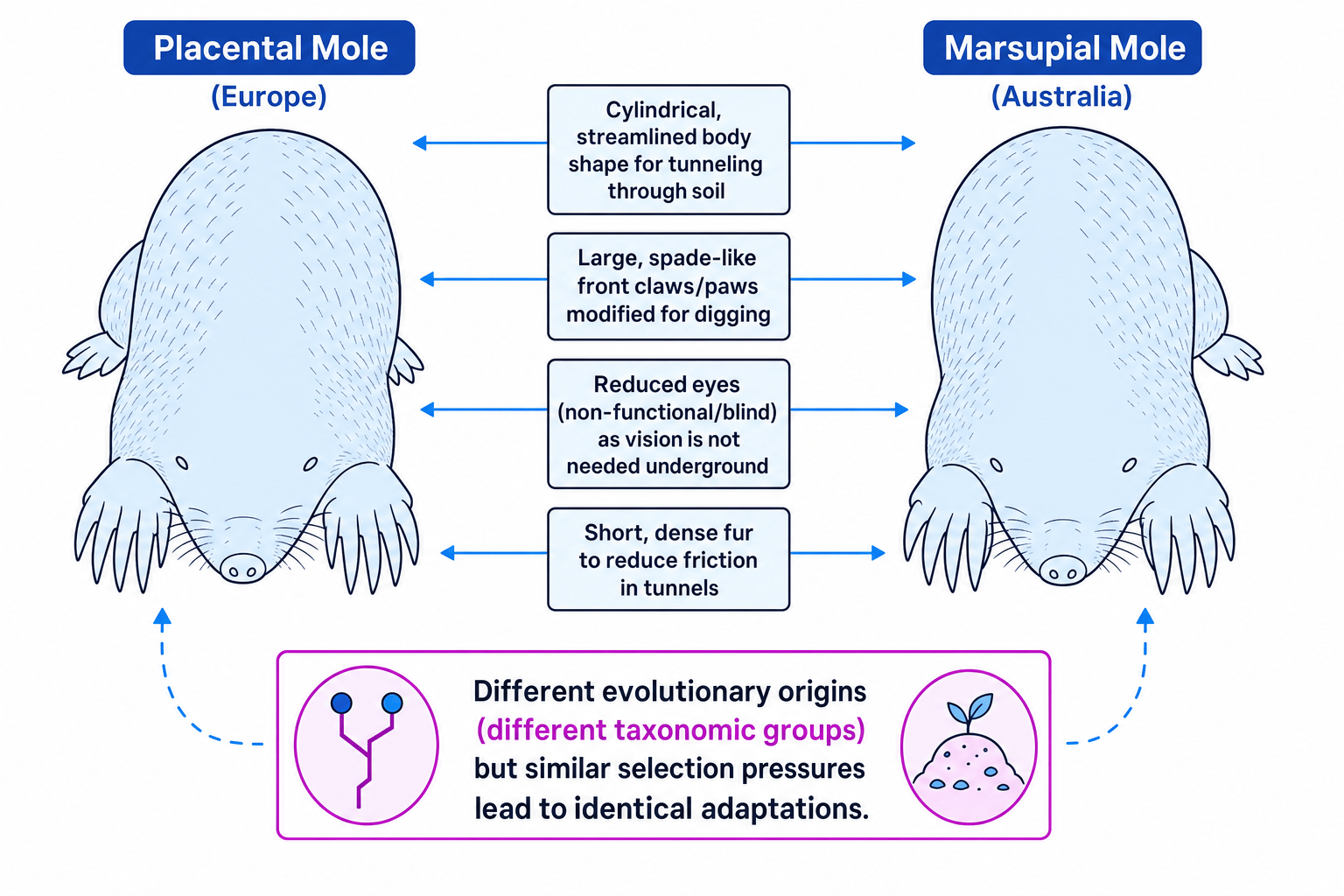
Despite diverging over 100 million years ago and having completely different reproductive strategies (placental vs. marsupial), both moles have evolved:
- Streamlined, cylindrical body shapes to ease movement through soil.
- Powerful, spade-like front claws modified for rapid digging.
- Velvety, short fur that reduces friction against soil.
- Reduced eyes covered by skin, as vision is useless in dark underground tunnels.
The Mechanism of Natural Selection
Natural selection is the driving force behind evolution. The process occurs in a logical sequence of steps:
- Mutation: A random mutation occurs in DNA, creating a new, advantageous allele.
- Variation: This allele introduces phenotypic variation into the population.
- Selection Pressure: An environmental change or pressure occurs (e.g., a new predator, disease, extreme temperature, or antibiotic).
- Survival: Individuals possessing the advantageous allele/phenotype are better adapted to survive this selection pressure ("survival of the fittest").
- Reproduction: The surviving individuals reproduce and pass on the advantageous allele to their offspring.
- Inheritance & Allele Frequency: This cycle repeats over many generations, causing the frequency of the advantageous allele in the gene pool to increase.
Human Implications of Evolution
Human actions have introduced massive selection pressures onto other species, causing rapid, measurable evolutionary shifts that have serious impacts on society.
1. Antibiotic Resistance in Microorganisms
The overuse and misuse of antibiotics in medicine and farming acts as a massive selection pressure on bacterial populations.
- In a population of bacteria, a random mutation may occur that makes a bacterium resistant to a specific drug (e.g., methicillin-resistant Staphylococcus aureus, or MRSA).
- When the patient takes the antibiotic, the non-resistant bacteria are killed.
- The resistant bacterium survives, lacks competition for resources, and reproduces rapidly via binary fission.
- The resistance allele is passed on, and soon, the entire population of bacteria is drug-resistant.
- Implication: Infections become untreatable, leading to longer hospital stays and increased mortality rates.
2. Pesticide Resistance in Insects
In agriculture, chemical pesticides are sprayed onto crops to kill pest insects.
- A random mutation in an insect may alter the active site of an enzyme, preventing the pesticide from binding and killing the cell.
- When the pesticide is applied, the resistant insects survive, while the susceptible ones die.
- The survivors reproduce, passing on the resistance allele.
- Implication: Crop yields are severely reduced as pesticides become ineffective, leading to higher food prices and potential food shortages.
Pesticides and Antibiotics Do Not *Cause* Mutations
A common exam error is stating that the antibiotic or pesticide causes the mutation. This is false! The mutations occur randomly and are already present in a tiny fraction of the population before the chemical is introduced. The chemical simply acts as the selection pressure that filters them.
In the exam
- Be precise with names: When discussing natural selection, always mention the specific advantageous allele (not just "gene") and state that its frequency increases in the population over generations.
- Use molecular terminology: When comparing domains and kingdoms, refer explicitly to rRNA nucleotide sequences, RNA polymerase structure, and membrane lipid linkages.
- Distinguish types of variation: Remember that continuous variation is polygenic and influenced by the environment, whereas discontinuous variation is monogenic and unaffected by the environment.
Check yourself
- Why did Carl Woese place Archaea in a separate domain from Bacteria, even though both are microscopic single-celled organisms without nuclei?
- Outline how the selection pressures of pesticide use lead to a resistant insect population.
- Explain the difference between anatomical, physiological, and behavioural adaptations, giving one example of each.
