Skip to content
MathsGenie logo
Open app

Course home

  1. A Level
  2. Biology OCR A
  3. Question bank

Analysis

EasyMedium
12345678910111213141516171819202122
Question 22

Biologists studied the beak depths of two species of Galapagos finch living on the same island, Geospiza difficilis and Geospiza scandens. Beak depth is a heritable trait linked to feeding efficiency.

Some of the results are shown in the chart below.
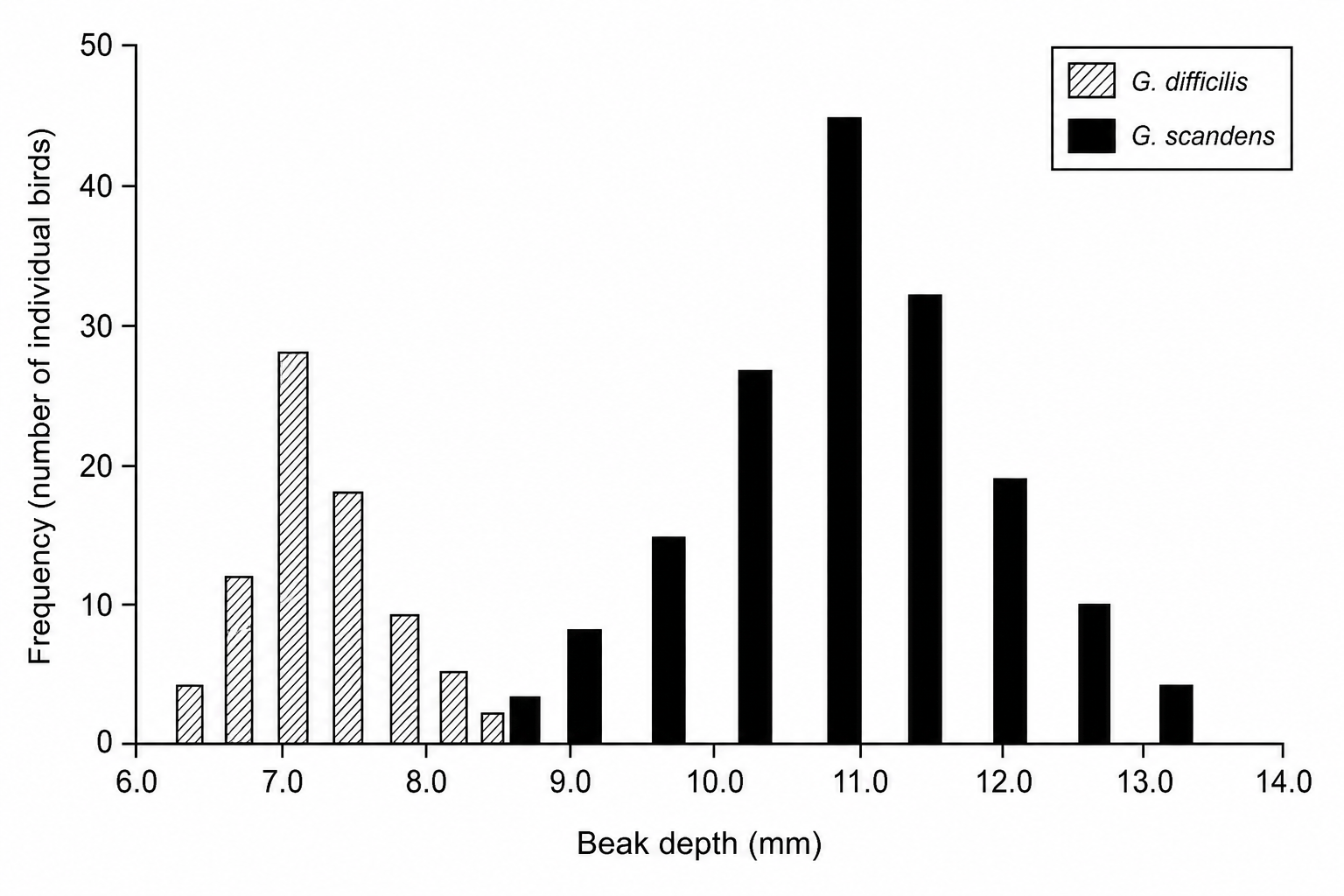
A bar chart showing the frequency of individual birds plotted against beak depth (mm) for two species of Galapagos finch: G. difficilis (patterned bars) and G. scandens (solid grey bars). The x-axis is labeled 'beak depth (mm)' ranging from 6.0 to 14.0 mm. The y-axis represents 'frequency (number of individual birds)' ranging from 0 to 50. For G. difficilis, bars are present at: 6.8 mm (height 4), 7.1 mm (height 12), 7.4 mm (height 28), 7.7 mm (height 18), 8.0 mm (height 9), 8.3 mm (height 5), and 8.6 mm (height 2). For G. scandens, bars are present at: 8.2 mm (height 3), 8.8 mm (height 8), 9.4 mm (height 15), 10.0 mm (height 27), 10.6 mm (height 45), 11.2 mm (height 32), 11.8 mm (height 19), 12.4 mm (height 10), and 13.0 mm (height 4).

a.

Identify the modal beak depth of G. difficilis.

[1]
b.

Calculate the range of G. difficilis beak depth as a proportion of the range of G. scandens beak depth.

Give your answer to 2 significant figures.

[3]

Analysis Questions

  1. A Level
  2. /Biology
  3. /Analysis
