What you'll learn
- How to recognise xylem, phloem and sclerenchyma fibres in plant stems.
- How each tissue’s structure is adapted to its function.
- How plant fibres and starch-based products can support sustainability — and where the trade-offs are.
- How conservation protects plant biodiversity and natural resources.
Why plants need transport tissues
Small organisms can often rely on diffusion alone, because substances only need to move short distances. Larger plants cannot: roots, stems and leaves may be far apart, and different organs need different substances.
Plants therefore have specialised vascular tissues, which are tissues involved in transport.
Tissue
A tissue is a group of similar cells working together to carry out a particular function.
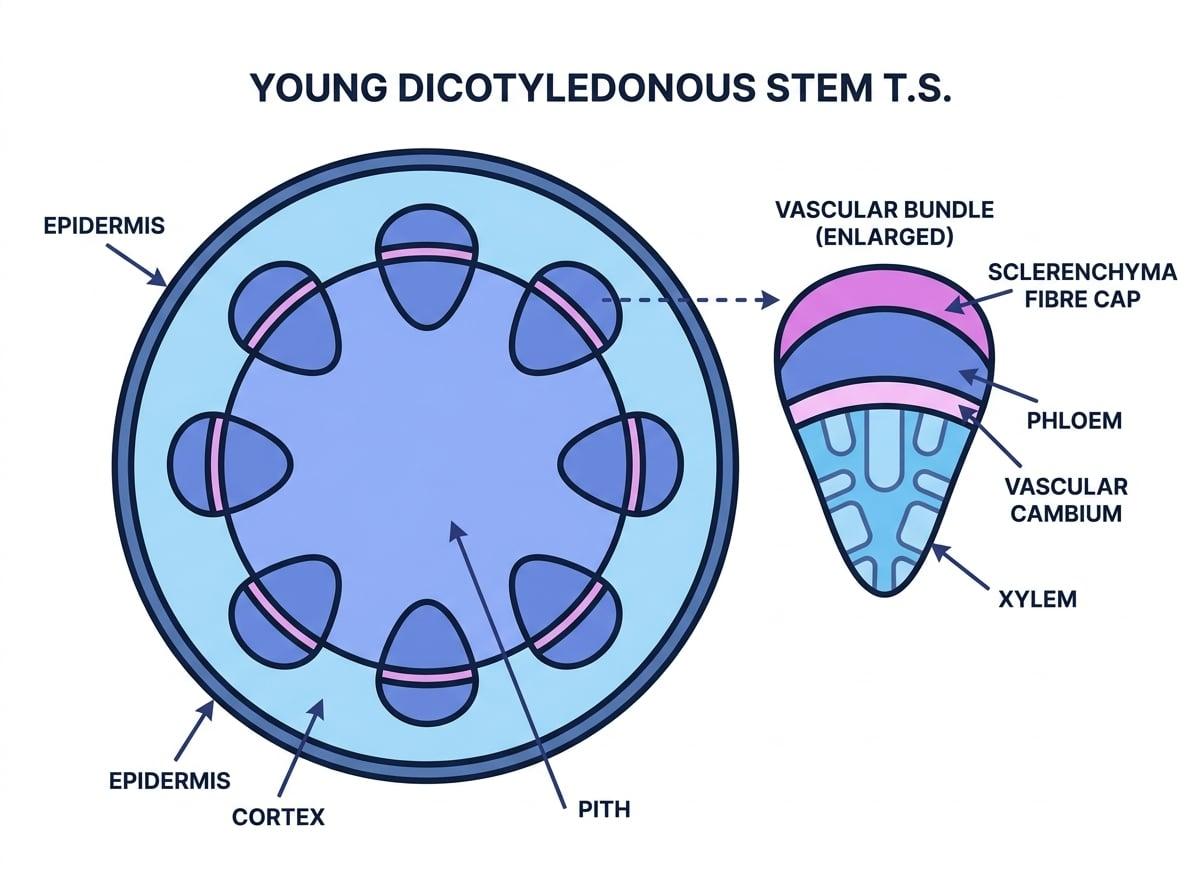
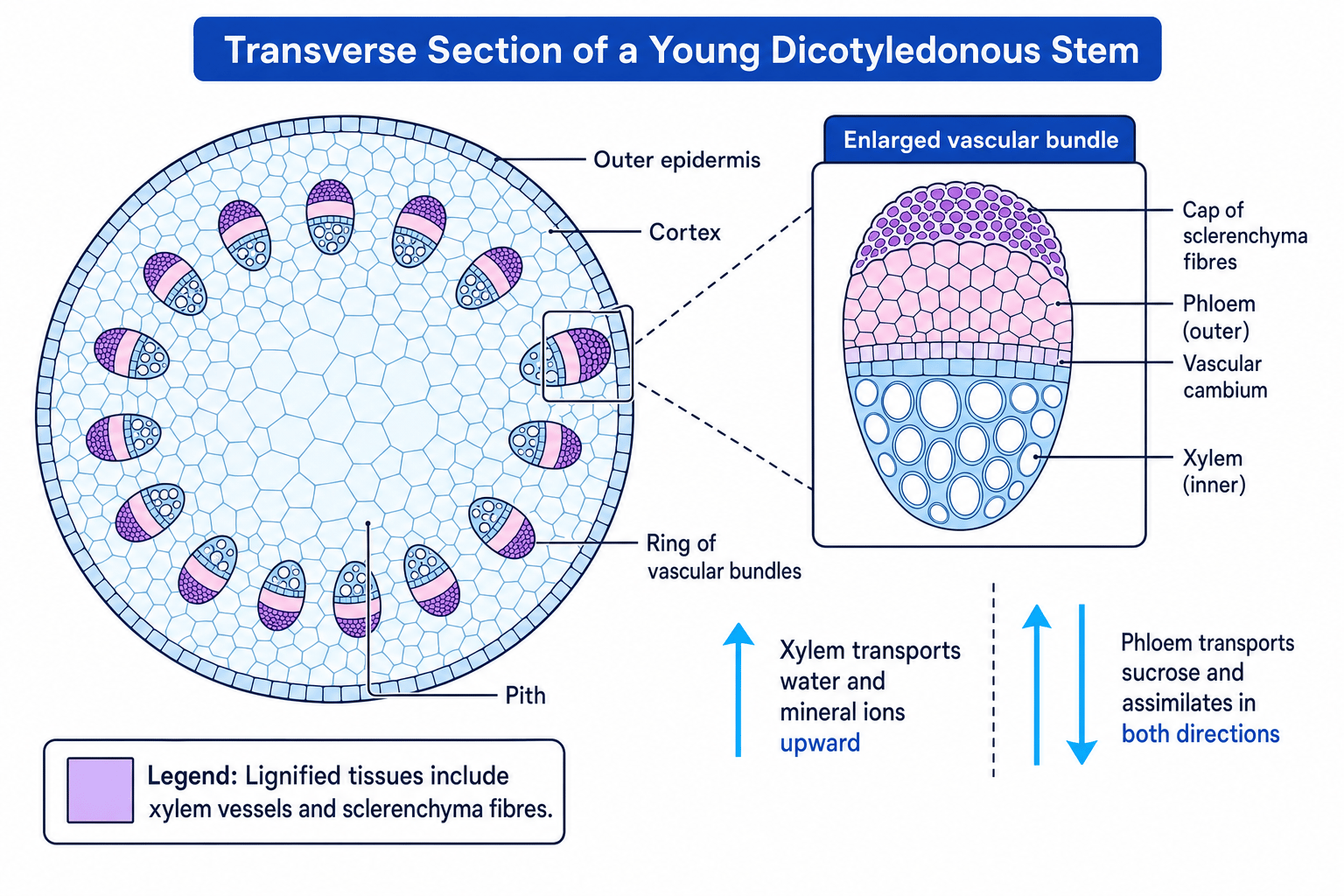
In stems, vascular tissues are arranged in vascular bundles. In many young dicotyledonous stems, each bundle has phloem nearer the outside and xylem nearer the inside, with vascular cambium between them. Sclerenchyma fibres often form a supportive cap near the phloem.
Big picture
Xylem transports water and mineral ions, phloem transports organic solutes such as sucrose, and sclerenchyma fibres provide mechanical support.
Xylem: water transport and support
Xylem
Xylem is plant vascular tissue that transports water and dissolved mineral ions from roots to the rest of the plant.
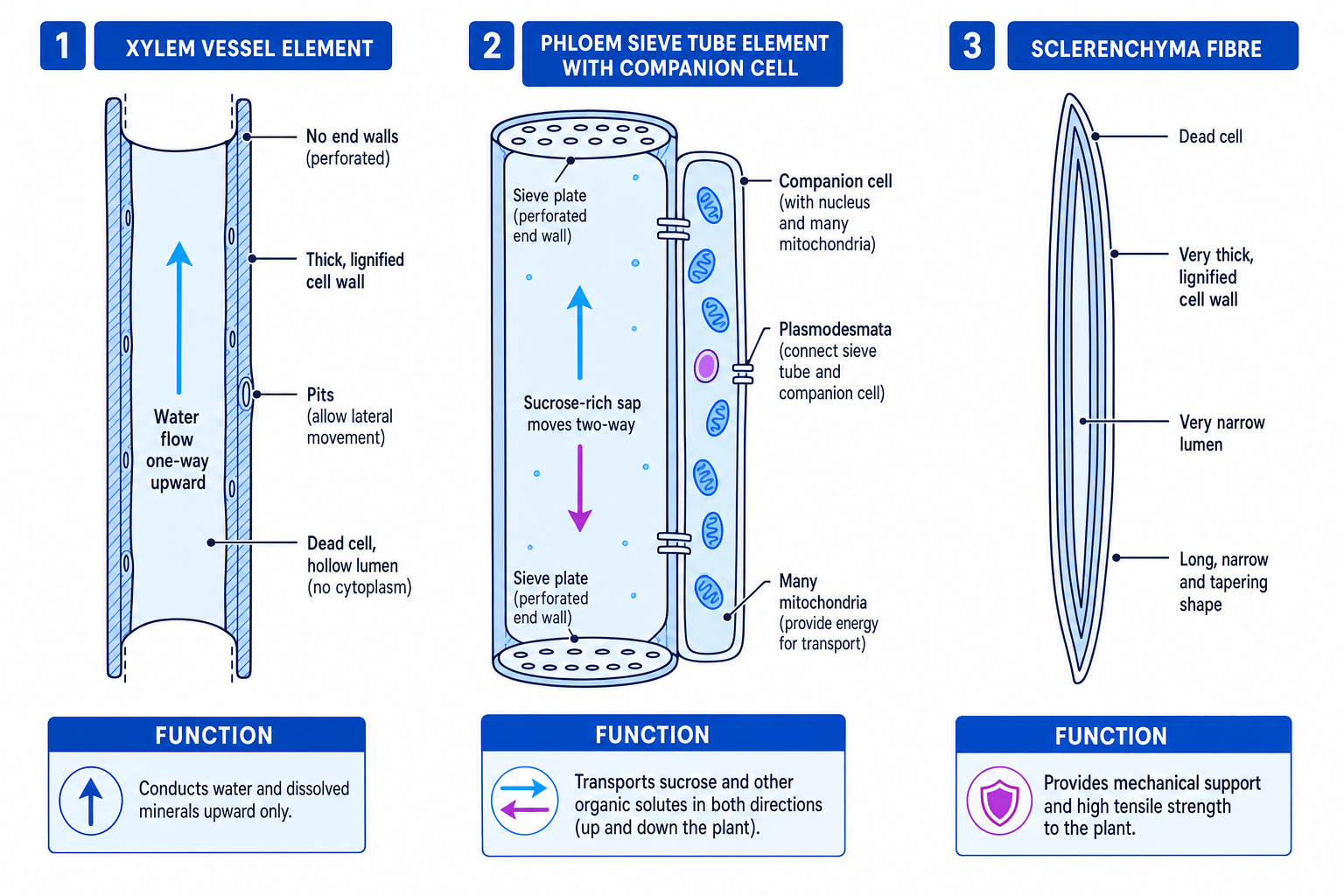
Xylem vessels are made from dead cells joined end to end. Their end walls break down, forming continuous hollow tubes. This reduces resistance to water flow.
Their walls contain lignin, a waterproof strengthening polymer. Lignin is deposited in rings, spirals or thickened patterns, helping the vessels resist collapse when water is pulled upwards during transpiration.
Lignin
Lignin is a strong, waterproof substance deposited in some plant cell walls, especially in xylem vessels and sclerenchyma fibres.
Xylem vessels also have pits, which are thin regions of the wall where lignin is absent. Pits allow water to move sideways between vessels and into surrounding tissues.
Phloem: transport of assimilates
Phloem
Phloem is plant vascular tissue that transports dissolved organic substances, especially sucrose and amino acids, around the plant.
This transport is called translocation. The substances being moved are often called assimilates, meaning products made by the plant, usually from photosynthesis or metabolism.
Phloem contains sieve tube elements and companion cells. Sieve tube elements are living cells, but they have very little cytoplasm and no nucleus, leaving more space for phloem sap. Their end walls form sieve plates, which contain pores.
Companion cells contain many mitochondria, so they can release ATP for active processes involved in loading sucrose into the phloem.
One-way versus two-way transport
Do not say “phloem flows both ways in one tube at the same time”. Phloem can transport in different directions in different sieve tubes, depending on where the source and sink are.
Sclerenchyma fibres: strength without transport
Sclerenchyma fibres
Sclerenchyma fibres are long, dead plant cells with thick lignified walls that provide mechanical support.
They are not mainly transport tissues, but they are often found close to vascular bundles. Their narrow lumen and thick walls make them strong under tension, so they help stems resist bending and pulling forces.
Identifying tissues in a stem micrograph
A student observes a stained transverse section of a stem. One region contains large hollow cells with thick stained walls towards the inside of each vascular bundle. Another region contains smaller cells towards the outside of the bundle.
-
The large hollow cells with thick walls are most likely xylem vessels, because xylem is lignified, hollow and usually found on the inner side of a dicot stem vascular bundle.
-
The smaller outer cells are most likely phloem, because phloem lies outside the cambium and is made of living sieve tube elements and companion cells rather than large empty vessels.
-
If there is a cap of very thick-walled cells outside the phloem, that region is likely sclerenchyma fibres, because their role is support rather than transport.
Practical skill: observing plant transport tissues
A common practical skill in this topic is preparing and observing plant stem sections using a light microscope.
A thin transverse section is cut from a stem, mounted on a slide and stained. Stains help distinguish tissues: lignified tissues such as xylem and sclerenchyma often stain more strongly than surrounding cells. You then observe at low power to locate the vascular bundles, before using higher power to examine individual tissues.
Good biological drawings
Use clear single lines, avoid shading, label with ruled lines, and include a title plus magnification if you know it.
You may also need to use the magnification relationship:
magnification=image sizeactual size\text{magnification} = \frac{\text{image size}}{\text{actual size}}magnification=actual sizeimage sizeCalculating magnification
A xylem vessel has an actual diameter of 80 µm. On a printed micrograph, its diameter is 24 mm. Calculate the magnification.
-
Convert the image size into the same unit as the actual size: 24 mm = 24 000 µm.
-
Substitute into the magnification equation:
- Cancel the units and calculate:
So the micrograph is magnified by ×300.
Plant fibres as natural resources
Plant fibres are useful because many contain cellulose and lignin. Cellulose is a polysaccharide made from β-glucose molecules. Long cellulose chains form microfibrils, which give plant cell walls high tensile strength.
Tensile strength
Tensile strength is the ability of a material to resist breaking when it is stretched or pulled.
Fibres from plants such as flax, hemp and cotton can be used in textiles, ropes, paper and composite materials. Sclerenchyma fibres are especially valuable because their long, lignified cells are strong and flexible.
You can compare fibres experimentally by clamping equal lengths of fibre and adding masses until they break. To make the comparison valid, control variables such as fibre length, diameter, hydration, plant source and method of attachment.
Comparing tensile strength
A circular plant fibre has diameter 0.40 mm and breaks when a mass of 3.2 kg is attached. Estimate its tensile strength using g=9.81 N kg−1g = 9.81\ \text{N kg}^{-1}g=9.81 N kg−1.
- Convert diameter to metres and calculate radius:
- Calculate cross-sectional area using A=πr2A = \pi r^2A=πr2:
- Calculate breaking force using F=mgF = mgF=mg:
- Calculate tensile strength:
Sustainability and plant-based products
Sustainability
Sustainability means using resources in a way that meets present needs without reducing the ability of future generations to meet their needs.
Plant-based materials can improve sustainability because plants are renewable: they can be regrown, and photosynthesis removes carbon dioxide from the atmosphere. Plant starch and cellulose can be used to make biodegradable packaging, films and other bioplastics.
However, “plant-based” does not automatically mean sustainable. Growing crops may require land, water, fertilisers, pesticides and energy. Large monocultures can reduce biodiversity, and using farmland for materials may compete with food production.
Sustainability is a balance
To judge whether a plant-based product is sustainable, consider its whole life cycle: growing, harvesting, processing, transport, use and disposal.
Assuming biodegradable means harmless
A biodegradable plastic may only break down quickly under specific conditions, such as industrial composting. If it enters the sea or landfill, degradation may be much slower.
Conservation of plant biodiversity
Conservation
Conservation is the active protection and management of species, habitats and genetic diversity.
Plant biodiversity matters because plants provide food, fibres, medicines, fuels, building materials and ecosystem services such as carbon storage and soil protection. Wild relatives of crop plants may contain useful alleles for disease resistance, drought tolerance or improved yield.
There are two broad approaches:
- In situ conservation protects species in their natural habitats, for example in nature reserves or protected forests.
- Ex situ conservation protects species outside their natural habitats, for example in seed banks, botanic gardens or tissue culture collections.
Seed banks are especially useful for many plant species. Seeds can be dried and stored at low temperatures, slowing metabolism and preserving genetic material for future restoration or research.
Not all seeds store well
Some species produce seeds that cannot survive drying or freezing. These may need alternatives such as living collections, tissue culture or cryopreservation.
Conservation and sustainable use often work best together. For example, a forest may be managed so that only selected trees are harvested, seedlings are allowed to regenerate, and habitats for other species are protected.
In the exam
-
Link structure to function: hollow lignified xylem for water transport, sieve tubes with companion cells for translocation, and thick lignified sclerenchyma for support.
-
When evaluating sustainability, avoid one-sided answers. Include both benefits and limitations, such as renewability versus land use or fertiliser demand.
-
For practical questions, mention validity: control fibre length and diameter, use repeats, calculate means, and use appropriate units.
Check yourself
- How would you distinguish xylem, phloem and sclerenchyma in a stained stem section?
- Why do companion cells contain many mitochondria?
- What factors would you consider before calling a plant-based plastic “sustainable”?