What you'll learn
- How plant cells are built, including walls, vacuoles, chloroplasts, amyloplasts and plasmodesmata.
- Why starch is a good storage molecule in plants.
- Why cellulose is strong enough to support plant cell walls.
- How to connect plant cell structure to microscopy, staining and exam questions.
Plant cells are eukaryotic cells
A cell is the basic unit of life. Plant cells are eukaryotic, meaning they have internal compartments called organelles surrounded by membranes.
Eukaryotic cell
A eukaryotic cell has a membrane-bound nucleus and membrane-bound organelles, such as mitochondria and chloroplasts. Plants, animals, fungi and protoctists all have eukaryotic cells.
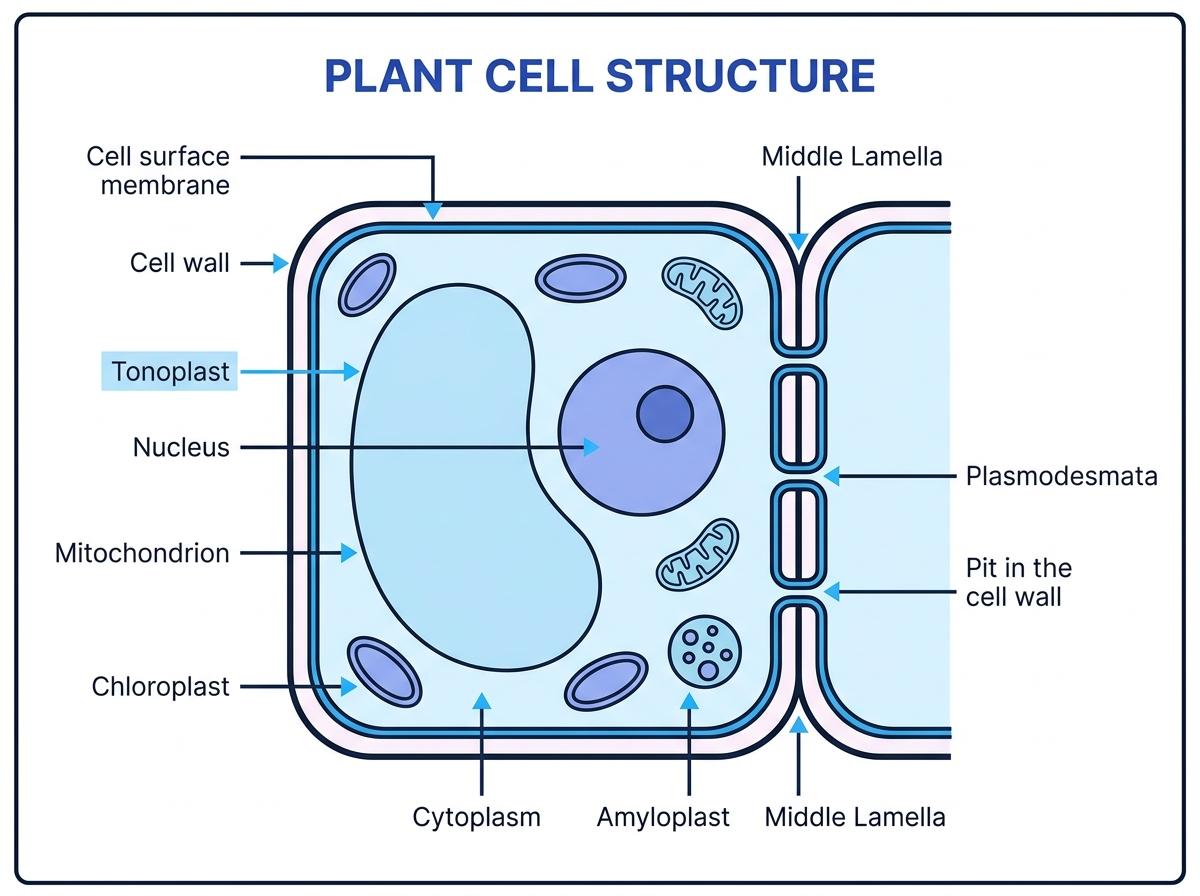
Plant cells share some structures with animal cells: a cell surface membrane, cytoplasm, nucleus, mitochondria and ribosomes. Their distinctive features include a cellulose cell wall, large permanent vacuole, chloroplasts, amyloplasts and connections between cells called plasmodesmata.
The diagram pulls together the main plant cell structures you should recognise in diagrams and photomicrographs.
Key plant cell structures
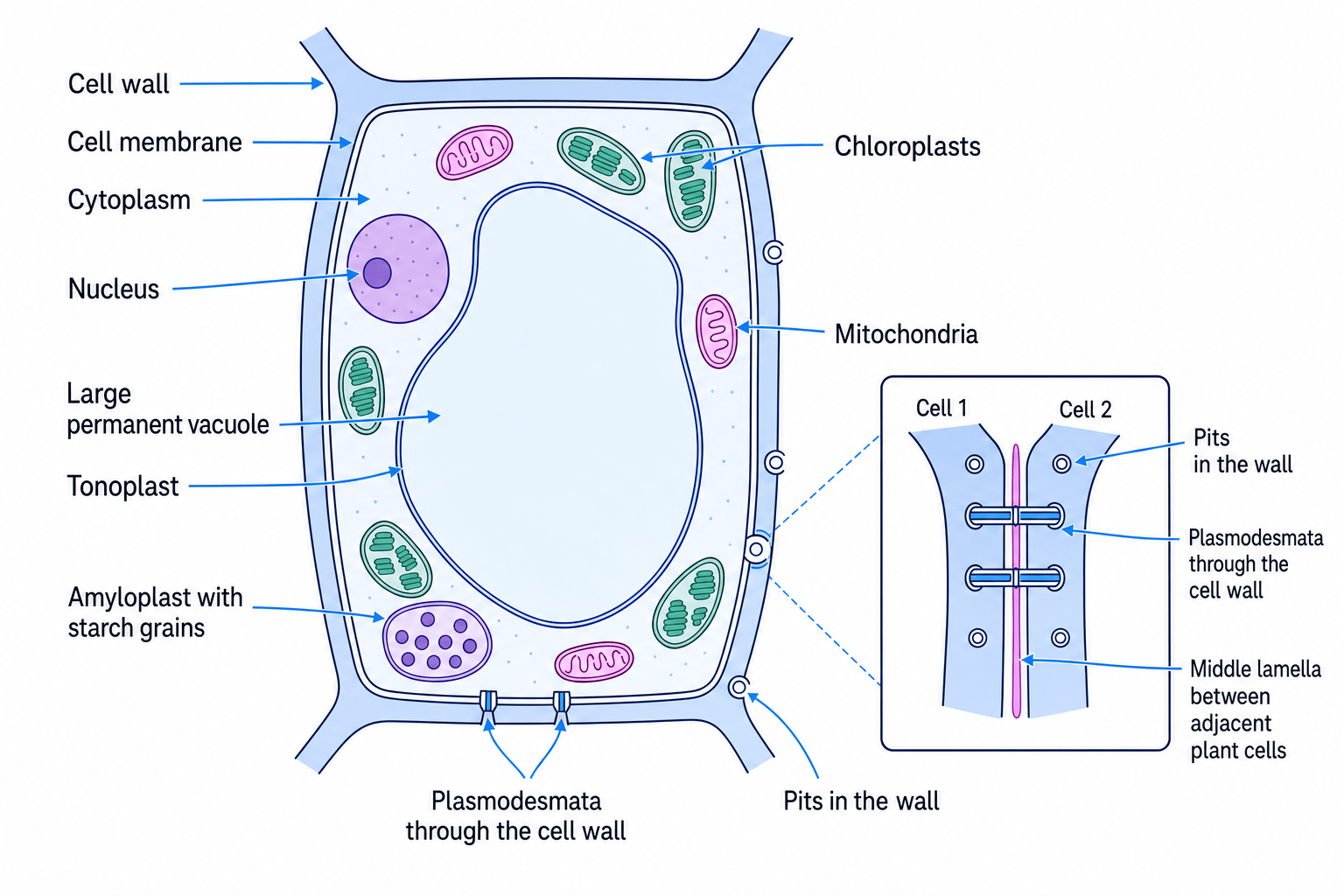
Cell wall, middle lamella and pits
The cell wall is a strong outer layer found outside the cell surface membrane. In plants, it is mainly made of cellulose, a structural polysaccharide. It gives support and prevents the cell from bursting when water enters by osmosis.
The middle lamella is a pectin-rich layer between neighbouring plant cells. It acts like a cement, holding adjacent cell walls together.
Pits are thinner regions of the cell wall, often where plasmodesmata pass between cells. They make cell-to-cell communication easier.
Cell wall versus cell membrane
The cell wall provides support and is freely permeable to many substances. The cell surface membrane controls what enters and leaves the cell; it is partially permeable.
Vacuole and tonoplast
Most mature plant cells contain a large permanent vacuole filled with cell sap, a solution of water, ions, sugars, amino acids and other dissolved substances.
The membrane around the vacuole is the tonoplast. It helps control movement of substances between the cytoplasm and the vacuole.
Turgor pressure
Turgor pressure is the pressure exerted by the cell contents against the cell wall when water enters the cell by osmosis. It helps support non-woody plant tissue.
Chloroplasts and amyloplasts
Chloroplasts are organelles where photosynthesis takes place. They contain the green pigment chlorophyll, which absorbs light energy.
Amyloplasts are colourless storage organelles found especially in storage tissues such as potato tubers and seeds. They store starch grains.
Both chloroplasts and amyloplasts are types of plastid, a group of plant organelles involved in making or storing useful molecules.
Plant-cell design
Many distinctive plant cell features support one of three jobs: photosynthesis, storage, or mechanical support.
Microscopy link: measuring plant cells
In practical work, you may view plant tissue using a light microscope. A thin section or epidermal peel is placed on a slide, stained if needed, covered with a coverslip, and observed from low power to higher power.
If you measure cells from a micrograph, use the magnification equation:
M=image sizeactual sizeM=\frac{\text{image size}}{\text{actual size}}M=actual sizeimage sizeHere, magnification means how many times larger the image is than the real object. Magnification has no units.
Calculating actual plant-cell size
A plant cell appears 54 mm long on a printed photomicrograph. The image magnification is 450 times. Find the actual length of the cell in micrometres.
- Convert the image length into micrometres so it matches the cell-scale answer: 54 mm is 54 000 µm.
- Rearrange the magnification equation: M=image sizeactual sizeM=\frac{\text{image size}}{\text{actual size}}M=actual sizeimage size, so actual size=image sizeM\text{actual size}=\frac{\text{image size}}{M}actual size=Mimage size.
- Substitute with units: actual size=54 000 μm450=120 μm\text{actual size}=\frac{54\,000\ \mu\text{m}}{450}=120\ \mu\text{m}actual size=45054000 μm=120 μm.
The actual cell length is 120 µm.
Microscopy sanity check
Plant cells are usually measured in micrometres. If your answer is several millimetres for one cell, you probably forgot to divide by magnification or convert units.
Glucose monomers and polysaccharides
A monomer is a small molecule that can join to many similar molecules. A polymer is a large molecule made from repeating monomers.
Glucose is a monosaccharide, which means a single sugar unit. Plants use glucose to build larger carbohydrates, especially starch and cellulose.
Polysaccharide
A polysaccharide is a carbohydrate polymer made from many monosaccharide units joined together by glycosidic bonds.
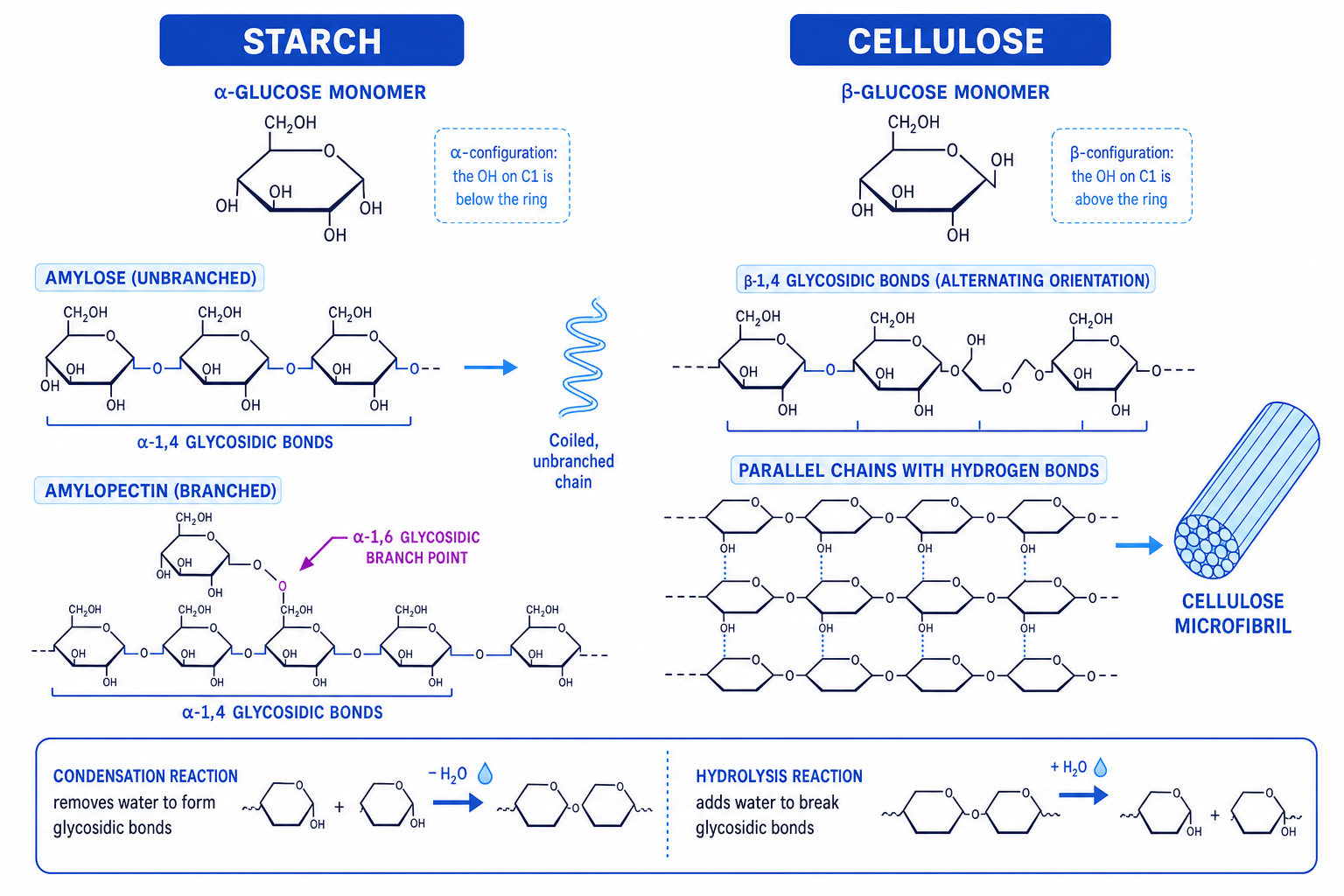
A glycosidic bond is the covalent bond between two monosaccharides. It forms in a condensation reaction, where water is removed. It breaks in a hydrolysis reaction, where water is added.
Glucose exists in different forms called isomers. Alpha-glucose and beta-glucose have the same molecular formula, but the hydroxyl group on carbon 1 is arranged differently. This small difference has a huge effect on polymer shape and function.
The diagram compares how alpha-glucose forms starch and beta-glucose forms cellulose.
Starch: the plant storage polysaccharide
Plants make glucose during photosynthesis. They often convert glucose into starch for storage.
Starch is a mixture of two polysaccharides:
- Amylose: an unbranched chain of alpha-glucose joined by alpha-1,4 glycosidic bonds. The chain coils into a compact helix.
- Amylopectin: a branched chain of alpha-glucose with alpha-1,4 bonds along the chain and alpha-1,6 bonds at branch points.
Starch is useful for storage because it is:
- Insoluble, so it does not easily diffuse out of cells and has little effect on osmosis.
- Compact, so lots of glucose can be stored in a small space.
- Easily hydrolysed, so glucose can be released for respiration when needed.
- Branched in amylopectin, giving many ends where enzymes can work at once.
Why plants store starch
Plants store glucose as starch because starch is compact, insoluble and can be broken down when glucose is needed for respiration or biosynthesis.
You can test plant material for starch using iodine solution. Iodine solution is orange-brown and turns blue-black if starch is present. For example, potato tissue often stains strongly because its amyloplasts contain many starch grains.
Cellulose: the plant structural polysaccharide
Cellulose is made from beta-glucose monomers joined by beta-1,4 glycosidic bonds. Each beta-glucose is rotated compared with the next one, producing long, straight chains.
Many cellulose chains run alongside each other. Hydrogen bonds form between chains. A hydrogen bond is a weak attraction between slightly charged parts of neighbouring molecules, but many hydrogen bonds together create great strength.
Groups of cellulose chains form microfibrils, and these microfibrils help build the cell wall. This gives plant cell walls high tensile strength, meaning they resist being stretched or pulled apart.
Cellulose is excellent for support because it is:
- Strong, due to many hydrogen bonds between parallel chains.
- Straight and unbranched, so chains can pack closely.
- Insoluble, so it remains in the wall.
- Difficult for many organisms to digest without the enzyme cellulase.
Humans produce amylase, an enzyme that digests starch, but we do not produce cellulase. That is why starch can be digested as an energy source, while cellulose acts as dietary fibre.
Starch and cellulose are not the same
Starch and cellulose are both polymers of glucose, but starch is made from alpha-glucose and cellulose is made from beta-glucose. This changes the bonds, the shape and the function.
Comparing starch and cellulose
| Feature | Starch | Cellulose |
|---|---|---|
| Monomer | Alpha-glucose | Beta-glucose |
| Main bonds | Alpha-1,4; alpha-1,6 in branches | Beta-1,4 |
| Shape | Coiled and branched | Straight, parallel chains |
| Main role | Energy storage in plants | Structural support in cell walls |
| Useful property | Compact and easily hydrolysed | Strong due to many hydrogen bonds |
Choosing the suitable glucose polymer
A plant tissue needs a molecule that stores glucose without causing major osmotic effects, and that can be broken down quickly when respiration increases. Decide whether amylopectin or cellulose is better suited.
- The molecule should not dissolve freely in cell sap, because many dissolved glucose molecules would affect water movement by osmosis. Both polymers are insoluble, so both initially seem possible.
- The molecule must be broken down quickly. Amylopectin is branched, so enzymes can hydrolyse glycosidic bonds at many chain ends at the same time.
- Cellulose is designed for strength: straight beta-glucose chains are held by many hydrogen bonds in microfibrils. It is not the best short-term glucose store.
Amylopectin is better suited because its branched structure allows rapid release of glucose.
Practical skills to keep in mind
When preparing or analysing plant cell slides:
- Make the tissue thin so light can pass through and cells do not overlap too much.
- Lower the coverslip at an angle to reduce air bubbles.
- Use a stain only when it improves contrast or identifies a substance, such as iodine solution for starch.
- If measuring with an eyepiece graticule, calibrate it using a stage micrometer at the same objective lens.
- Draw what you see with clear continuous lines, labels and a stated magnification or scale bar.
In the exam
- Link structure to function: name the feature, describe the relevant detail, then explain the effect.
- For starch, think “alpha-glucose, compact storage”; for cellulose, think “beta-glucose, straight chains, hydrogen bonds, strength”.
- In magnification questions, convert units before substituting, then use actual size equals image size divided by magnification.
Check yourself
- Why does storing glucose as starch avoid major osmotic problems for plant cells?
- How does beta-glucose lead to strong cellulose microfibrils?
- Where would you expect to find many amyloplasts in a plant, and why?