What you'll learn
- What an inorganic ion is and why ions are dissolved in cells and body fluids.
- How hydrogen ions affect pH and protein shape.
- Why iron, sodium and phosphate ions matter in haemoglobin, co-transport, DNA and ATP.
- How to link an ion’s properties to its biological role in exam answers.
The basic idea: ions in solution
An ion is a charged particle. It may be a single atom, such as a sodium ion, or a group of atoms, such as a phosphate ion.
An inorganic ion is an ion that is not part of a large carbon-based biological molecule like a carbohydrate, lipid or protein. In biology, these ions are usually found in solution, meaning they are dissolved in water.
Inorganic ion
An inorganic ion is a charged particle, not based on a carbon skeleton, that is dissolved in the cytoplasm or body fluids and has a specific biological role.
The cytoplasm is the material inside a cell, excluding the nucleus. Body fluids are liquids in an organism, such as blood plasma and tissue fluid.
Some ions are present in relatively high concentrations, such as sodium ions in many body fluids. Others are present in very low concentrations, such as hydrogen ions, but still have major effects.
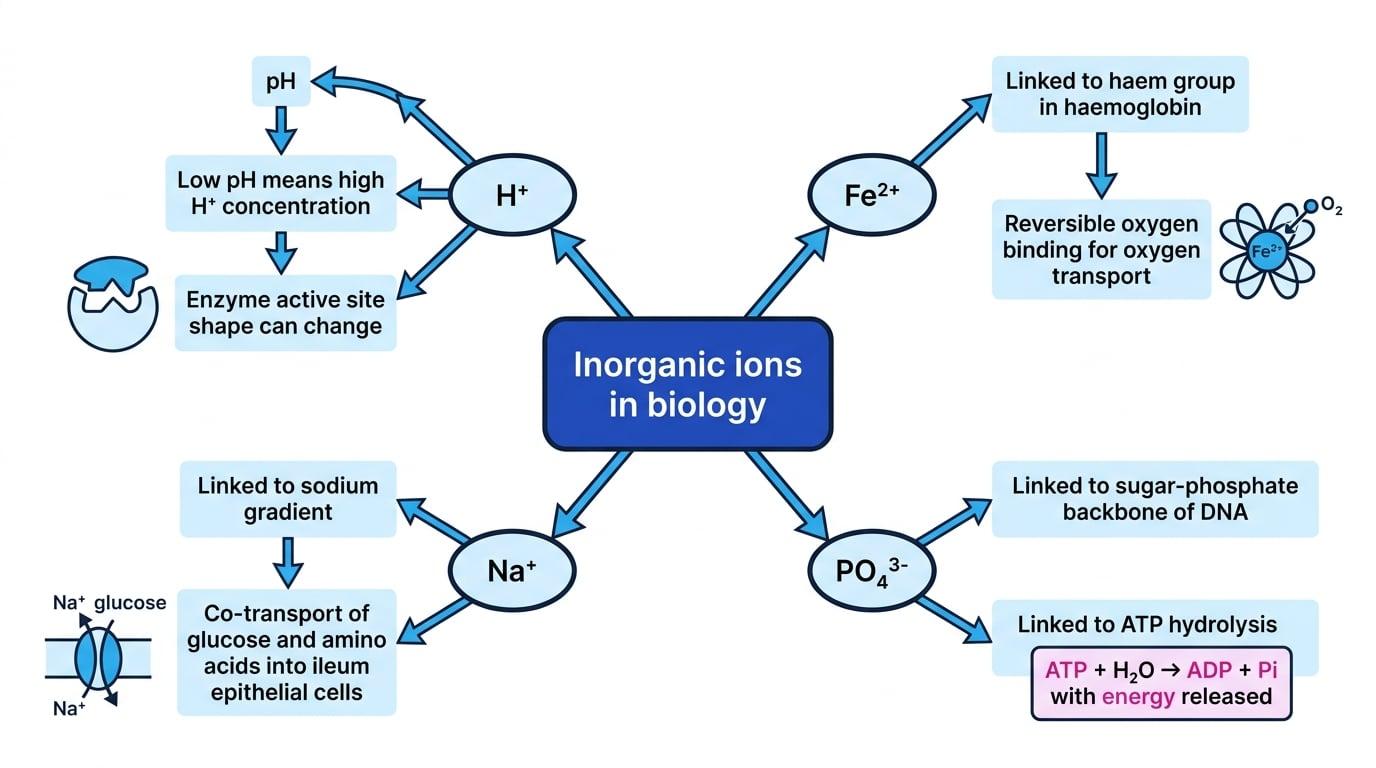
This overview shows the four ions you need to recognise for this specification point.
Properties determine roles
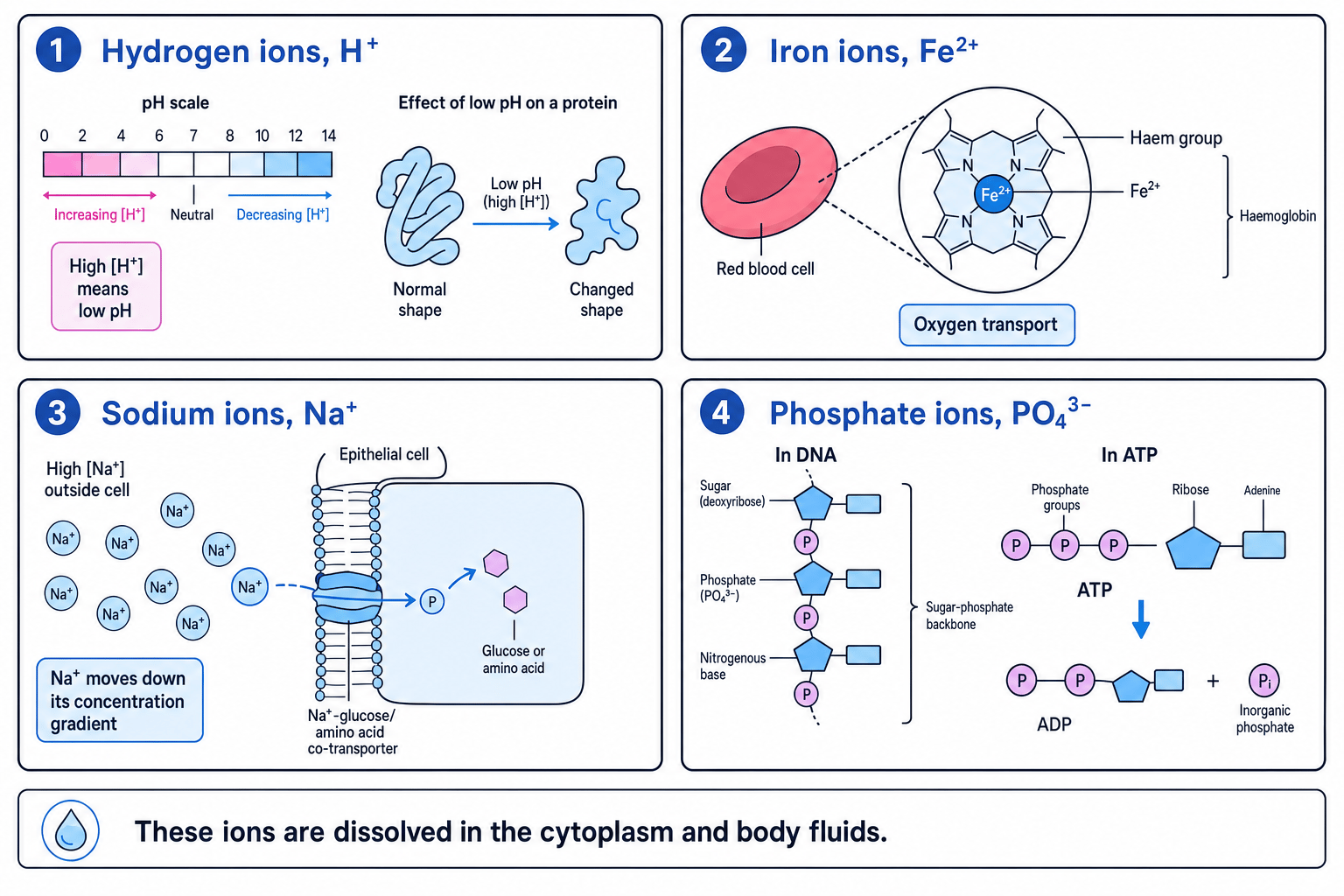
Each ion’s biological role depends on its properties: its charge, size, concentration, solubility in water, and ability to bind to or form part of larger molecules.
Hydrogen ions and pH
Hydrogen ions are written as H+\text{H}^+H+. Their concentration determines pH, which is a measure of how acidic or alkaline a solution is.
The relationship is:
pH=−log10[H+]\text{pH} = -\log_{10}[\text{H}^+]pH=−log10[H+]where [H+][\text{H}^+][H+] means hydrogen ion concentration, usually measured in mol dm⁻³.
A lower pH means a higher hydrogen ion concentration. This is easy to mix up, because the pH number goes down as acidity goes up.
Hydrogen ions are important because they can affect the charges on amino acid side chains in proteins. This can disrupt hydrogen bonds and ionic bonds that help maintain a protein’s tertiary structure. In enzymes, this may change the shape of the active site and reduce enzyme activity.
Comparing hydrogen ion concentrations
A solution at pH 5 is compared with a solution at pH 7.
-
Convert the pH values into hydrogen ion concentrations: pH 5 corresponds to 1.0×10⁻⁵ mol dm−31.0 \times 10^{-5}\ \text{mol dm}^{-3}1.0×10⁻⁵ mol dm−3, while pH 7 corresponds to 1.0×10⁻⁷ mol dm−31.0 \times 10^{-7}\ \text{mol dm}^{-3}1.0×10⁻⁷ mol dm−3.
-
Compare the concentrations using a ratio: (1.0×10⁻⁵)÷(1.0×10⁻⁷)=1.0×102=100(1.0 \times 10^{-5}) \div (1.0 \times 10^{-7}) = 1.0 \times 10^2 = 100(1.0×10⁻⁵)÷(1.0×10⁻⁷)=1.0×102=100.
-
The pH 5 solution has 100 times the hydrogen ion concentration of the pH 7 solution, so it is much more acidic and more likely to disrupt protein structure.
pH direction
Do not write “high pH means high hydrogen ion concentration”. It is the opposite: high hydrogen ion concentration means low pH.
Iron ions in haemoglobin
Iron ions are written as Fe2+\text{Fe}^{2+}Fe2+ when referring to their role in haemoglobin.
Haemoglobin is a protein found in red blood cells. It transports oxygen around the body. Each haemoglobin molecule contains haem groups, and each haem group contains an iron ion.
The iron ion is crucial because oxygen can bind reversibly to it. This means haemoglobin can load oxygen in the lungs, where oxygen concentration is high, and unload oxygen in respiring tissues, where oxygen concentration is lower.
If there are not enough iron ions available, fewer functional haemoglobin molecules can be produced. This can reduce oxygen transport and limit aerobic respiration in tissues.
Linking iron deficiency to aerobic respiration
-
Iron is needed to form haem groups in haemoglobin, so iron deficiency can reduce the amount of functional haemoglobin in red blood cells.
-
With less functional haemoglobin, less oxygen can be transported from the lungs to respiring tissues.
-
Oxygen is needed as the final electron acceptor in aerobic respiration, so reduced oxygen delivery can lower ATP production and cause tiredness or weakness.
Iron wording
In exams, be specific: iron ions are part of the haem group in haemoglobin. Avoid vague phrasing like “iron is in the blood” unless you link it to haemoglobin and oxygen transport.
Sodium ions and co-transport
Sodium ions are written as Na+\text{Na}^+Na+. They are especially important in the absorption of glucose and amino acids in the small intestine.
A concentration gradient is a difference in concentration between two regions. Particles tend to move down their concentration gradient, from higher concentration to lower concentration.
Co-transport is the movement of two substances across a membrane using the same transport protein. In this topic, sodium ions moving down their concentration gradient help move glucose or amino acids into epithelial cells.
Here is the sequence in the ileum, a part of the small intestine:
- The sodium-potassium pump actively transports sodium ions out of the epithelial cell.
- This creates a low sodium ion concentration inside the epithelial cell.
- Sodium ions then diffuse from the gut lumen into the epithelial cell through a co-transporter protein.
- As sodium ions move in, glucose or amino acids are carried into the cell with them.
- Glucose or amino acids can then move from the epithelial cell into the blood.
This is often called secondary active transport because ATP is used indirectly: ATP powers the sodium-potassium pump, which creates the sodium ion gradient.
Predicting the effect of inhibiting the sodium-potassium pump
-
If the sodium-potassium pump is inhibited, sodium ions are not actively transported out of the epithelial cell as effectively.
-
Sodium ion concentration inside the epithelial cell rises, so the sodium ion concentration gradient from the gut lumen into the cell becomes smaller.
-
Less sodium moves through the co-transporter, so less glucose or amino acid is absorbed into the epithelial cell.
Co-transport is not simple diffusion
Glucose and amino acids are not just “diffusing in with sodium”. The sodium ion gradient drives their movement through a specific co-transporter protein.
Phosphate ions in DNA and ATP
Phosphate ions are written as PO43−\text{PO}_4^{3-}PO43−. In biological molecules, phosphate is often found as a phosphate group attached to another molecule.
Phosphate in DNA
DNA is made from nucleotides. Each DNA nucleotide contains:
- a deoxyribose sugar
- a phosphate group
- a nitrogen-containing base
The phosphate groups form part of the sugar-phosphate backbone of DNA. This backbone gives DNA a strong, stable structure, with the bases projecting inwards where complementary base pairing occurs.
Phosphate in ATP
ATP stands for adenosine triphosphate. It contains adenine, ribose and three phosphate groups.
When ATP is hydrolysed, it forms ADP and inorganic phosphate:
ATP+H2O→ADP+Pi\text{ATP} + \text{H}_2\text{O} \to \text{ADP} + \text{P}_iATP+H2O→ADP+PiHere, Pi\text{P}_iPi means inorganic phosphate. ATP hydrolysis releases energy that can be used for processes such as active transport, muscle contraction and building larger molecules.
Explaining why phosphate shortage slows cell division
-
Before a cell divides, it must replicate its DNA, and each new nucleotide needs a phosphate group.
-
Cell division also requires ATP for energy-demanding processes, and ATP contains phosphate groups.
-
If phosphate availability is low, DNA synthesis and ATP production may both be limited, so growth and cell division can slow down.
ATP energy wording
Avoid saying “energy is released by breaking a phosphate bond” on its own. A better A-Level answer is: ATP is hydrolysed to ADP and inorganic phosphate, and the overall reaction releases energy.
Bringing the four ions together
For this section, you do not need to memorise a long pathway for every ion. Instead, practise linking the ion to the correct biological role.
- H+\text{H}^+H+ affects pH, which can affect protein and enzyme structure.
- Fe2+\text{Fe}^{2+}Fe2+ is part of the haem group in haemoglobin, allowing oxygen transport.
- Na+\text{Na}^+Na+ is involved in co-transport of glucose and amino acids.
- PO43−\text{PO}_4^{3-}PO43− is part of DNA and ATP.
In the exam
-
Link the ion to its specific role, not just the general topic: for example, “iron ion in haem group of haemoglobin” is stronger than “iron is for blood”.
-
Use cause-and-effect wording: ion property → effect on molecule or gradient → biological consequence.
-
Watch direction words carefully: high hydrogen ion concentration means low pH, and sodium ions move down their gradient during co-transport.
Check yourself
- Why does an increase in hydrogen ion concentration usually reduce enzyme activity?
- How does the sodium ion gradient help absorb glucose in the ileum?
- Where are phosphate ions found in DNA and ATP?