

What you'll learn
- How responding to internal and external stimuli increases survival.
- How indoleacetic acid (IAA) controls phototropism and gravitropism in flowering plants.
- How taxes and kineses help mobile organisms stay in favourable conditions.
- How a three-neurone reflex protects the body, and how to investigate animal movement using a choice chamber or maze.
Why response matters
Organisms survive better when they can detect changes and respond appropriately. A change might be external, such as light, humidity, temperature or gravity, or internal, such as a change in blood water potential.
This section is A-level-only, so the focus is on linking the stimulus to the survival value of the response.
Stimulus and response
A stimulus is a detectable change in the internal or external environment. A response is a change in behaviour, physiology or growth caused by that stimulus.
Responses improve survival
A response is useful if it helps the organism move towards favourable conditions, move away from harmful conditions, grow in a better direction, or avoid damage.
Plant responses: growth rather than movement
Flowering plants cannot usually move from place to place, but they can change the direction of their growth. These growth responses are slower than animal movements, but they are still highly adaptive.
A growth factor is a chemical that affects growth. In plants, growth factors are made in growing regions and move to other tissues, where they regulate cell elongation. A meristem is a region of plant tissue where cells divide and growth occurs, such as the tip of a shoot or root.
Tropism
A tropism is a directional growth response to a directional stimulus. Positive means growth towards the stimulus; negative means growth away from the stimulus.
Important examples are:
- Phototropism: growth response to light.
- Gravitropism: growth response to gravity.
IAA and differential cell elongation
The main growth factor you need here is indoleacetic acid, usually shortened to IAA. It is a type of auxin.
IAA
Indoleacetic acid (IAA) is a plant growth factor produced in growing regions, such as shoot tips, that moves to other tissues and affects cell elongation.
IAA does not have the same effect everywhere. Its effect depends on both its concentration and the organ involved:
- In shoots, higher IAA concentration generally stimulates cell elongation.
- In roots, higher IAA concentration can inhibit cell elongation because roots are more sensitive to IAA.
This difference explains why the same redistribution of IAA can make shoots and roots bend in opposite directions.
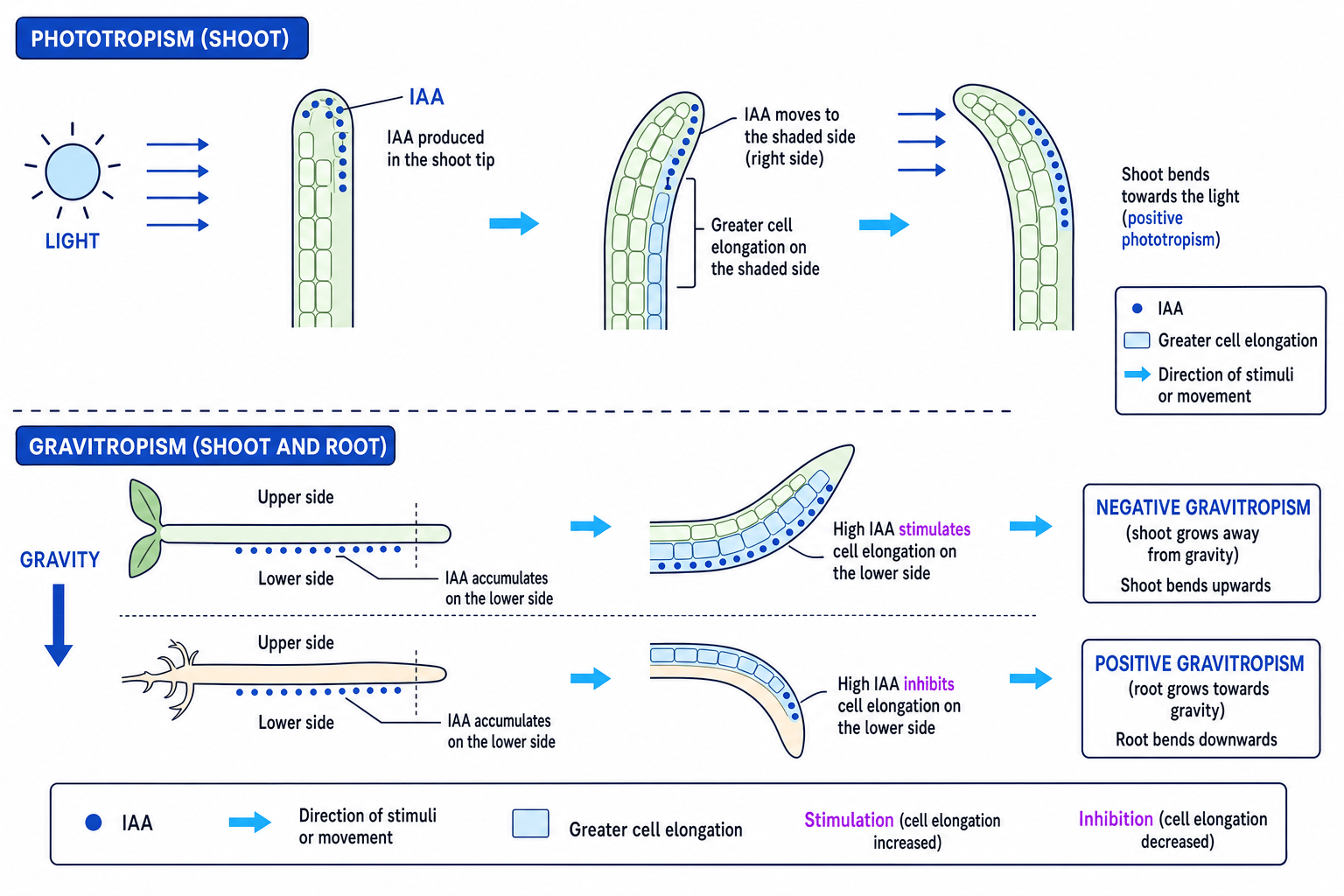
The diagram summarises how IAA distribution causes bending in phototropism and gravitropism.
Phototropism in shoots
When light comes from one side, IAA moves to the shaded side of the shoot. In shoots, IAA stimulates elongation, so cells on the shaded side elongate more than cells on the lit side. This makes the shoot bend towards the light.
This is positive phototropism, and it increases the chance of photosynthesis because the leaves and shoot are directed towards light.
Gravitropism in shoots and roots
When a seedling is placed horizontally, gravity causes IAA to accumulate on the lower side of both the shoot and root.
In a shoot, high IAA stimulates elongation on the lower side, so the shoot bends upwards. This is negative gravitropism because the shoot grows away from gravity.
In a root, high IAA inhibits elongation on the lower side. The upper side elongates more, so the root bends downwards. This is positive gravitropism because the root grows towards gravity.
IAA does not always stimulate growth
Do not write “IAA causes more elongation” without saying where. In shoots, high IAA stimulates elongation; in roots, high IAA can inhibit elongation.
Predicting seedling growth direction
A seedling is placed horizontally in darkness. Predict the direction of growth of the shoot and root.
- The directional stimulus is gravity, so IAA accumulates on the lower side of both the shoot and the root.
- In the shoot, the higher IAA concentration stimulates elongation on the lower side, so that side grows faster.
- In the root, the higher IAA concentration inhibits elongation on the lower side, so the upper side grows faster.
- Therefore, the shoot bends upwards away from gravity, while the root bends downwards towards gravity.
Investigating IAA and root growth
You could investigate the effect of IAA concentration on seedling root growth by growing seedlings in different IAA concentrations, usually measured in mol dm⁻³, and measuring root length after a fixed time.
Good design means you should:
- use a suitable range of IAA concentrations, including a control with no added IAA
- use seedlings of the same species and similar starting size
- keep temperature, light, water availability and time constant
- repeat each concentration and calculate a mean
- measure root growth using the same method each time
Simple responses in mobile organisms
Animals that can move can maintain themselves in favourable environments using simple movement responses. These do not need complex learning or decision-making.
Taxes and kineses
A taxis is a directional movement response towards or away from a stimulus. A kinesis is a non-directional change in movement activity in response to stimulus intensity.
Taxes
In a taxis, the animal’s direction of movement depends on the direction of the stimulus.
Examples include:
- positive phototaxis: movement towards light
- negative phototaxis: movement away from light
- positive chemotaxis: movement towards a chemical
Kineses
In a kinesis, the animal does not move directly towards or away from the stimulus. Instead, the stimulus affects how fast it moves or how often it changes direction.
For example, woodlice may move more rapidly and change direction more often in dry conditions. This increases the chance that they leave the dry area. In damp conditions, they move less and remain there for longer. Over time, more woodlice collect in the damp region.
Classifying an animal response
An insect moves directly away from a bright lamp. Woodlice in a dry area move randomly but faster than woodlice in a damp area. Classify each response.
- For the insect, the direction of movement depends on the direction of the light source.
- Movement away from light is a taxis, specifically negative phototaxis.
- For the woodlice, movement is not directed towards the damp area; instead, activity changes depending on humidity.
- That response is a kinesis because the movement is non-directional but affected by stimulus intensity.
Required practical 10: animal movement
You need to be able to describe an investigation into how an environmental variable affects animal movement, using either a choice chamber or a maze.
Required practical 10
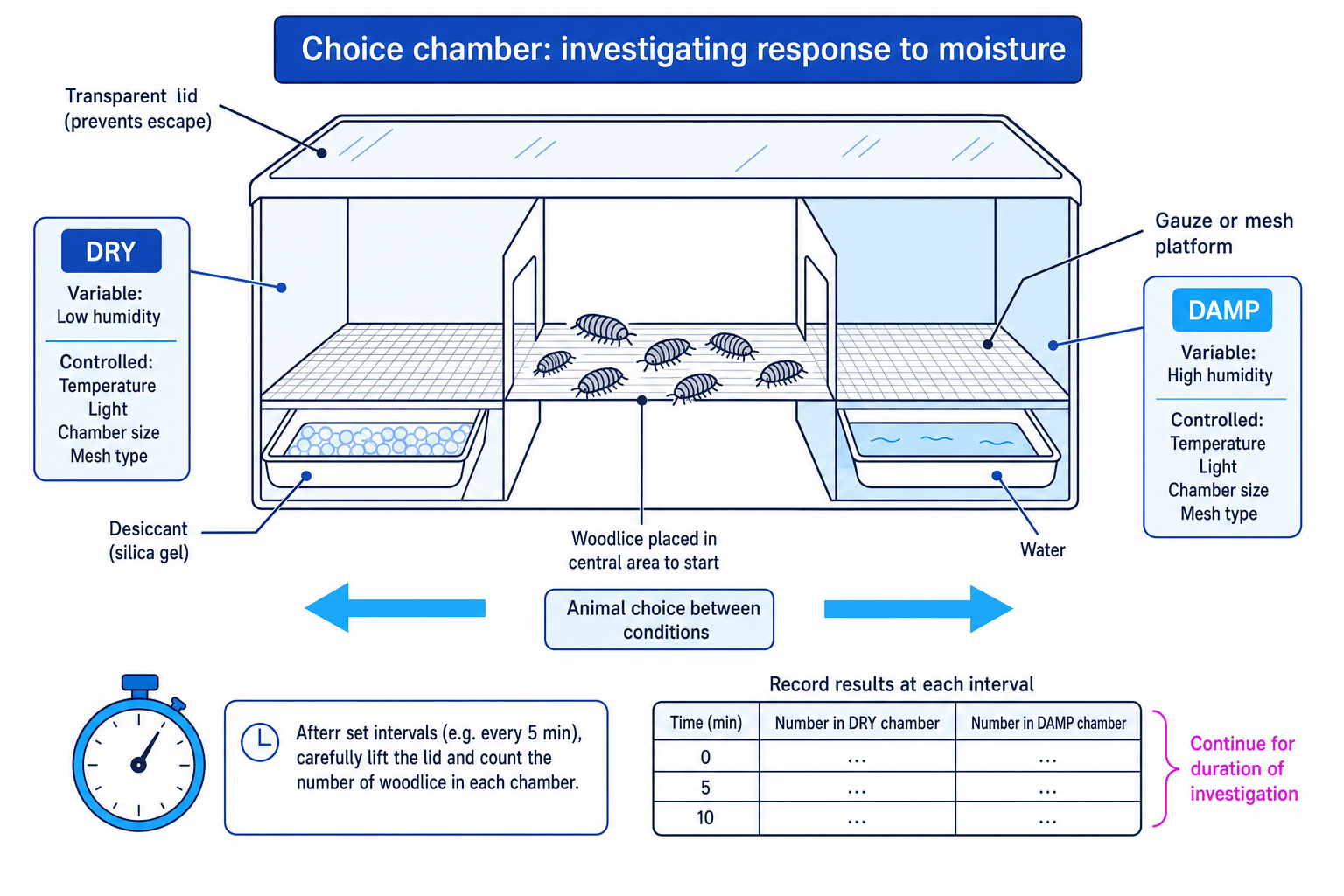
A choice chamber lets animals choose between different conditions, so you can test whether an environmental variable affects their distribution or movement.
A common setup uses woodlice and humidity. One side of the chamber is made dry using a desiccant such as silica gel, and the other side is made damp using water. The woodlice are placed in the central region, and the number in each side is counted after fixed time intervals.
Variables in a choice chamber
The independent variable is the environmental condition you change, such as humidity or light intensity.
The dependent variable is what you measure, such as the number of animals in each region after 5 minutes.
The control variables are factors kept the same, such as temperature, chamber size, light intensity, number of animals and duration of the investigation.
Change only one environmental variable
If you are testing humidity, both sides should have the same light intensity and temperature. Otherwise, you cannot tell which stimulus caused the distribution.
Improving validity and reliability
To improve the investigation:
- use several animals, not just one
- repeat the experiment and calculate a mean
- swap which side is damp or dry to check for side bias
- allow a short acclimatisation period before recording
- handle animals gently and return them to their habitat afterwards
Calculating percentage preference
In a choice chamber, 12 woodlice are used. After 10 minutes, 9 are in the damp side and 3 are in the dry side. Calculate the percentage in the damp side and interpret the result.
- Use the total number of animals as the denominator: percentage in damp side=number in damp sidetotal number of animals×100\text{percentage in damp side} = \frac{\text{number in damp side}}{\text{total number of animals}} \times 100percentage in damp side=total number of animalsnumber in damp side×100.
- Substitute the values: 912×100=75%\frac{9}{12} \times 100 = 75\%129×100=75%.
- Since 75% of the woodlice are in the damp side, the results suggest a preference for damp conditions.
- To make the conclusion stronger, repeat the investigation and check that other variables, such as light and temperature, were controlled.
Reflexes: fast protective responses
Some responses need to happen very quickly. A reflex is rapid, automatic and involuntary, meaning it does not require conscious thought before the response happens.
Reflex arc
A reflex arc is the pathway of nerve impulses from a receptor to an effector during a reflex response.
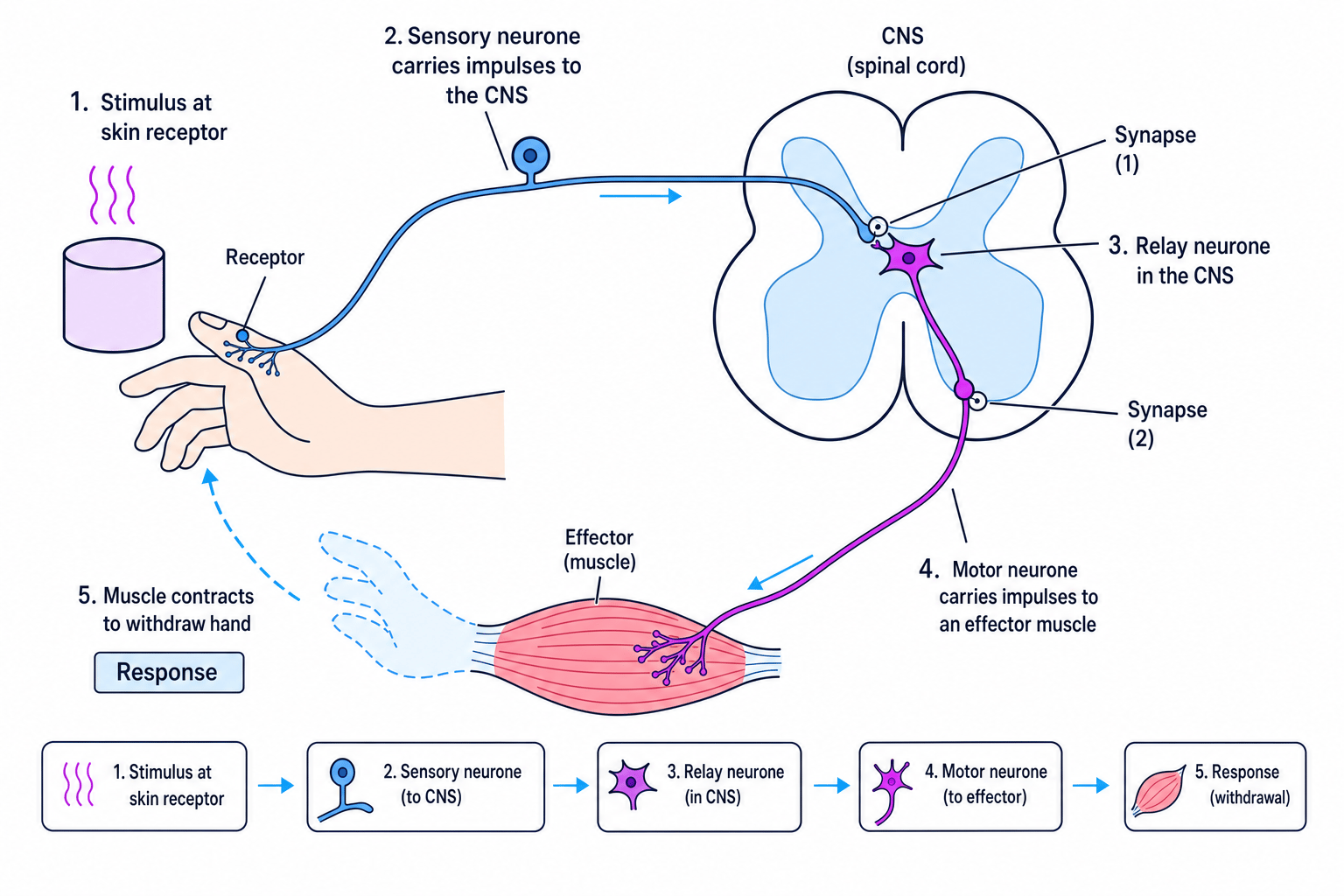
A simple protective reflex can involve three neurones:
- a sensory neurone, which carries impulses from a receptor to the central nervous system
- a relay neurone, which passes impulses within the central nervous system
- a motor neurone, which carries impulses to an effector
A receptor detects the stimulus. An effector is a muscle or gland that produces the response. A synapse is a junction between neurones where signals pass from one neurone to the next.
You do not need details of the dorsal and ventral roots of the spinal cord for this section.
Tracing a withdrawal reflex
A person touches a hot object and quickly pulls their hand away. Explain how the reflex protects them.
- Heat or pain receptors in the skin detect the harmful stimulus and generate nerve impulses in a sensory neurone.
- The sensory neurone carries impulses to the central nervous system, where they pass across a synapse to a relay neurone.
- The relay neurone passes impulses across another synapse to a motor neurone.
- The motor neurone carries impulses to a muscle effector, causing the muscle to contract.
- The hand is withdrawn rapidly, reducing the chance of tissue damage.
In the exam
- For tropisms, always state the stimulus, where IAA accumulates, its effect on cell elongation, and the direction of bending.
- For taxes and kineses, decide whether movement is directional. Directional movement is taxis; changed random activity is kinesis.
- For required practical 10, name the independent, dependent and control variables, and explain repeats or means.
- For reflexes, give the sequence: receptor → sensory neurone → relay neurone → motor neurone → effector → response.
Check yourself
- Why does IAA make shoots and roots bend in opposite directions during gravitropism?
- How can you tell whether an animal response is a taxis or a kinesis?
- In a choice chamber testing humidity, which variables should be controlled?
