What you'll learn
- What surface area, volume, and surface area to volume ratio mean.
- Why increasing size usually makes exchange harder.
- How body shape and exchange systems help larger organisms survive.
- How to calculate SA:V and apply it to agar block diffusion investigations.
Why exchange matters
All organisms must exchange materials with their environment. This means substances move into or out of the organism. Examples include oxygen, carbon dioxide, mineral ions, nutrients, water, urea, and heat energy.
Many exchanges happen by diffusion, which is the net movement of particles from a region of higher concentration to a region of lower concentration. The difference in concentration between two regions is called a concentration gradient.
For diffusion to supply cells effectively, substances need enough surface to cross and not too far to travel. This is where surface area to volume ratio becomes important.
Surface area and volume
Surface area is the total area of the outside of an organism or structure. It is measured in square units, such as square millimetres.
Volume is the amount of three-dimensional space inside an organism or structure. It is measured in cubic units, such as cubic millimetres.
In biology, surface area often represents the area available for exchange. Volume roughly represents the amount of living material that needs supplying and produces waste.
Surface area to volume ratio
The surface area to volume ratio, often written as SA:V, compares the exchange surface available with the volume that must be supplied.
SA:V ratio=surface areavolume\text{SA:V ratio} = \frac{\text{surface area}}{\text{volume}}SA:V ratio=volumesurface areaA high SA:V means there is lots of surface area for each unit of volume.
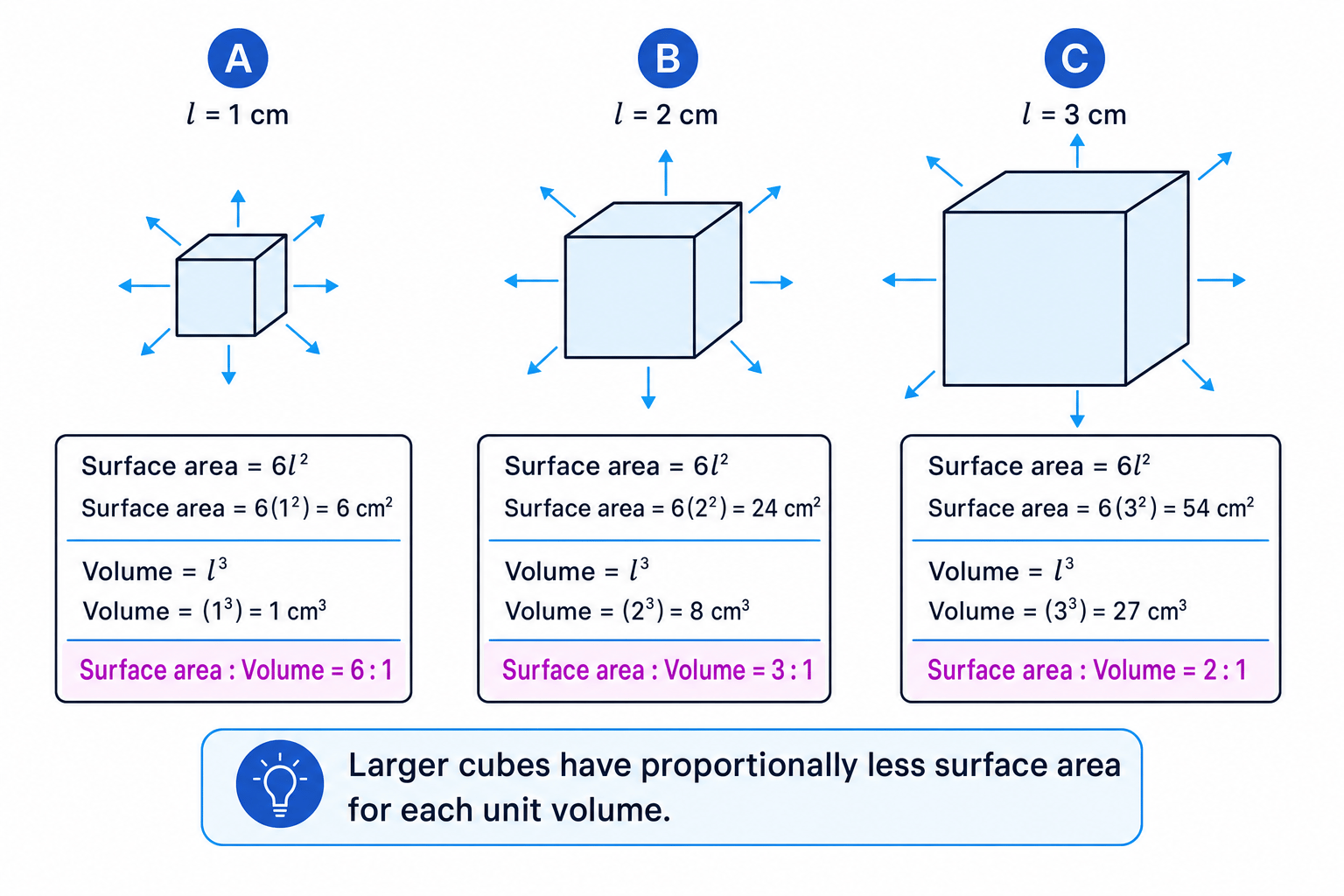
The diagram below shows the key pattern: as a cube gets bigger, its total surface area increases, but its volume increases faster.
Calculating SA:V for a cube
A cube has side length 4.0 mm. Calculate its surface area to volume ratio.
-
A cube has six identical square faces, so use SA=6l2SA = 6l^2SA=6l2.
SA=6×(4.0)2=96 mm2SA = 6 \times (4.0)^2 = 96\ \text{mm}^2SA=6×(4.0)2=96 mm2 -
The volume of a cube is V=l3V = l^3V=l3.
V=(4.0)3=64 mm3V = (4.0)^3 = 64\ \text{mm}^3V=(4.0)3=64 mm3 -
Compare surface area with volume.
SA:V=96:64=1.5:1\text{SA:V} = 96:64 = 1.5:1SA:V=96:64=1.5:1As a quotient, SAV=1.5 mm−1\frac{SA}{V} = 1.5\ \text{mm}^{-1}VSA=1.5 mm−1. If whole-number ratios are preferred, 96:6496:6496:64 also simplifies to 3:23:23:2.
Ratio sanity check
If the question asks for SA:V as something to 1, divide surface area by volume. Always keep the length units consistent before calculating.
Why SA:V decreases as size increases
When an organism or structure gets bigger, its linear dimensions increase. A linear dimension is a length, such as height, width, or radius.
If every length is multiplied by the same scale factor, surface area increases with the square of that scale factor, but volume increases with the cube of that scale factor.
For scale factor kkk:
new surface area∝k2new volume∝k3new SA:Vold SA:V=k2k3=1k\begin{aligned} \text{new surface area} &\propto k^2 \\ \text{new volume} &\propto k^3 \\ \frac{\text{new SA:V}}{\text{old SA:V}} &= \frac{k^2}{k^3} = \frac{1}{k} \end{aligned}new surface areanew volumeold SA:Vnew SA:V∝k2∝k3=k3k2=k1So, if an object becomes 10 times longer, its SA:V becomes one tenth of what it was.
The big pattern
As size increases, volume increases faster than surface area. Larger organisms therefore have less exchange surface available for each unit of tissue.
Scaling up a cell
A cell keeps the same shape but becomes 5 times larger in every linear dimension. What happens to its SA:V?
-
The scale factor is k=5k = 5k=5, so surface area changes by k2k^2k2.
52=255^2 = 2552=25The surface area becomes 25 times larger.
-
Volume changes by k3k^3k3.
53=1255^3 = 12553=125The volume becomes 125 times larger.
-
Compare the change in SA:V.
25125=15\frac{25}{125} = \frac{1}{5}12525=51The new SA:V is one fifth of the original. There is much less membrane surface available per unit of cytoplasm.
Bigger surface area does not mean bigger SA:V
A larger organism can have a greater total surface area but a lower surface area to volume ratio. In exchange questions, focus on surface area per unit volume, not just total surface area.
Why this matters for metabolic rate
Metabolic rate is the rate at which an organism carries out metabolic reactions, including respiration. A higher metabolic rate means cells need oxygen and nutrients faster, and they produce carbon dioxide and other wastes faster.
Small organisms often have a high SA:V, so diffusion across their body surface may be enough to meet their needs. However, they may also lose heat and water quickly because so much surface is exposed relative to their volume.
Larger organisms have a lower SA:V. They also have cells deep inside the body, so diffusion from the outer surface alone would be too slow. If the organism is active and has a high metabolic demand, this becomes a serious problem.
Linking size, SA:V and metabolic demand
Explain why a large active mammal cannot rely on diffusion across its body surface alone.
-
A large mammal has many cells, so its total demand for oxygen and nutrients is high, and it produces large amounts of carbon dioxide and other wastes.
-
Its SA:V is low, so there is relatively little outer surface for each unit of body volume. Many cells are also a long distance from the body surface.
-
Diffusion across the skin alone would be too slow to meet metabolic demand, so the mammal needs specialised exchange surfaces, such as lungs, and a transport system, such as the blood circulatory system.
Body shape as an adaptation
An adaptation is a feature that helps an organism survive or reproduce in its environment.
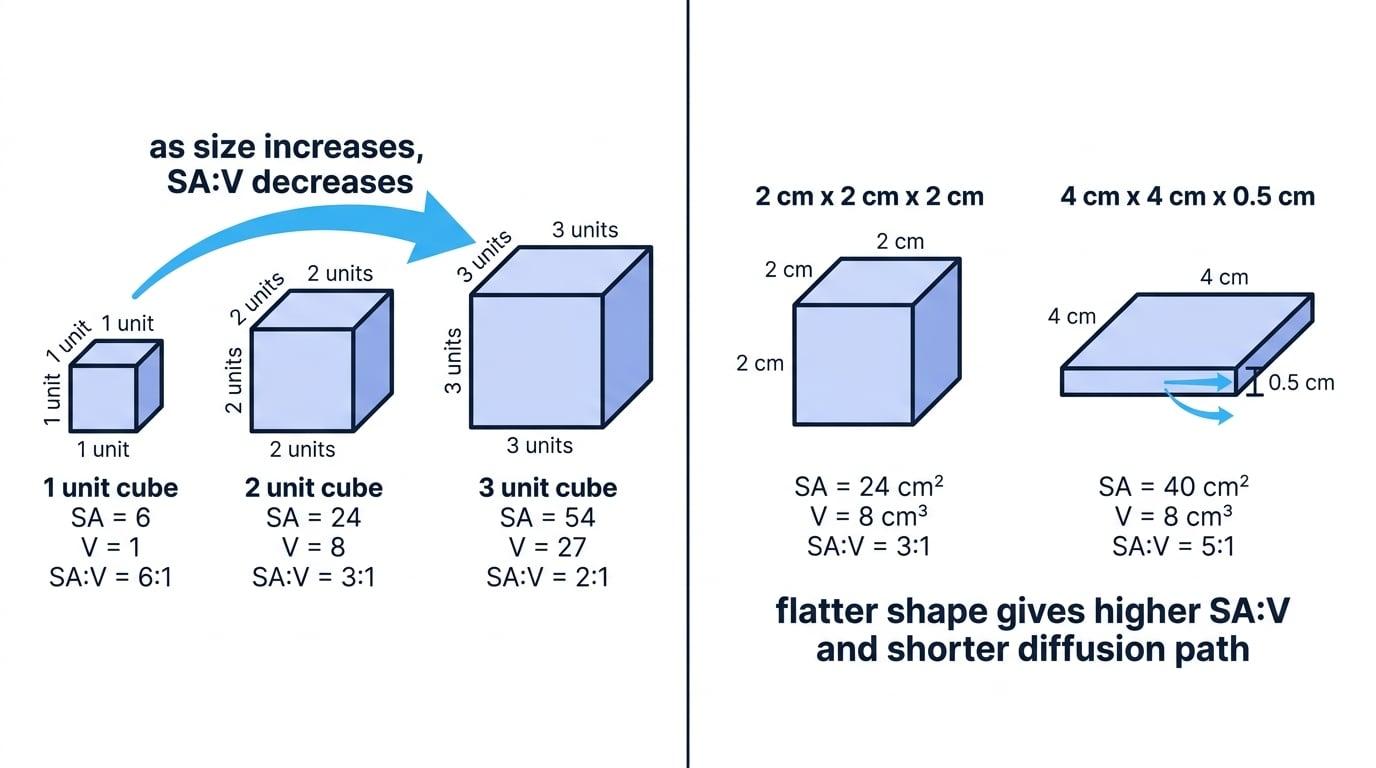
Some organisms increase their SA:V by having a shape that is thin, flat, long, or highly folded. This provides more exchange surface and can reduce the diffusion pathway, which is the distance particles must travel during diffusion.
For example, a flatworm has a thin, flattened body. This means most cells are close to the body surface, so diffusion can occur over a short distance.
Comparing a cube with a flattened shape
A cube and a flattened cuboid both have a volume of 8.0 cm³. Compare their SA:V ratios.
-
For a cube with side length 2.0 cm:
SA=6l2=6×(2.0)2=24 cm2V=(2.0)3=8.0 cm3\begin{aligned} SA &= 6l^2 = 6 \times (2.0)^2 = 24\ \text{cm}^2 \\ V &= (2.0)^3 = 8.0\ \text{cm}^3 \end{aligned}SAV=6l2=6×(2.0)2=24 cm2=(2.0)3=8.0 cm3So its SA:V is 24:8.0=3.0:124:8.0 = 3.0:124:8.0=3.0:1.
-
For a flattened cuboid measuring 4.0 cm by 4.0 cm by 0.50 cm:
V=4.0×4.0×0.50=8.0 cm3SA=2(lw+lh+wh)=2((4.0×4.0)+(4.0×0.50)+(4.0×0.50))=40.0 cm2\begin{aligned} V &= 4.0 \times 4.0 \times 0.50 = 8.0\ \text{cm}^3 \\ SA &= 2(lw + lh + wh) \\ &= 2((4.0 \times 4.0) + (4.0 \times 0.50) + (4.0 \times 0.50)) \\ &= 40.0\ \text{cm}^2 \end{aligned}VSA=4.0×4.0×0.50=8.0 cm3=2(lw+lh+wh)=2((4.0×4.0)+(4.0×0.50)+(4.0×0.50))=40.0 cm2 -
Compare the ratios.
flattened cuboid SA:V=40.0:8.0=5.0:1\text{flattened cuboid SA:V} = 40.0:8.0 = 5.0:1flattened cuboid SA:V=40.0:8.0=5.0:1The flattened shape has the same volume but a higher SA:V, so it is better suited for exchange by diffusion.
Exchange systems in larger organisms
As organisms get larger, changing body shape alone is usually not enough. Larger multicellular organisms develop specialised exchange surfaces and transport systems.
An exchange surface is a surface across which substances move between the organism and its environment. Good exchange surfaces usually have:
- a large surface area
- a short diffusion pathway
- a steep concentration gradient
- a transport system to move substances to and from the surface
Examples include lungs in mammals, gills in fish, villi in the small intestine, and root hair cells in plants. Transport systems include blood circulation in animals and xylem and phloem in plants.
Why systems are needed
A low SA:V means the body surface alone cannot supply every cell fast enough. Larger organisms solve this using specialised exchange surfaces plus transport systems.
Investigating SA:V using agar blocks
A common model uses agar, a jelly-like material, containing a pH indicator, which is a dye that changes colour when pH changes. Agar blocks are cut into different sizes and placed in acid or alkali.
The acid or alkali diffuses into the block and changes the indicator colour. Smaller blocks, with higher SA:V, usually have a larger percentage of their volume changed in the same time.
To investigate concentration gradient, keep the block size the same and vary the acid or alkali concentration. A higher concentration outside the block gives a steeper concentration gradient, so diffusion should be faster.
Important variables:
- Independent variable: block size, SA:V, or external acid/alkali concentration.
- Dependent variable: depth diffused, time for colour change, or percentage volume changed.
- Control variables: temperature, time in solution, agar composition, indicator concentration, and acid/alkali volume.
Calculating percentage volume changed in agar
An agar cube has side length 2.0 cm. After 5 minutes in acid, the acid has diffused 0.40 cm in from every surface. Calculate the percentage of the cube’s volume that has changed colour.
-
Find the side length of the unchanged inner cube. Acid diffuses in from both opposite faces, so subtract twice the diffusion distance.
2.0−(2×0.40)=1.20 cm2.0 - (2 \times 0.40) = 1.20\ \text{cm}2.0−(2×0.40)=1.20 cm -
Calculate the total volume and unchanged volume.
total volume=(2.0)3=8.0 cm3unchanged volume=(1.20)3=1.728 cm3\begin{aligned} \text{total volume} &= (2.0)^3 = 8.0\ \text{cm}^3 \\ \text{unchanged volume} &= (1.20)^3 = 1.728\ \text{cm}^3 \end{aligned}total volumeunchanged volume=(2.0)3=8.0 cm3=(1.20)3=1.728 cm3 -
Calculate the changed volume and percentage changed.
changed volume=8.0−1.728=6.272 cm3percentage changed=6.2728.0×100=78.4%\begin{aligned} \text{changed volume} &= 8.0 - 1.728 = 6.272\ \text{cm}^3 \\ \text{percentage changed} &= \frac{6.272}{8.0} \times 100 = 78.4\% \end{aligned}changed volumepercentage changed=8.0−1.728=6.272 cm3=8.06.272×100=78.4%So 78.4% of the agar cube changed colour.
Agar is only a model
Agar blocks show diffusion into a gel, not into living cells. They do not model membranes, blood flow, ventilation, active transport, or metabolism.
In the exam
- For calculations, write the formula, keep units consistent, calculate surface area and volume separately, then simplify the ratio.
- For explanations, link low SA:V to limited exchange per unit volume, longer diffusion distances, and high metabolic demand.
- For adaptations, state the feature and its effect: increases surface area, reduces diffusion distance, maintains a steep concentration gradient, or transports substances.
Check yourself
- Why does doubling every linear dimension reduce the SA:V ratio?
- A cuboid cell measures 10 μm10\ \mu\text{m}10 μm by 5 μm5\ \mu\text{m}5 μm by 2 μm2\ \mu\text{m}2 μm. How would you calculate its SA:V?
- Why do large active organisms need both exchange surfaces and transport systems?