What you'll learn
- What DNA and RNA are, and why they are important information-carrying molecules.
- How nucleotides are built from a pentose sugar, phosphate group and nitrogen-containing base.
- How condensation reactions form phosphodiester bonds between nucleotides.
- How DNA and RNA differ in structure, bases and biological role.
Why nucleic acids matter
A nucleic acid is a biological molecule that carries genetic information. The two nucleic acids you need here are deoxyribonucleic acid (DNA) and ribonucleic acid (RNA).
In all living cells, DNA holds the genetic information. This information is stored in the order of bases along the DNA molecule. RNA transfers genetic information from DNA to ribosomes, which are small cell structures where proteins are made.
Ribosomes themselves are made from RNA and proteins. That matters because RNA is not just a “messenger”; it is also a structural part of ribosomes.
Core idea
DNA stores genetic information, while RNA helps transfer that information from DNA to ribosomes, where proteins are made.
Nucleotides: the monomers of DNA and RNA
A polymer is a large molecule made from many repeating smaller units called monomers. DNA and RNA are both polymers. Their monomers are called nucleotides.
Nucleotide
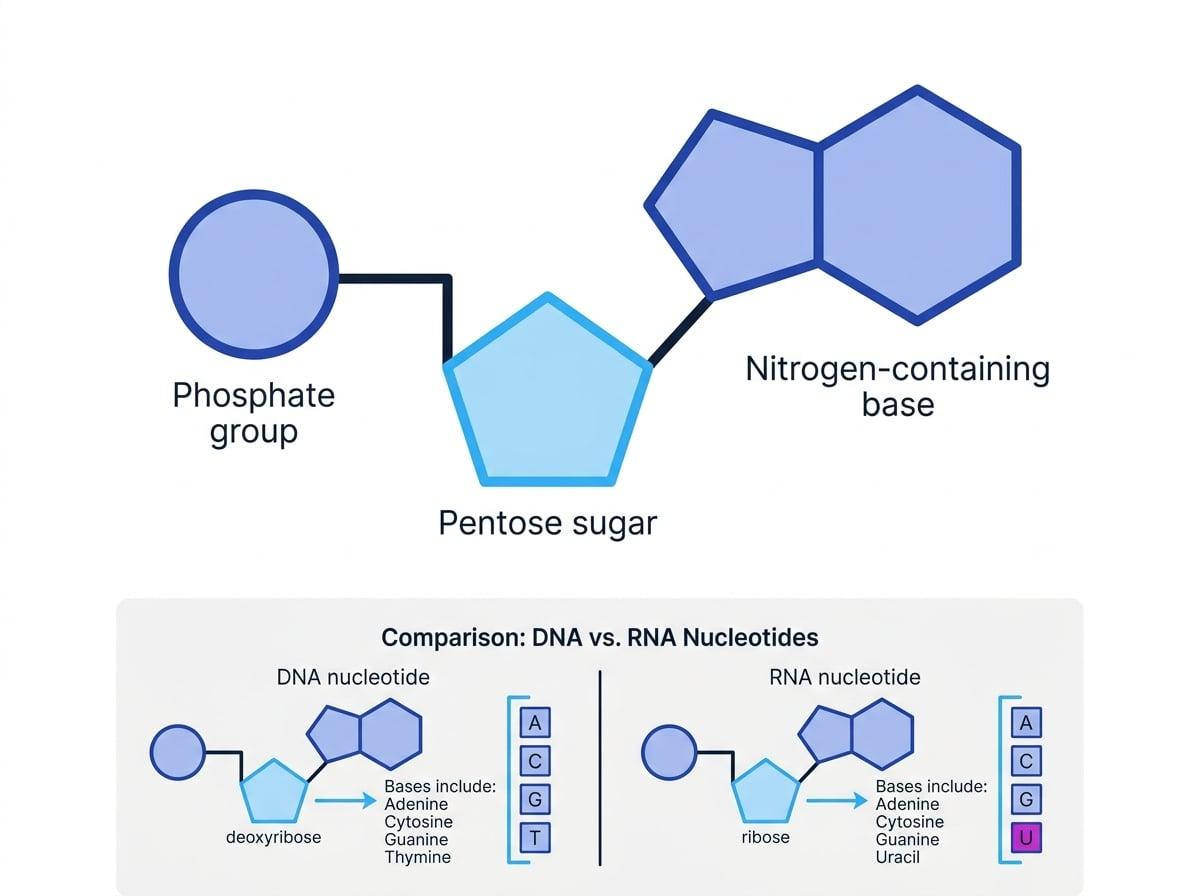
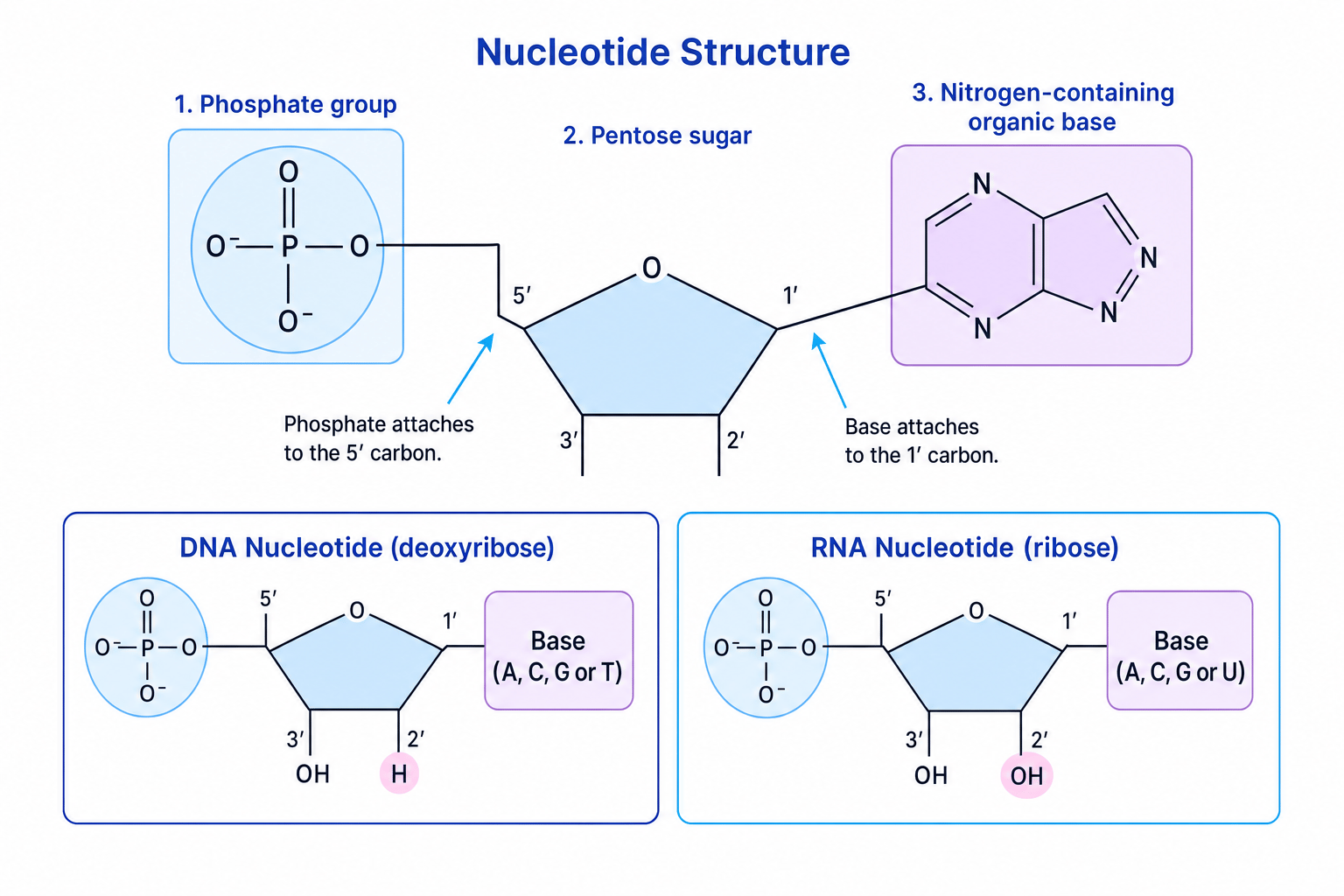
A nucleotide is the monomer of DNA and RNA, made from a pentose sugar, a phosphate group and a nitrogen-containing organic base.
A pentose sugar is a sugar with five carbon atoms. A phosphate group is a chemical group containing phosphorus and oxygen. A nitrogen-containing organic base is a carbon-containing molecule that includes nitrogen and helps form the “letters” of the genetic code.
This diagram shows the basic nucleotide plan and the key difference between DNA and RNA nucleotides.
DNA nucleotides
A DNA nucleotide contains:
- Deoxyribose, the pentose sugar in DNA.
- A phosphate group.
- One of four bases: adenine (A), cytosine (C), guanine (G) or thymine (T).
RNA nucleotides
An RNA nucleotide contains:
- Ribose, the pentose sugar in RNA.
- A phosphate group.
- One of four bases: adenine (A), cytosine (C), guanine (G) or uracil (U).
Thymine and uracil
Do not put thymine in RNA or uracil in DNA. DNA uses T; RNA uses U instead of T.
Joining nucleotides together
Nucleotides join by condensation reactions. A condensation reaction is a reaction in which two molecules join together and a molecule of water is released.
When two nucleotides join, a phosphodiester bond forms between the phosphate group of one nucleotide and the sugar of the next nucleotide.
Phosphodiester bond
A phosphodiester bond is a strong covalent bond that links nucleotides together in a polynucleotide chain, forming the sugar-phosphate backbone.
A polynucleotide is a polymer made from many nucleotides. In DNA and RNA, the repeated sugar and phosphate parts form the sugar-phosphate backbone. The bases project from this backbone, and their order carries information.
Counting phosphodiester bonds
A short linear RNA molecule is made from 10 nucleotides. How many phosphodiester bonds are formed?
- In a linear chain, each phosphodiester bond joins one nucleotide to the next, so the number of joins is one fewer than the number of nucleotides.
- For 10 nucleotides, the number of joins is 10−1=910 - 1 = 910−1=9.
- Each join forms one phosphodiester bond, so 9 phosphodiester bonds are formed. Because each forms by condensation, 9 water molecules are also released.
DNA structure: two strands in a double helix
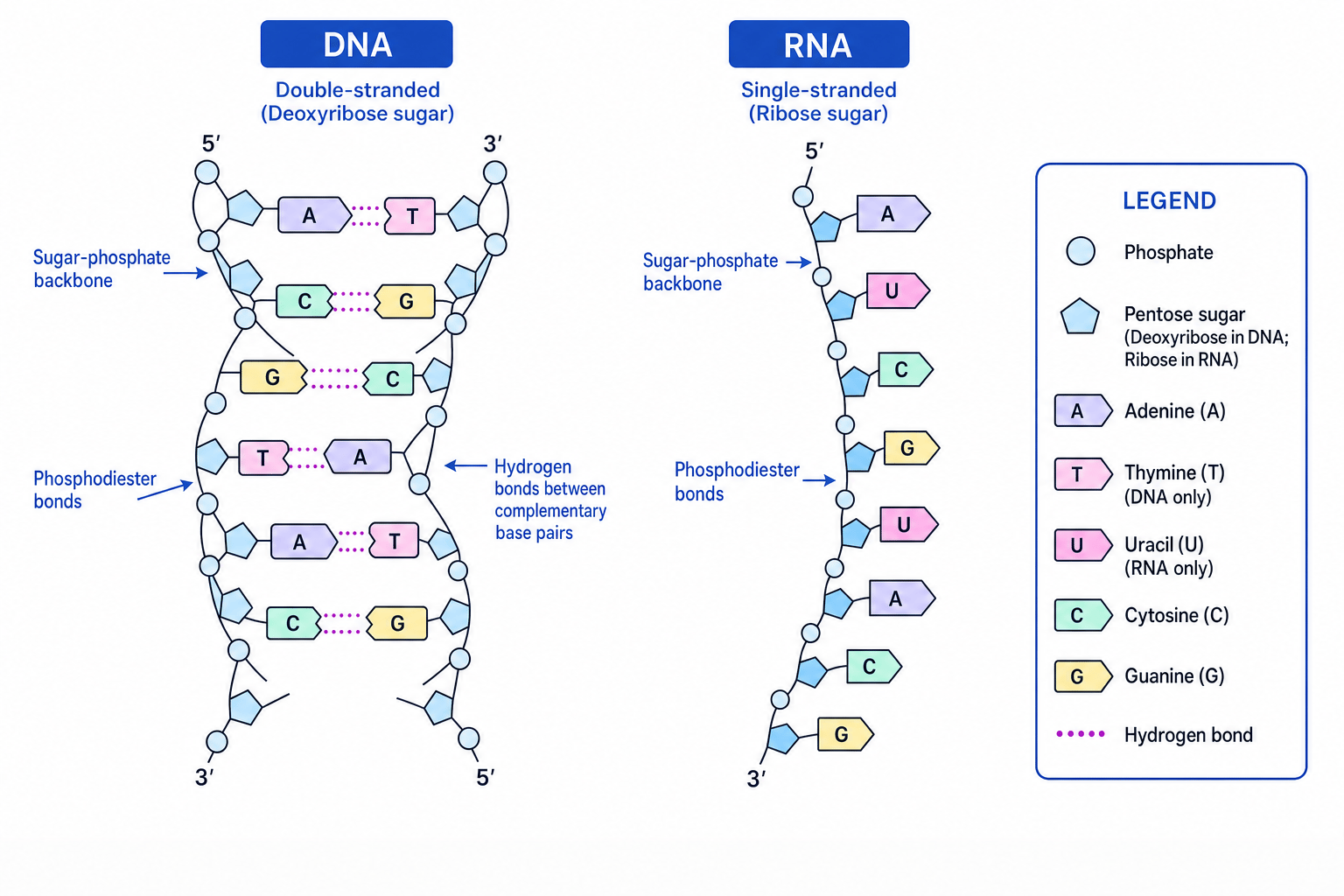
A DNA molecule is made from two polynucleotide chains. These chains twist around each other to form a double helix, which means a two-stranded spiral shape.
The sugar-phosphate backbones are on the outside of the helix. The bases point inwards and pair with bases on the opposite strand.
The two strands are held together by hydrogen bonds. A hydrogen bond is a weak attraction between slightly charged parts of molecules. One hydrogen bond is weak, but lots of hydrogen bonds together help stabilise the DNA molecule.
DNA has specific complementary base pairs:
- Adenine pairs with thymine: A-T
- Cytosine pairs with guanine: C-G
The two DNA strands run in opposite directions. This is called being antiparallel. You may see the strand ends labelled 5' and 3', named after carbon positions in the pentose sugar.
This diagram compares double-stranded DNA with single-stranded RNA.
Complementary base pairing
In double-stranded DNA, A always pairs with T, and C always pairs with G. This lets one strand determine the base sequence of the other strand.
RNA structure: usually shorter and single-stranded
An RNA molecule is a relatively short polynucleotide chain. Unlike DNA, RNA is usually single-stranded, meaning it normally has one polynucleotide chain rather than two.
RNA still has a sugar-phosphate backbone, formed by phosphodiester bonds. However, RNA contains ribose sugar and uses uracil instead of thymine.
Different types of RNA have different roles, but the key idea for this section is that RNA transfers genetic information from DNA to ribosomes, and ribosomes are formed from RNA and proteins.
Using base-pairing rules
Because bases pair specifically in DNA, the percentages of bases in double-stranded DNA are linked.
If you know the percentage of adenine, you also know the percentage of thymine. If you know the percentage of cytosine, you also know the percentage of guanine.
For double-stranded DNA:
A=TA = TA=T C=GC = GC=GAnd all four bases together make 100%:
A+T+C+G=100%A + T + C + G = 100\%A+T+C+G=100%Finding missing base percentages
A sample of double-stranded DNA contains 28% adenine. Find the percentages of thymine, cytosine and guanine.
- Use complementary base pairing: adenine pairs with thymine, so A=TA = TA=T. If A=28%A = 28\%A=28%, then T=28%T = 28\%T=28%.
- Add adenine and thymine together: 28%+28%=56%28\% + 28\% = 56\%28%+28%=56%. This leaves 100%−56%=44%100\% - 56\% = 44\%100%−56%=44% for cytosine and guanine combined.
- Cytosine pairs with guanine, so C=GC = GC=G. Split the remaining 44% equally: 44%÷2=22%44\% \div 2 = 22\%44%÷2=22%. Therefore, cytosine is 22% and guanine is 22%.
Base-pairing shortcut
For double-stranded DNA, the paired bases have equal percentages: A equals T, and C equals G. If one base is known, its partner is known immediately.
Why DNA seemed too simple at first
Today, it feels obvious that DNA carries the genetic code. Historically, many scientists doubted this because DNA seemed chemically quite simple.
DNA is made from only four different bases and has a repeating sugar-phosphate backbone. Proteins, by contrast, are made from 20 different amino acids and seemed more varied. This led many scientists to think proteins were more likely to carry genetic information.
The important insight is that DNA’s information is not stored in a huge variety of chemical building blocks. It is stored in the sequence of bases along the DNA molecule.
Sequence stores information
The repeating sugar-phosphate backbone is not the genetic code. The genetic information is in the order of the bases.
DNA and RNA compared
| Feature | DNA | RNA |
|---|---|---|
| Full name | Deoxyribonucleic acid | Ribonucleic acid |
| Sugar | Deoxyribose | Ribose |
| Bases | A, C, G, T | A, C, G, U |
| Typical structure | Double helix with two polynucleotide strands | Relatively short single polynucleotide chain |
| Main role here | Holds genetic information | Transfers genetic information from DNA to ribosomes |
| Bond within backbone | Phosphodiester bonds | Phosphodiester bonds |
In the exam
- If asked for nucleotide components, give all three: pentose sugar, phosphate group and nitrogen-containing organic base.
- If comparing DNA and RNA, mention sugar, base difference and strand structure: deoxyribose/thymine/double-stranded versus ribose/uracil/single-stranded.
- In base-percentage questions, use A = T and C = G for double-stranded DNA, then make the total add to 100%.
Check yourself
- What three components make up a nucleotide?
- Which bases are found in DNA, and which base is found in RNA instead of thymine?
- A DNA sample contains 18% guanine. What percentage of the sample is cytosine?