What you'll learn
- How enzymes speed up reactions by lowering activation energy.
- Why an enzyme’s active site shape depends on its tertiary structure.
- How the induced-fit model explains enzyme specificity.
- How enzyme concentration, substrate concentration, inhibitors, pH and temperature affect reaction rate.
Proteins as biological catalysts
Many proteins are enzymes. Enzymes are essential because most reactions in living organisms would be far too slow at body temperature without them.
Enzyme
An enzyme is a protein that acts as a biological catalyst: it speeds up a metabolic reaction without being used up in the reaction.
A catalyst increases the rate of a reaction without being permanently changed. Enzymes can work inside cells, such as enzymes involved in respiration, or outside cells, such as digestive enzymes released into the gut.
Activation energy
Before many reactions can happen, bonds in the reactants must be stressed, weakened or broken. This requires energy.
Activation energy
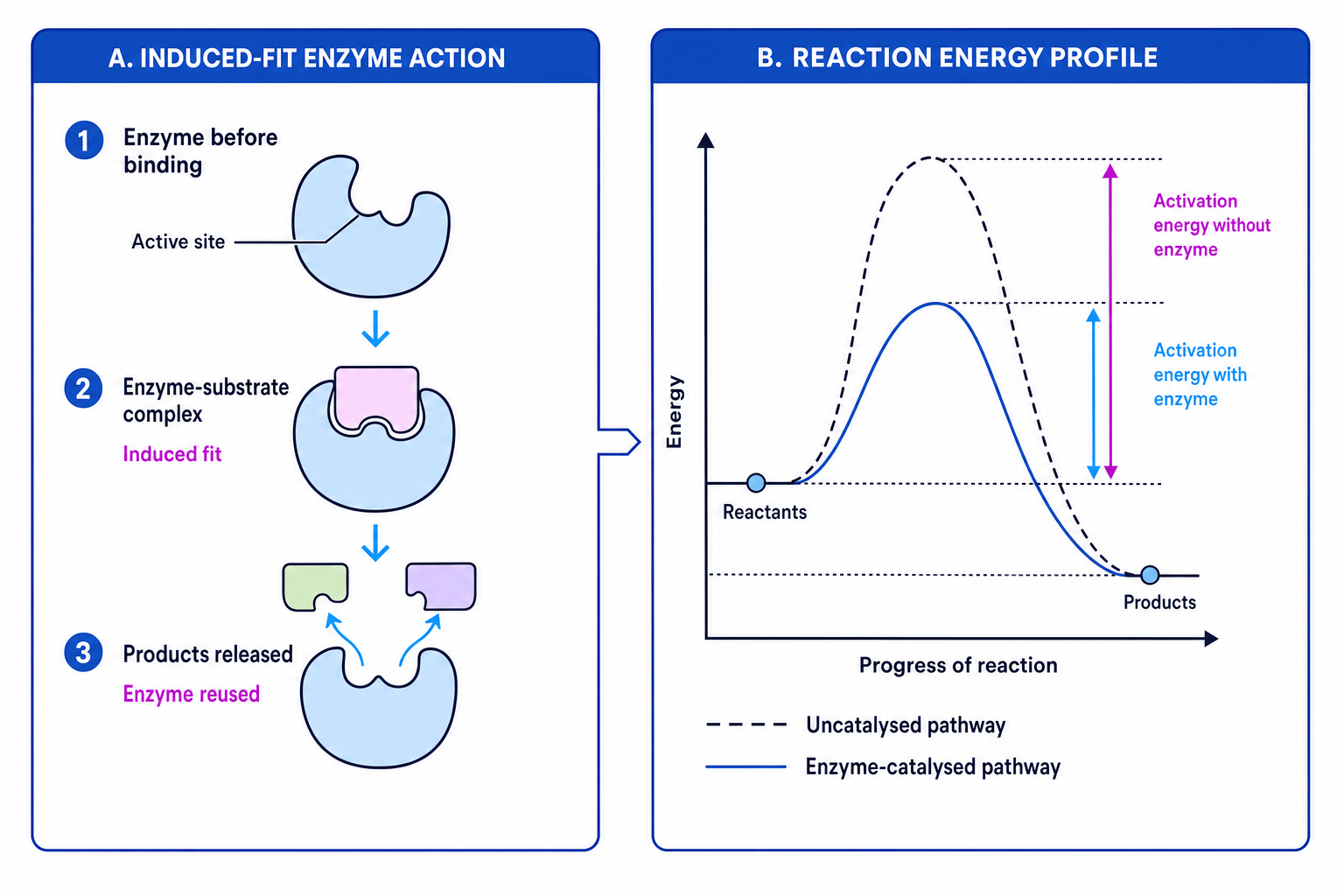
Activation energy is the minimum energy needed for a reaction to start.
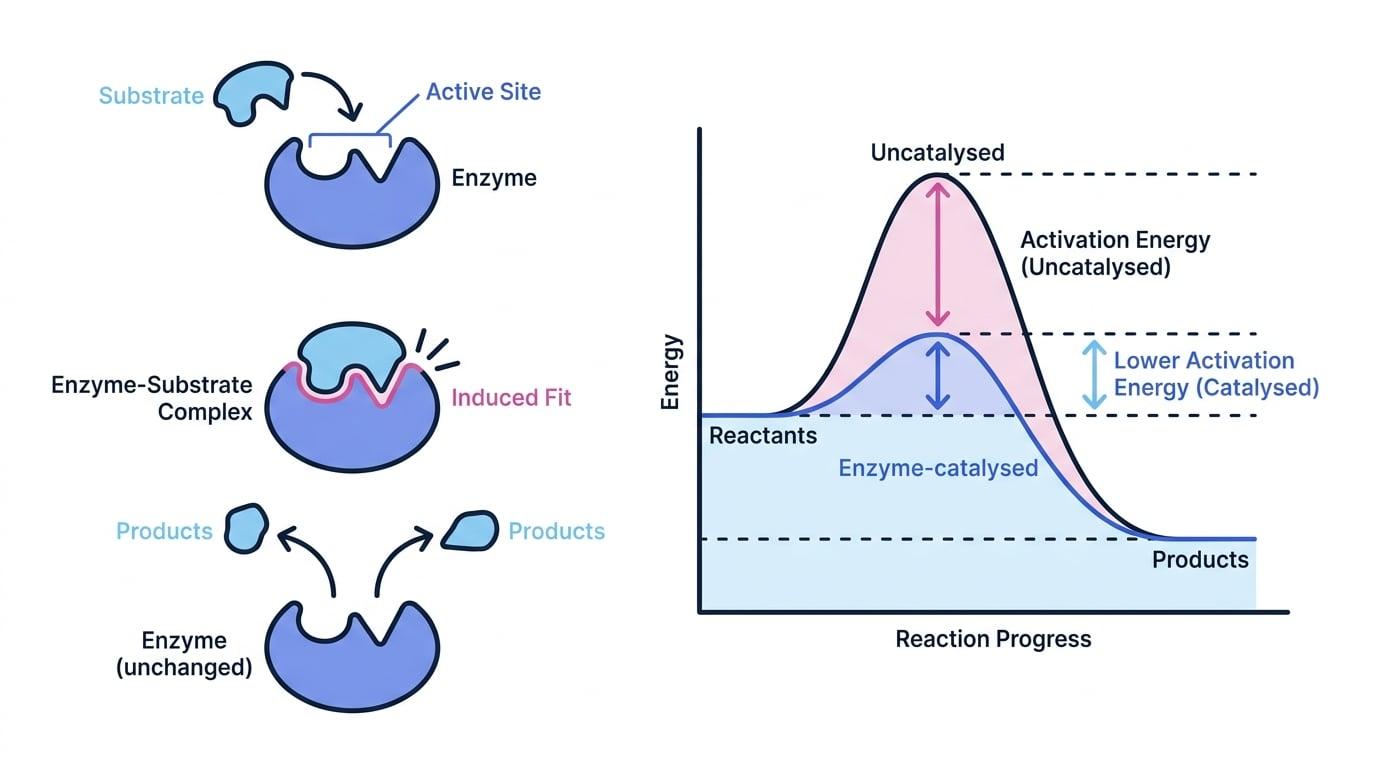
Each enzyme lowers the activation energy of the reaction it catalyses. It does this by providing an alternative reaction pathway, often by bringing substrates together in the correct orientation, straining bonds, or creating a suitable chemical environment in the active site.
Enzymes do not change the products formed, and they do not change the overall energy difference between reactants and products.
What enzymes actually change
An enzyme lowers the activation energy, so more substrate molecules have enough energy to react per second.
The active site and tertiary structure
A protein’s tertiary structure is its overall three-dimensional shape, produced by interactions between R groups in the polypeptide chain. These interactions include hydrogen bonds, ionic bonds, disulfide bridges and hydrophobic interactions.
The active site is the specific region of an enzyme where the substrate binds. A substrate is the molecule, or molecules, on which the enzyme acts. When the substrate binds to the active site, an enzyme-substrate complex forms.
The active site has a particular shape and chemical properties. These are determined by the enzyme’s tertiary structure.
Shape controls function
If the tertiary structure changes, the active site may change shape, so the substrate may no longer bind effectively.
Specificity and the induced-fit model
Enzymes are specific, meaning each enzyme usually catalyses only one reaction or a small group of similar reactions. This is because only particular substrate molecules are complementary to the enzyme’s active site.
Older explanations used the lock-and-key model, where the active site was seen as a rigid shape exactly matching the substrate. This helped explain specificity, but it was too simple.
Induced-fit model
The induced-fit model says that the active site is flexible: when the substrate binds, the active site changes shape slightly to fit the substrate more closely and help catalyse the reaction.
This model better explains how enzymes lower activation energy. The change in active site shape can put strain on substrate bonds or position reacting groups so the reaction is more likely to occur.
Rigid active sites
Do not describe induced fit as the active site being a perfectly rigid shape. In induced fit, binding causes a small change in the enzyme’s active site.
Factors affecting enzyme-controlled reactions
The rate of reaction is how quickly substrate is converted into product. It can be measured as the amount of product formed per second, or the amount of substrate used per second.
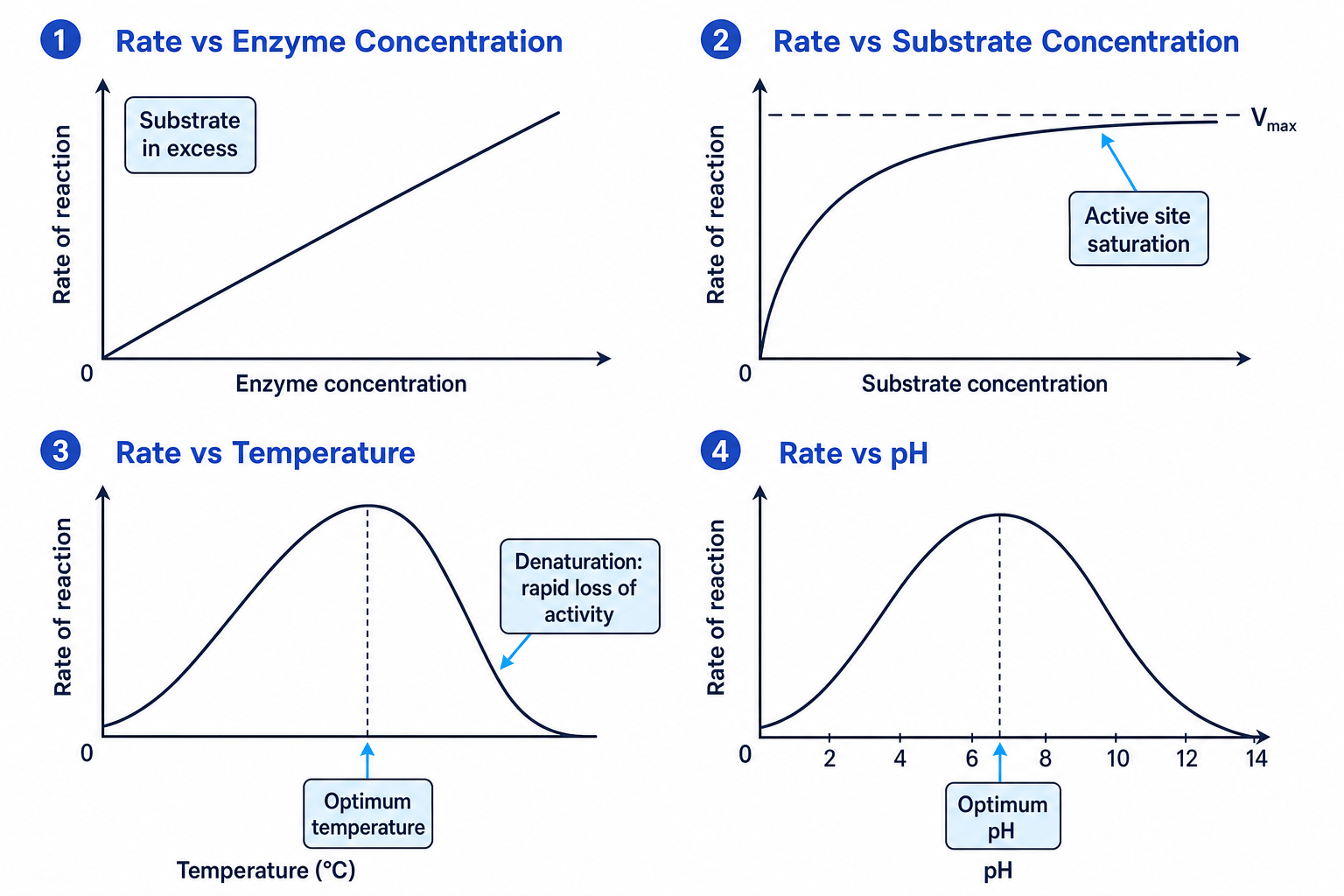
These graphs show the main patterns you need to recognise.
Enzyme concentration
If substrate is in excess, increasing enzyme concentration increases the rate of reaction. This is because there are more active sites available, so more enzyme-substrate complexes can form per second.
If substrate becomes limiting, adding more enzyme will no longer increase the rate much because there are not enough substrate molecules to occupy the extra active sites.
Substrate concentration
At low substrate concentration, increasing substrate concentration increases the rate because enzyme active sites are not all occupied.
At high substrate concentration, the rate levels off. This is because the active sites are saturated, meaning nearly all active sites are occupied most of the time. The enzyme is working at its maximum rate, often called Vmax.
Spotting saturation
A plateau on a substrate concentration graph usually means enzyme active sites are saturated, not that the enzyme has stopped working.
Temperature
As temperature increases, molecules gain kinetic energy. Enzymes and substrates collide more frequently, and more collisions have enough energy to form enzyme-substrate complexes. So the rate rises up to an optimum temperature.
Above the optimum, bonds maintaining the enzyme’s tertiary structure begin to break. The active site changes shape, so fewer enzyme-substrate complexes form.
Denaturation
Denaturation is a change in the enzyme’s tertiary structure that changes the shape of the active site and reduces enzyme activity.
Enzymes are not alive
Do not say enzymes are “killed” by high temperature. Enzymes are proteins, not living cells; they are denatured.
pH
pH is a measure of hydrogen ion concentration. A low pH means a high concentration of H⁺ ions. The spec expects you to use:
pH=−log10[H+]\text{pH} = -\log_{10}[\text{H}^+]pH=−log10[H+]where [H+][\text{H}^+][H+] is the hydrogen ion concentration in mol dm⁻³.
Changes in pH alter the charges on amino acid R groups. This can disrupt ionic bonds and hydrogen bonds in the enzyme’s tertiary structure, changing the active site shape. Each enzyme has an optimum pH.
Calculating pH from hydrogen ion concentration
A solution has [H+]=3.2×10⁻⁴ mol dm−3[\text{H}^+] = 3.2 \times 10^{-4}\ \text{mol dm}^{-3}[H+]=3.2×10⁻⁴ mol dm−3.
- Substitute the hydrogen ion concentration into the equation: pH=−log10(3.2×10⁻⁴)\text{pH} = -\log_{10}(3.2 \times 10^{-4})pH=−log10(3.2×10⁻⁴).
- Use a calculator to evaluate the logarithm: pH=3.49\text{pH} = 3.49pH=3.49.
- State the answer with no units: the pH is 3.49, so the solution is acidic.
Optimum pH is enzyme-specific
Do not assume every enzyme works best at pH 7. For example, stomach proteases work best in acidic conditions.
Inhibitors
An inhibitor is a substance that reduces the rate of an enzyme-controlled reaction.
A competitive inhibitor has a shape similar to the substrate and binds to the active site. It competes with the substrate, so fewer enzyme-substrate complexes form. Increasing substrate concentration can reduce the inhibitor’s effect, because substrate molecules are more likely to enter the active site.
A non-competitive inhibitor binds to a different part of the enzyme, not the active site. This changes the tertiary structure and therefore changes the active site shape. Increasing substrate concentration does not overcome this because the active site itself is no longer functioning properly.
Identifying a competitive inhibitor from a graph
A reaction is tested with and without an inhibitor. With the inhibitor, the rate is lower at low substrate concentration, but at very high substrate concentration the same maximum rate is eventually reached.
- Compare the low substrate region: the inhibitor lowers the rate, so it is reducing enzyme-substrate complex formation.
- Compare the plateau: the same maximum rate is reached, so the enzyme molecules can still work if enough substrate is present.
- Conclude that the inhibitor is competitive, because high substrate concentration outcompetes it at the active site.
Required practical 1: enzyme reaction rates
You need to be able to describe an investigation into the effect of a named variable on the rate of an enzyme-controlled reaction.
A common method is investigating catalase breaking down hydrogen peroxide into water and oxygen. You can measure the volume of oxygen produced over time using a gas syringe.
Possible independent variables include temperature, pH, substrate concentration, enzyme concentration or inhibitor concentration. The dependent variable is the rate of reaction.
Control variables might include enzyme volume, enzyme concentration, substrate volume, pH, temperature and total reaction volume, depending on which variable you are changing.
Required practical 1
Change one named variable, measure the initial rate, control the other variables, repeat results, and present the data in a suitable graph.
Initial rate is usually best because substrate concentration has not yet fallen much and product has not built up much. If you plot product formed against time, the initial rate is the gradient of a tangent drawn near the start of the curve.
rate=change in amount of producttime\text{rate} = \frac{\text{change in amount of product}}{\text{time}}rate=timechange in amount of productFinding initial rate from a tangent
On a graph of oxygen volume against time, a tangent at the start passes through 10 s, 2.0 cm310\ \text{s},\ 2.0\ \text{cm}^310 s, 2.0 cm3 and 70 s, 18.0 cm370\ \text{s},\ 18.0\ \text{cm}^370 s, 18.0 cm3.
- Use the two points on the tangent to find the change in oxygen volume and time: oxygen increases by 16.0 cm316.0\ \text{cm}^316.0 cm3 over 60 s60\ \text{s}60 s.
- Calculate the gradient: initial rate=16.0 cm360 s=0.267 cm3 s−1\text{initial rate} = \frac{16.0\ \text{cm}^3}{60\ \text{s}} = 0.267\ \text{cm}^3\ \text{s}^{-1}initial rate=60 s16.0 cm3=0.267 cm3 s−1.
- Use this rate to compare conditions, because it reflects the reaction before substrate concentration has fallen substantially.
For repeats, calculate a mean rate. Uncertainty can be estimated using half the range of repeat values, with the same units as the rate. A line graph is usually appropriate when both variables are continuous, such as temperature or substrate concentration.
Why enzymes matter in organisms
Enzymes catalyse a huge range of intracellular and extracellular reactions. They help determine cell structure, metabolism, digestion, movement, signalling and whole-organism function. For example, enzymes build DNA, break down glucose in respiration, digest food molecules, and synthesise biological polymers.
In the exam
- Link enzyme function to tertiary structure: active site shape, complementary substrate binding, and enzyme-substrate complex formation.
- For rate questions, explain the graph shape using collisions, active site availability, saturation or denaturation.
- In practical questions, name the independent variable, dependent variable, control variables, repeats, uncertainty and how initial rate is calculated.
Check yourself
- Why does increasing substrate concentration eventually stop increasing the reaction rate?
- How does the induced-fit model differ from the lock-and-key model?
- Why can a non-competitive inhibitor not usually be overcome by adding more substrate?