Stimuli, both internal and external, are detected and lead to a response (A-level only)

Medium
1234567891011121314151617
Question 7
Medium

A research scientist investigated the effect of a herbal tea on heart rate in human volunteers.

Before drinking the tea, the mean heart rate of the volunteers was 72 beats per minute72\text{ beats per minute}72 beats per minute.

The mean change in heart rate over 120 minutes120\text{ minutes}120 minutes after consuming the tea is shown in the graph below:
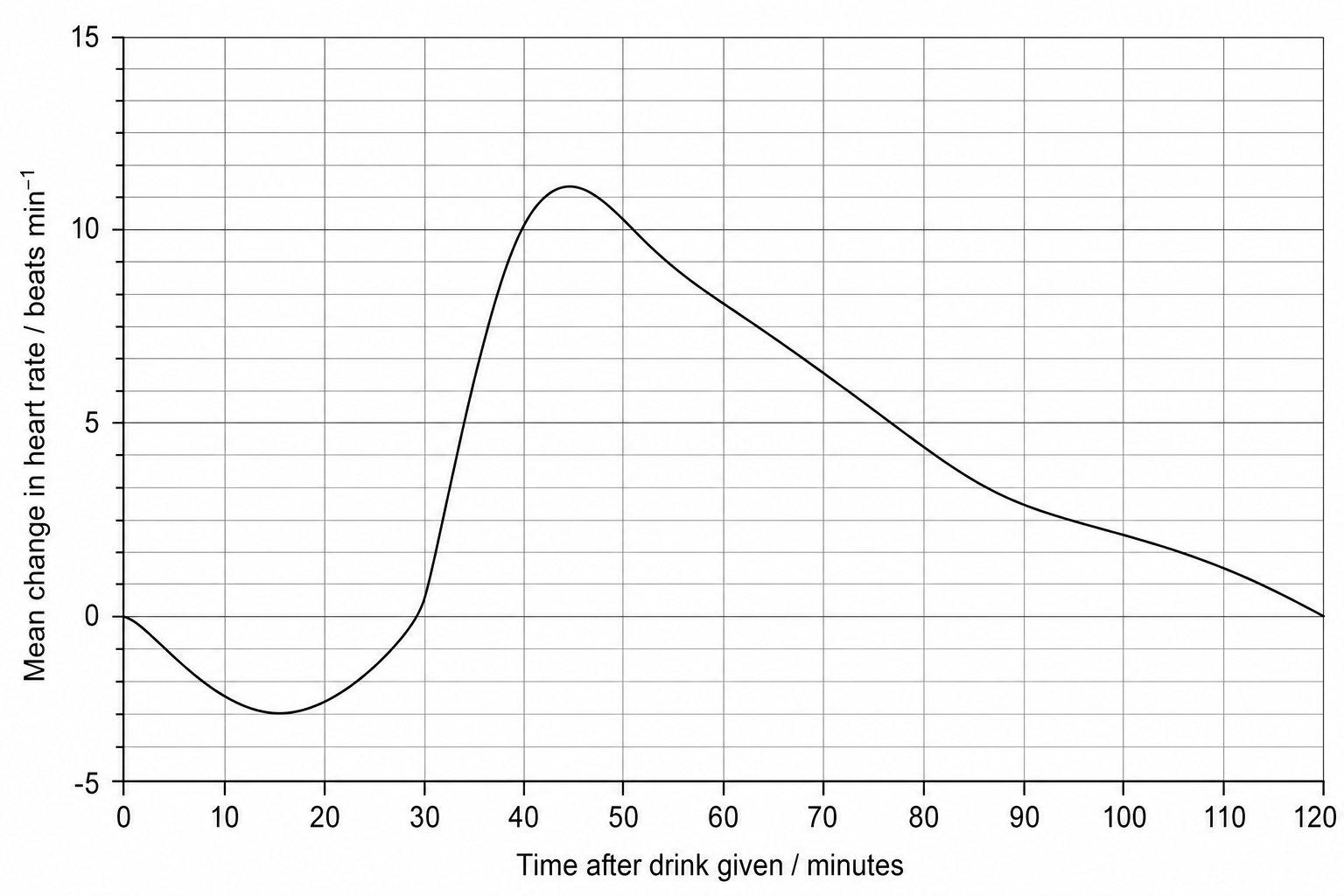
A line graph showing the mean change in heart rate in beats per minute against time after taking the drink. The x-axis is labeled 'Time after drink given / minutes' and ranges from 0 to 120 with grid lines every 10 minutes. The y-axis is labeled 'Mean change in heart rate / beats min^{-1}' and ranges from -5 to +15 with grid lines every 1 unit. The line for the herbal tea group starts at (0,0), decreases to (15, -3), rises to cross the x-axis at (30, 0), reaches a maximum of (45, 11), and then decreases to pass through (60, 8), (90, 3) and (120, 0).

Sixty minutes after drinking the tea, the mean volume of blood leaving the hearts of the volunteers was 6120 cm3 per minute6120\text{ cm}^3\text{ per minute}6120 cm3 per minute.

Calculate the mean volume of blood leaving the heart at each beat sixty minutes after drinking the tea.

[3]

Stimuli, both internal and external, are detected and lead to a response (A-level only) Questions

  1. A Level
  2. /Biology
  3. /Stimuli, both internal and external, are detected and lead to a response (A-level only)