Biologists investigated the directional movement of woodlice (Porcellio scaber\textit{Porcellio scaber}Porcellio scaber), which normally live in damp, dark environments under logs and stones to avoid desiccation.
The biologists introduced a newly captured woodlouse, A, into the center of a circular testing arena. A single light source was positioned at one end of the arena. They recorded the path taken by the woodlouse. They repeated the test with three more woodlice: B, C, and D.
Figure 1 shows the biologists' results.
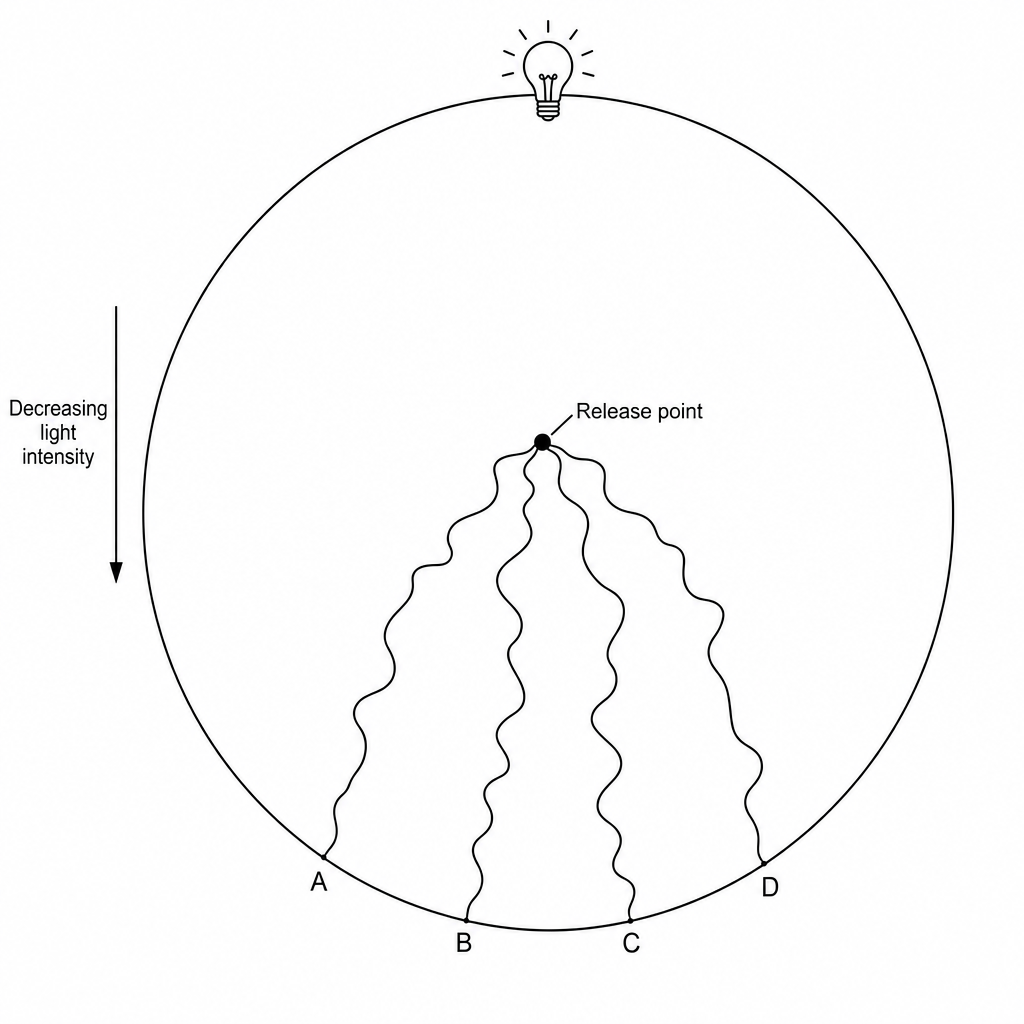
Name the type of behavior shown by woodlice A, B, C, and D, and suggest one advantage to woodlice of this type of behavior.
At higher temperatures, woodlice show increased rate of movement, but extreme heat can lead to immobilization or death.
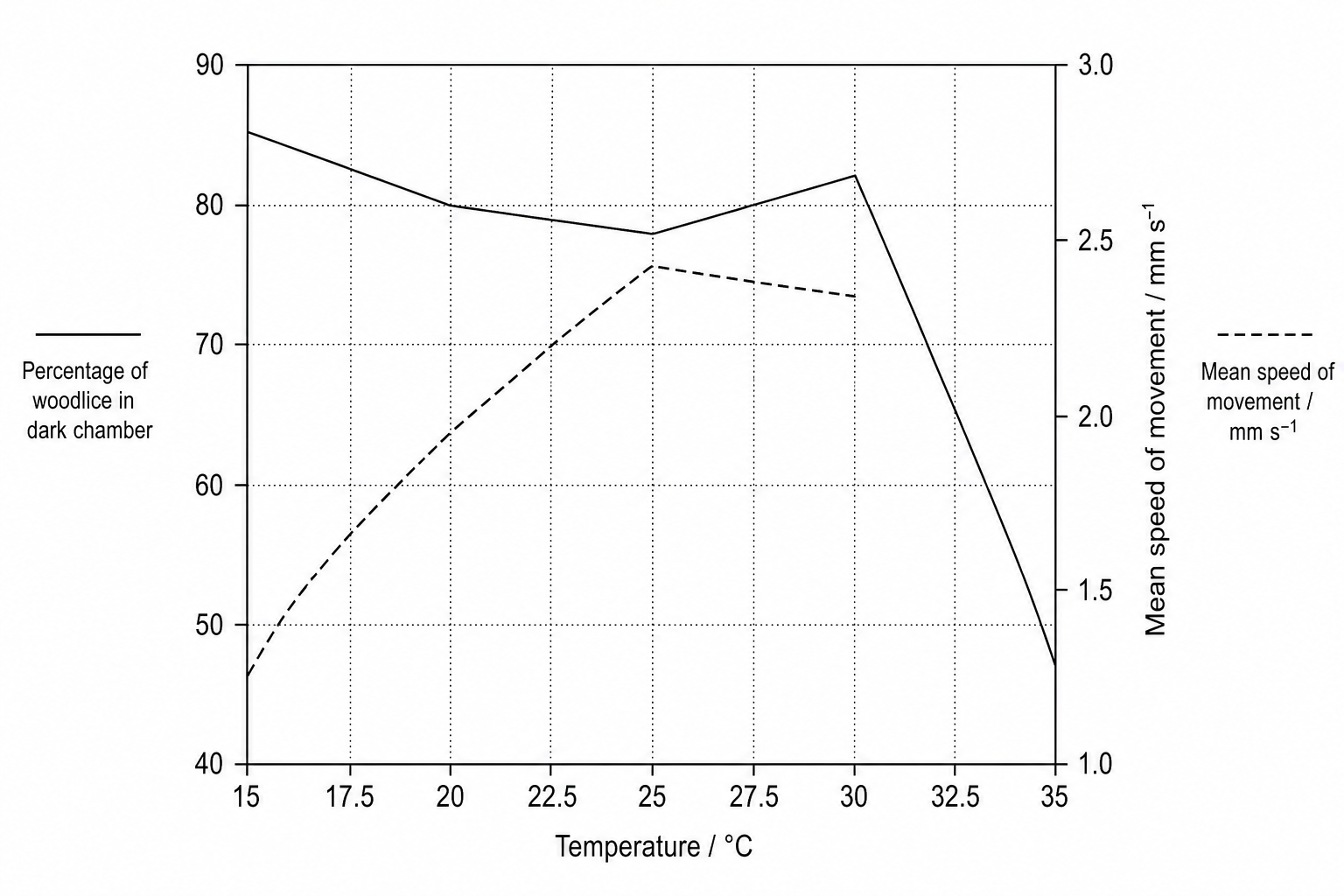
The biologists investigated the movement of woodlice at different temperatures in a choice chamber that was half in the light and half in the dark. They released woodlice at the midpoint of the central dividing line between the light and dark areas. They recorded the location of the woodlice after 10 minutes, and calculated their mean speed of movement. They repeated the chamber experiment with many woodlice at several temperatures.
Figure 2 shows the biologists' results.
After studying these experiments, a student concluded:
- there is a significant change in movement behavior between 30 ∘C30\text{ }^\circ\text{C}30 ∘C and 32.5 ∘C32.5\text{ }^\circ\text{C}32.5 ∘C
- between 30 ∘C30\text{ }^\circ\text{C}30 ∘C and 32.5 ∘C32.5\text{ }^\circ\text{C}32.5 ∘C, more woodlice prefer to stay in the light
- between 30 ∘C30\text{ }^\circ\text{C}30 ∘C and 32.5 ∘C32.5\text{ }^\circ\text{C}32.5 ∘C, woodlice have a slower walking speed.
Suggest reasons why these conclusions might not be valid.