

What you'll learn
- How AQA defines a species, and why fertile offspring matters.
- Why courtship behaviour helps organisms recognise suitable mates.
- How a phylogenetic classification system uses nested taxa to show evolutionary relationships.
- How binomial names, immunology, and genome sequencing help biologists classify organisms.
Starting point: what is a species?
Biologists need a consistent way to decide whether two organisms belong to the same species. At A-Level, the key definition is based on whether they can reproduce successfully.
Species
Two organisms belong to the same species if they are able to produce fertile offspring with each other. Fertile means the offspring can themselves reproduce.
So the focus is not just “can they mate?” or “can they produce offspring?” The offspring must also be fertile.
A classic example is a horse and a donkey. They can produce a mule, but mules are usually sterile, so horses and donkeys are not the same species by this definition.
Applying the fertile offspring definition
Two populations of insects look very similar. When individuals from the two populations mate in the laboratory, they produce offspring, but those offspring cannot produce their own young.
- The definition asks whether the organisms can produce fertile offspring, not just any offspring.
- The two populations can produce offspring, so mating and fertilisation are possible.
- The offspring are infertile, so the full species definition is not met.
- Therefore, the two populations would not be classified as the same species using this definition.
The definition has limits
This species definition works best for sexually reproducing organisms. It is less useful for asexual organisms, fossils, or cases where organisms cannot realistically be tested for breeding.
Courtship behaviour and species recognition
Before mating can happen, many animals carry out courtship behaviour. This means a sequence of signals or actions that occurs before mating, such as birdsong, dances, visual displays, pheromones, or touch.
Courtship is not just “showing off”. It helps make successful reproduction more likely.
Species recognition
Species recognition is the ability of an organism to identify a potential mate as belonging to the same species.
Courtship helps because it can:
- attract a mate of the correct species
- allow individuals to recognise members of their own species
- show that the individual is sexually mature and ready to mate
- synchronise reproductive behaviour, increasing the chance of fertilisation
- reduce wasted energy and reduce the chance of producing infertile hybrids
Courtship and successful mating
Courtship behaviour is often a necessary precursor to successful mating because it helps organisms recognise and respond to suitable mates of the same species.
Thinking courtship is only about attraction
In exam answers, do not just say courtship “attracts a mate”. Link it to species recognition and the production of fertile offspring.
Classification: organising biodiversity
There are millions of species, so biologists need a system for naming and grouping them. Classification means arranging organisms into groups based on shared features or relationships.
Taxonomy is the science of classification, especially the naming and grouping of organisms.
Taxon
A taxon is a named taxonomic group. The plural is taxa. Examples include kingdom, class, family, genus and species.
Phylogenetic classification
A phylogeny is the evolutionary history and relationships of organisms. A common ancestor is an ancestral organism or population from which two or more later groups evolved.
A phylogenetic classification system attempts to arrange species into groups based on their evolutionary origins and relationships. In other words, it aims to reflect how recently organisms shared common ancestors.
Phylogenetic classification
A phylogenetic system groups organisms according to evolutionary relationships, not just superficial similarity.
This matters because two organisms may look similar because they live in similar environments, even if they are not very closely related. Molecular evidence can help reveal their true evolutionary relationship.
The taxonomic hierarchy
A phylogenetic classification uses a hierarchy. A hierarchy is a ranking system where smaller groups are placed inside larger groups.
The standard hierarchy you need is:
- Domain
- Kingdom
- Phylum
- Class
- Order
- Family
- Genus
- Species
The groups are nested and do not overlap. For example, every member of a genus belongs to one family; every member of that family belongs to one order, and so on.
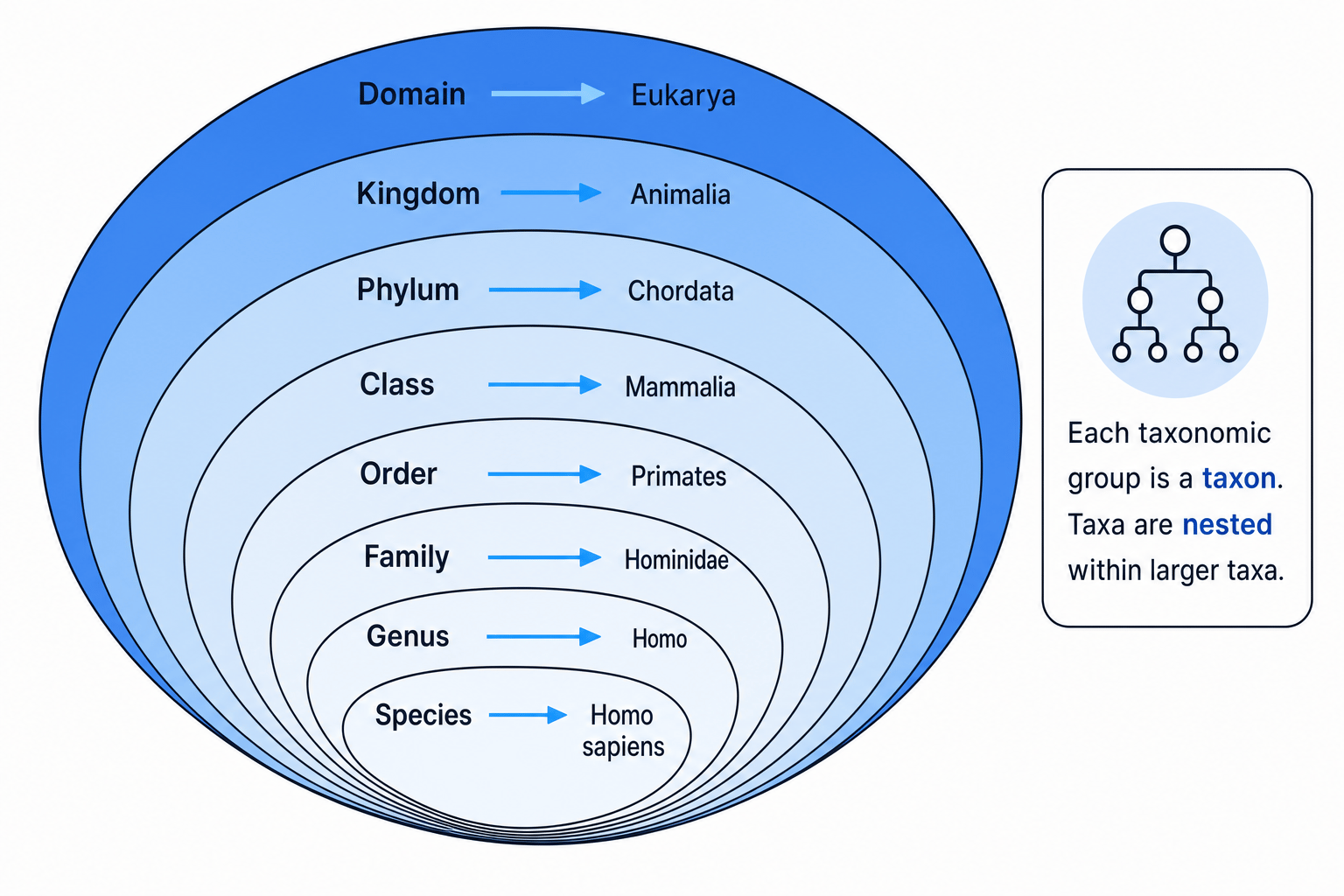
Remembering the order
A common mnemonic is: Dear King Philip Came Over For Good Soup — Domain, Kingdom, Phylum, Class, Order, Family, Genus, Species.
The smaller the taxon two organisms share, the more closely related they usually are. For example, two organisms in the same genus are generally more closely related than two organisms only in the same family.
Comparing taxonomic relatedness
Three cat species are classified as follows:
- Lion: genus Panthera, family Felidae
- Leopard: genus Panthera, family Felidae
- Domestic cat: genus Felis, family Felidae
Which two are most closely related?
- Compare the most specific taxon shared by each pair.
- Lion and leopard share the same genus, Panthera.
- Lion and domestic cat share only the same family, Felidae, but not the same genus.
- Leopard and domestic cat also share only the same family, Felidae.
- Because genus is a smaller, more specific taxon than family, lion and leopard are the most closely related pair.
Binomial naming
Each species is given a universal two-part scientific name called a binomial.
Binomial name
A binomial is the two-part scientific name of a species. It consists of the genus name followed by the species name, for example Homo sapiens.
The formatting matters:
- The genus starts with a capital letter: Homo
- The species name starts with a lower-case letter: sapiens
- The full binomial is written in italics when typed: Homo sapiens
- If handwritten, underline each part separately
Binomial names are useful because common names vary between languages and regions, but the binomial is recognised internationally.
Writing only the species part
Do not write just sapiens as the species name. The full binomial is Homo sapiens. The second word is not unique enough on its own.
Molecular evidence and evolutionary relationships
Older classification systems relied heavily on visible features, such as body shape, anatomy, and behaviour. These are still useful, but they can sometimes be misleading.
Modern classification is improved by evidence from immunology and genome sequencing.
Immunology
Immunology is the study of the immune system. In classification, it can be used to compare proteins between species.
An antibody is a protein made by the immune system that binds to a specific molecule called an antigen. If antibodies made against proteins from one species bind strongly to proteins from another species, this suggests their proteins are similar.
Similar proteins usually mean similar genes, which suggests a more recent common ancestor.
Genome sequencing
A genome is the complete DNA content of an organism. Genome sequencing means determining the order of bases in DNA.
Species with more similar DNA sequences are usually more closely related because fewer changes have accumulated since they shared a common ancestor.
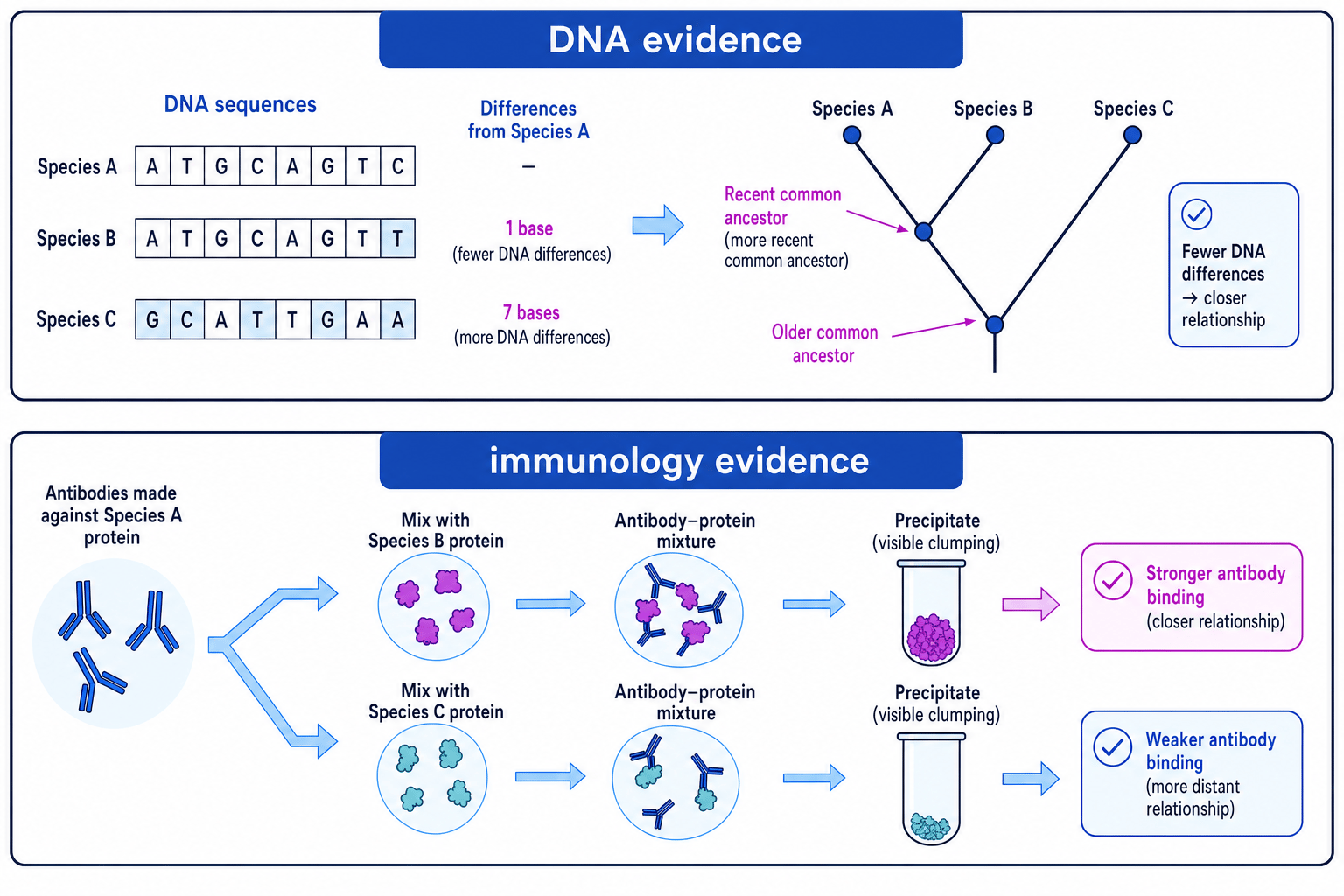
Using DNA differences to infer relatedness
A short gene sequence is compared in three species. Compared with species A, species B has 2 base differences and species C has 9 base differences. Which species is more closely related to species A?
- Use the number of DNA base differences as evidence for evolutionary distance.
- Species B has fewer differences from species A than species C does.
- Fewer DNA differences suggest less time since the two species shared a common ancestor.
- Therefore, species B is more closely related to species A than species C is.
Why molecular evidence matters
Advances in immunology and genome sequencing help clarify evolutionary relationships because they compare molecules inherited from common ancestors, not just visible features.
Assuming appearance is enough
Similar-looking organisms are not always closely related. Classification should use evidence of evolutionary origin, especially DNA and protein evidence where available.
What you do and do not need to recall
You need to know the taxonomic hierarchy from domain to species, the binomial naming system, and the idea that phylogenetic classification reflects evolutionary relationships.
You do not need to recall details of different taxonomic systems, such as the three-domain system or five-kingdom system. You may see them mentioned, but the key AQA focus here is the hierarchy and the principles behind classification.
In the exam
- If asked to define a species, include both parts: organisms can produce offspring, and those offspring are fertile.
- If asked about courtship, link it to species recognition and successful mating, not just attraction.
- If comparing relatedness, look for the most specific shared taxon or the fewest DNA/protein differences.
- Write binomial names carefully: capitalised genus, lower-case species name, and italics or underlining.
Check yourself
- Why does producing sterile offspring mean two organisms are not the same species?
- How does courtship behaviour reduce the chance of mating with the wrong species?
- Which taxon is more specific: family or genus?
