

What you'll learn
- What genetic diversity means and why it is essential for natural selection.
- How mutation, selection and inheritance change allele frequencies over generations.
- The difference between directional selection and stabilising selection.
- How Required practical 6 tests the effect of antimicrobial substances on microbial growth.
The starting point: genes, alleles and populations
A gene is a length of DNA that codes for a polypeptide or functional RNA. An allele is a version of a gene. For example, different alleles of the same gene may produce slightly different forms of a protein.
A population is a group of organisms of the same species living in the same area at the same time. A species is a group of organisms that can breed together to produce fertile offspring.
Genetic diversity
Genetic diversity is the number of different alleles of genes in a population. A population with many different alleles has high genetic diversity.
Your genotype is the alleles an organism has. Your phenotype is the observable characteristics, produced by the genotype and the environment.
Why diversity matters
Natural selection can only act if there is variation. If every individual in a population has exactly the same alleles, there is no inherited difference for selection to favour.
Mutation: the source of new alleles
A mutation is a change in the DNA base sequence. Mutations occur randomly and can create new alleles of a gene.
Many mutations are harmful or have no effect. However, in a particular environment, a new allele may give its possessor an advantage. For example, an allele that gives a bacterium resistance to an antibiotic may be very useful when that antibiotic is present.
A selection pressure is an environmental factor that affects which organisms survive and reproduce. Examples include antibiotics, predators, disease, competition, temperature and water availability.
Random mutation, non-random selection
Antibiotics do not “make bacteria mutate because they need to”. Mutations occur randomly. The antibiotic then selects bacteria that already have, or newly gain, a resistance allele.
Natural selection changes allele frequencies
Natural selection is the process where individuals with advantageous alleles are more likely to survive, reproduce and pass those alleles to the next generation.
Reproductive success means producing offspring that survive and can also reproduce. Allele frequency is how common a particular allele is in a population.
Evolution
Evolution is a change in allele frequencies in a population over generations.
A typical natural selection sequence is:
- A random mutation produces a new allele.
- In a certain environment, the allele gives an advantageous phenotype.
- Individuals with this phenotype have higher survival and reproductive success.
- The advantageous allele is inherited by offspring.
- Over many generations, the allele increases in frequency in the population.
For allele frequency:
allele frequency=number of copies of the alleletotal number of allele copies in the population\text{allele frequency} = \frac{\text{number of copies of the allele}}{\text{total number of allele copies in the population}}allele frequency=total number of allele copies in the populationnumber of copies of the alleleTracking an advantageous allele
A bacterial population is exposed to an antibiotic. Before treatment, 20 bacteria are resistant and 980 are not resistant. After treatment, 720 bacteria are resistant and 80 are not resistant.
-
Before treatment, the total number of bacteria is 1000, so the frequency of resistant bacteria is 201000=0.020\frac{20}{1000} = 0.020100020=0.020, or 2.0%.
-
After treatment, the total number of bacteria is 800, so the frequency of resistant bacteria is 720800=0.900\frac{720}{800} = 0.900800720=0.900, or 90.0%.
-
The resistant form has increased from 2.0% to 90.0%, so the antibiotic acted as a selection pressure. Resistant bacteria survived and reproduced, passing on the resistance allele.
Populations evolve, not individuals
An individual organism does not evolve during its lifetime. Natural selection changes the allele frequencies of a population over many generations.
Directional selection and stabilising selection
Directional selection
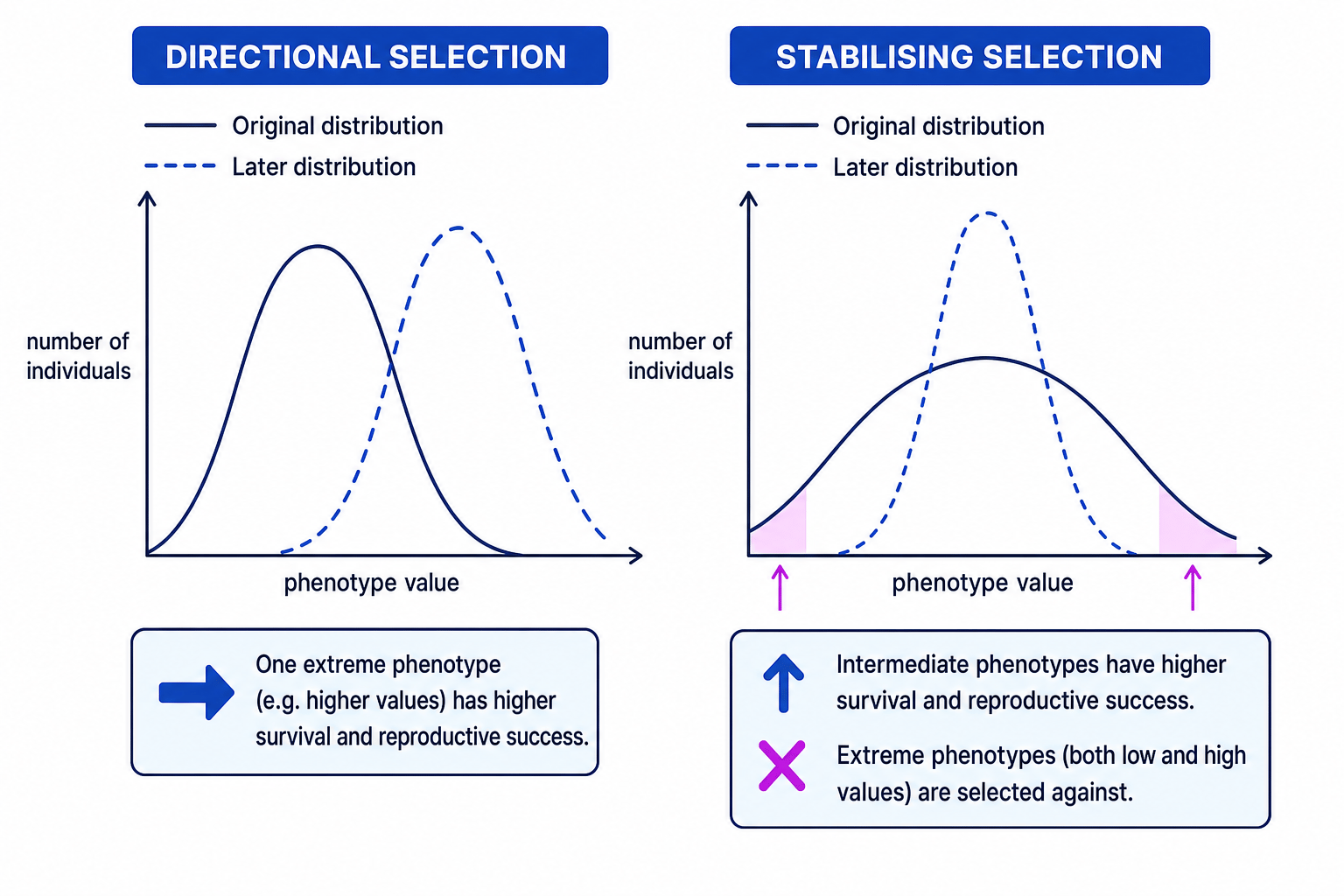
Directional selection occurs when individuals with one extreme phenotype are more likely to survive and reproduce. The mean phenotype shifts in one direction.
The classic example is antibiotic resistance in bacteria. An antibiotic is a substance that kills bacteria or inhibits their growth. When an antibiotic is used, resistant bacteria are more likely to survive. They reproduce by binary fission, a form of asexual cell division, so the resistance allele becomes more common.
Stabilising selection
Stabilising selection occurs when individuals with intermediate phenotypes are more likely to survive and reproduce. Extremes are selected against, so variation around the mean decreases.
A classic example is human birth weight. Babies with very low birth weights are more likely to have underdeveloped organs. Babies with very high birth weights are more likely to cause birth complications. Intermediate birth weights tend to have the highest survival.
Identifying the type of selection
A population of insects contains small, medium and large individuals. After a pesticide is used for many generations, the average body size increases because larger insects are more likely to survive.
-
Compare the population before and after selection: the mean body size has shifted towards larger insects.
-
Decide which phenotype had the advantage: one extreme, larger body size, had higher survival and reproductive success.
-
Conclude that this is directional selection, because the distribution has moved in one direction rather than becoming narrower around the same mean.
Using logarithmic scales for bacterial numbers
Bacteria can reproduce very quickly, so population sizes may range from hundreds to millions or billions. A logarithmic scale is useful when values differ by powers of 10. Equal distances on the axis represent equal multiplication, not equal addition.
This is especially relevant when interpreting data from bacterial cultures.
Using a logarithmic scale for bacterial numbers
A bacterial culture increases from 1.0×1041.0 \times 10^41.0×10⁴ bacteria to 1.0×1081.0 \times 10^81.0×10⁸ bacteria.
-
Convert each value to its power of 10: log10(1.0×10⁴)=4\log_{10}(1.0 \times 10^4) = 4log10(1.0×10⁴)=4 and log10(1.0×10⁸)=8\log_{10}(1.0 \times 10^8) = 8log10(1.0×10⁸)=8.
-
On a log₁₀ scale, the points would be plotted at 4 and 8, not at their raw bacterial counts.
-
The difference is 4 log units, so the population has increased by 10410^4104, meaning it is 10 000 times larger.
Adaptations: becoming better suited to the environment
An adaptation is an inherited feature that increases an organism’s chance of survival and reproduction in its environment.
Adaptations may be:
- Anatomical — structural features, such as a thick waxy cuticle on desert plant leaves.
- Physiological — internal chemical or metabolic features, such as producing very concentrated urine to reduce water loss.
- Behavioural — actions, such as animals migrating or being active at night to avoid heat.
Natural selection produces populations that are better adapted to their environment because advantageous alleles become more common over generations.
Classifying adaptations
A desert mammal has large ears, produces very concentrated urine, and hunts at night.
-
Large ears are a structural feature, so they are an anatomical adaptation.
-
Concentrated urine depends on kidney function and water balance, so it is a physiological adaptation.
-
Hunting at night is an action that reduces heat stress and water loss, so it is a behavioural adaptation.
Required practical 6: antimicrobial substances and microbial growth
An antimicrobial substance kills microorganisms or inhibits their growth. In this practical, you test how well different antimicrobial substances prevent bacterial growth on agar.
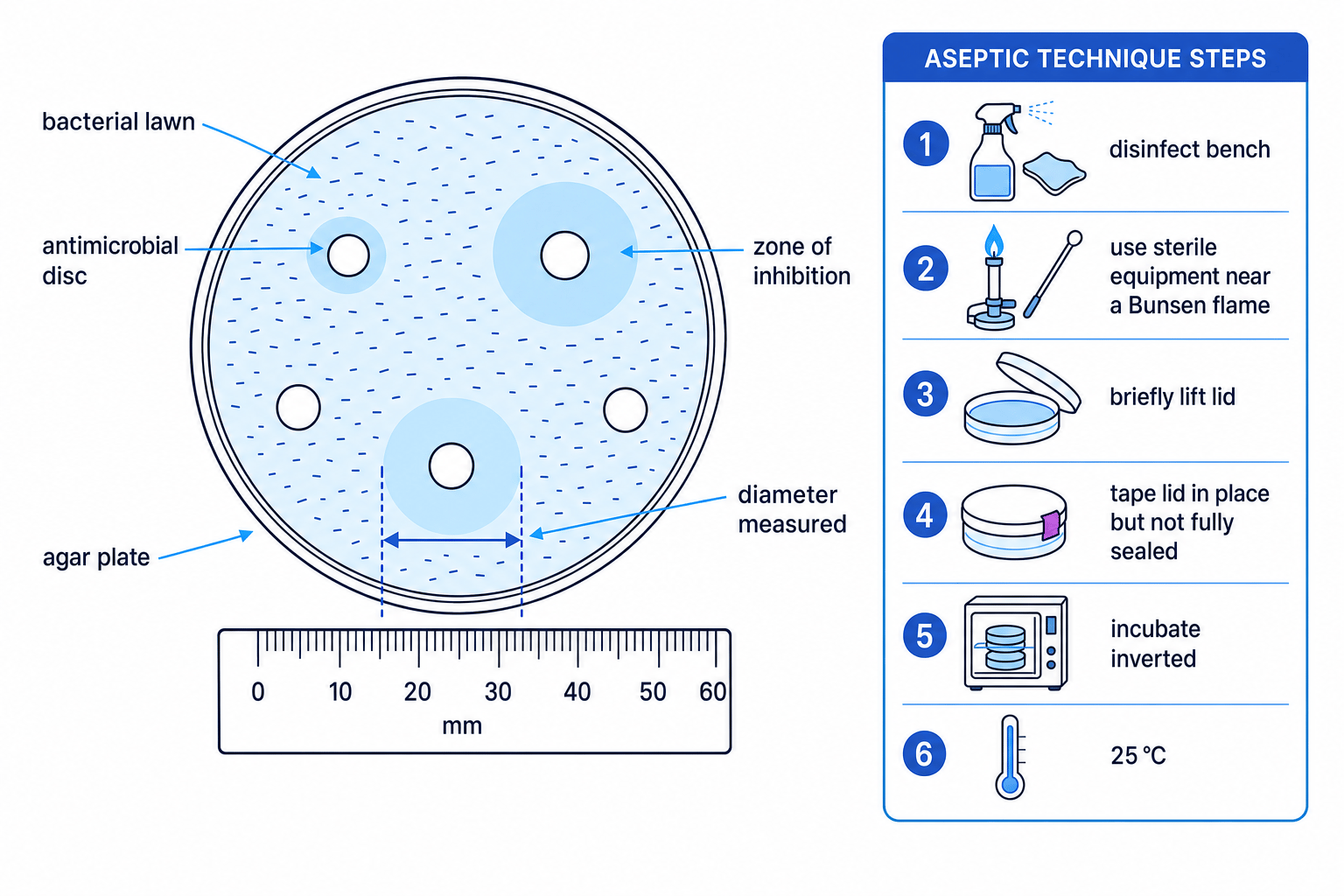
Aseptic technique means using methods that prevent contamination by unwanted microorganisms. This protects the culture, protects you, and makes the results more valid.
A typical method is:
- Disinfect the bench and work near a Bunsen flame.
- Use sterile equipment to spread bacteria evenly over sterile agar, forming a bacterial lawn.
- Place sterile paper discs soaked in antimicrobial substances onto the agar.
- Include a control disc, such as one soaked in sterile water or solvent only.
- Tape the lid but do not seal it fully.
- Incubate the plate inverted at 25 °C.
- Measure the diameter of each zone of inhibition, the clear area where bacteria have not grown.
Required practical 6
A larger zone of inhibition suggests the antimicrobial substance is more effective, but only if other variables are controlled and the results are repeated.
Important control variables include the bacterial species, volume of bacterial culture, agar depth, concentration of antimicrobial substance, disc size, incubation temperature and incubation time.
Do not seal Petri dishes completely
Petri dishes are taped but not fully sealed because a sealed plate may encourage the growth of harmful anaerobic bacteria. Incubating at 25 °C also reduces the chance of growing human pathogens.
You may be asked to calculate the area of a zone of inhibition. If the zone is circular:
A=πr2A = \pi r^2A=πr2Calculating a zone of inhibition
A clear zone has a diameter of 18 mm. Calculate its area.
-
Convert diameter to radius: r=18 mm2=9.0 mmr = \frac{18\ \text{mm}}{2} = 9.0\ \text{mm}r=218 mm=9.0 mm.
-
Substitute into the circle area formula: A=π(9.0 mm)2A = \pi(9.0\ \text{mm})^2A=π(9.0 mm)2.
-
Calculate the area: A=254 mm2A = 254\ \text{mm}^2A=254 mm2 to three significant figures.
Comparing diameters as if they are areas
A zone with twice the diameter does not have twice the area. Area depends on r2r^2r2, so larger zones can represent much larger differences in antimicrobial effect.
In the exam
-
For selection questions, always link the advantageous allele to survival, reproductive success, inheritance and increased allele frequency.
-
For unfamiliar examples, identify the selection pressure first, then state which phenotype is favoured and how the population changes over generations.
-
For practical questions, mention aseptic technique, a suitable control, controlled variables, repeats, and measuring zones of inhibition in millimetres or square millimetres.
Check yourself
- Why is genetic diversity necessary for natural selection to occur?
- How does directional selection differ from stabilising selection?
- In Required practical 6, why is a control disc needed?
