

What you'll learn
- Why large plants need specialised transport tissues.
- How xylem moves water using the cohesion-tension theory.
- How phloem moves organic substances using the mass flow hypothesis.
- How potometers, tracer experiments and ringing experiments provide evidence.
Why plants need mass transport
Small organisms can often rely on diffusion alone, but flowering plants are large and have many cells far from exchange surfaces. Leaves need water for photosynthesis and cooling; roots need sugars made in the leaves.
Mass transport
Mass transport is the movement of substances in a fluid, over a distance, by bulk flow. In plants, the main transport tissues are xylem and phloem.
Plant transport tissues are arranged in vascular bundles. Xylem and phloem are usually found close together, but they carry different materials and use different mechanisms.
Xylem: transporting water
Xylem
Xylem is plant tissue that transports water, and also dissolved mineral ions, mainly from the roots to the stem and leaves.
Xylem vessels are made from dead cells joined end to end. They have:
- No cytoplasm, so there is less resistance to water flow.
- No end walls, forming long hollow tubes.
- Lignified walls, meaning the walls contain lignin, a waterproof strengthening substance.
- Pits, which are unlignified regions where water can move sideways between vessels.
The lignin is very important because xylem is often under tension. Without strong walls, the vessels could collapse inwards.
Transpiration and the water pathway
Transpiration
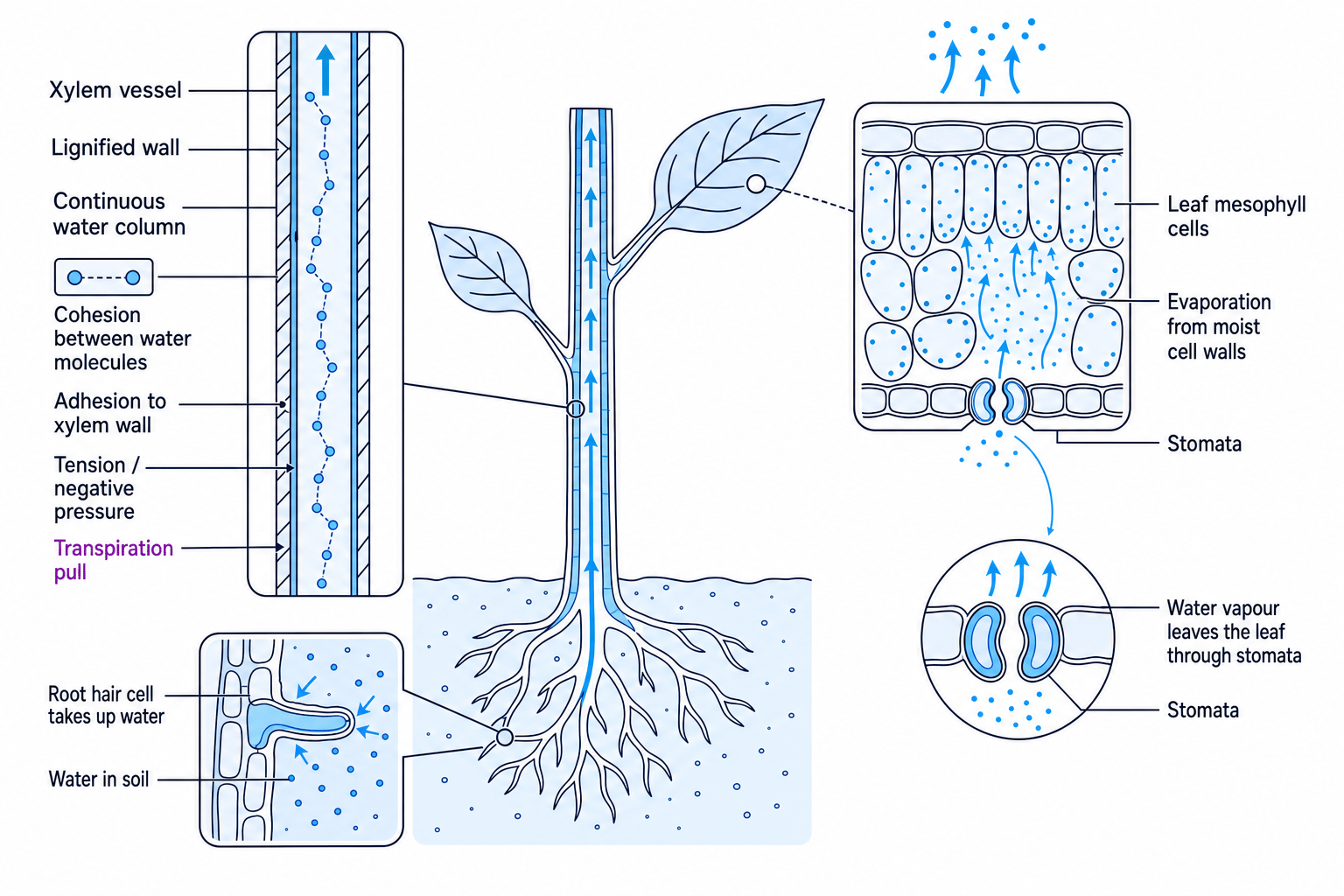
Transpiration is the loss of water vapour from the aerial parts of a plant, mainly through stomata in the leaves.
Water follows this overall pathway:
- Water enters root hair cells from the soil.
- Water moves across the root into the xylem.
- Water travels up the xylem in the stem.
- Water moves into leaf mesophyll cells.
- Water evaporates from moist mesophyll cell walls.
- Water vapour diffuses out through stomata.
The continuous movement of water through the plant is called the transpiration stream.
Cohesion-tension theory
Cohesion-tension theory
The cohesion-tension theory explains water movement in xylem: evaporation from leaves creates tension that pulls a continuous column of water upwards through xylem vessels.
The idea builds in stages.
1. Evaporation lowers water potential in the leaf
Water potential is the tendency of water to move. Water moves from a higher water potential to a lower water potential. It is measured in kilopascals, kPa.
When water evaporates from mesophyll cell walls, those cells lose water. This lowers their water potential, so water moves into them from nearby xylem.
2. Water is pulled out of the xylem
As water leaves the xylem in the leaf, it creates tension, which is a pulling force. Xylem pressure becomes negative compared with atmospheric pressure.
3. Cohesion keeps the water column together
Cohesion is attraction between molecules of the same substance. Water molecules cohere because of hydrogen bonding.
So when water molecules are pulled up at the top of the xylem, they pull other water molecules with them.
4. Adhesion helps water stick to the xylem walls
Adhesion is attraction between molecules of different substances. Water adheres to the xylem vessel walls, which helps resist the downward pull of gravity.
Xylem in one sentence
Water movement in xylem is passive: transpiration from the leaf creates tension, and cohesion between water molecules pulls a continuous water column upwards.
Thinking xylem uses pumps
Xylem vessels are dead, so they cannot actively pump water. The energy source is evaporation from the leaf, ultimately driven by heat energy from the environment.
Investigating transpiration with a potometer
Potometer
A potometer is apparatus used to estimate the rate of water uptake by a leafy shoot.
A potometer does not measure transpiration directly. It measures water uptake, which is usually close to water loss by transpiration because most water absorbed by a shoot is lost through leaves.
To use one well:
- Cut the shoot under water to prevent air entering the xylem.
- Assemble the apparatus so it is airtight.
- Introduce an air bubble into the capillary tube.
- Measure the distance moved by the bubble in a set time.
- Change one environmental variable, such as light intensity, temperature, wind speed or humidity.
- Keep other variables controlled and repeat readings.
Calculating water uptake rate from a potometer
A bubble moves 70 mm along a capillary tube in 600 s. The capillary radius is 0.40 mm. Calculate the volume of water taken up per second.
-
Convert measurements into SI units:
r=0.40 mm=4.0×10⁻⁴ mr = 0.40\ \text{mm} = 4.0 \times 10^{-4}\ \text{m}r=0.40 mm=4.0×10⁻⁴ m and l=70 mm=7.0×10⁻² ml = 70\ \text{mm} = 7.0 \times 10^{-2}\ \text{m}l=70 mm=7.0×10⁻² m. -
Calculate the volume of water taken up using the cylinder formula:
- Divide by time to find rate:
Potometer wording
In answers, say a potometer estimates water uptake, not “transpiration” directly. Then explain that water uptake is used as a proxy for transpiration rate.
Phloem: transporting organic substances
Phloem
Phloem is plant tissue that transports organic substances, mainly sucrose and amino acids, around the plant.
The movement of organic substances in phloem is called translocation.
Phloem contains living cells:
- Sieve tube elements form tubes for phloem sap to flow through.
- Sieve plates are perforated end walls between sieve tube elements.
- Companion cells carry out many metabolic functions for sieve tube elements.
Source and sink
A source is a region that releases sucrose into the phloem, such as a photosynthesising leaf. A sink is a region that removes sucrose from the phloem, such as a root, fruit, growing bud or storage organ.
A plant organ can change role. For example, a potato tuber may be a sink while storing starch, but later become a source when it releases sugars during growth.
Mass flow hypothesis
Mass flow hypothesis
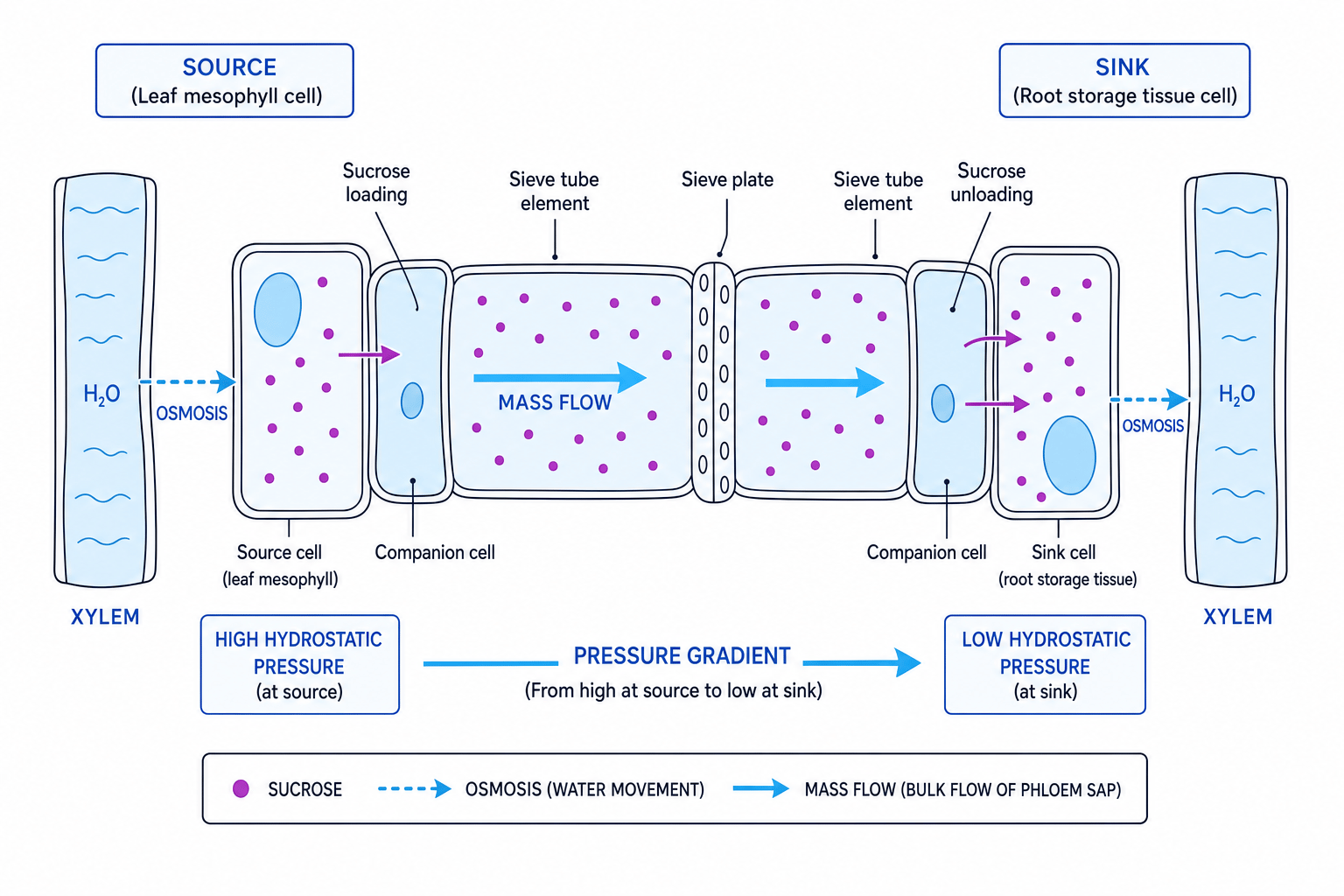
The mass flow hypothesis explains translocation as bulk flow of phloem sap from a source to a sink, down a hydrostatic pressure gradient.
Hydrostatic pressure is the pressure exerted by a fluid.
Here is the sequence:
- Sucrose is actively loaded into sieve tubes at the source.
- This lowers the water potential inside the phloem.
- Water enters the phloem from nearby xylem by osmosis.
- This increases hydrostatic pressure at the source.
- At the sink, sucrose is removed from the phloem.
- Water potential in the phloem rises, so water moves back into xylem.
- Hydrostatic pressure is lower at the sink.
- Phloem sap moves by mass flow from high pressure to low pressure.
Phloem in one sentence
Phloem translocation needs active loading and unloading of sucrose, but the movement of sap through sieve tubes is explained as pressure-driven mass flow.
Saying phloem only moves downwards
Phloem can move substances upwards or downwards in the plant, depending on the positions of sources and sinks. However, flow in one sieve tube is usually in one direction at a time.
Evidence from tracers and ringing experiments
Scientists use evidence to test whether phloem really transports organic substances.
Tracer
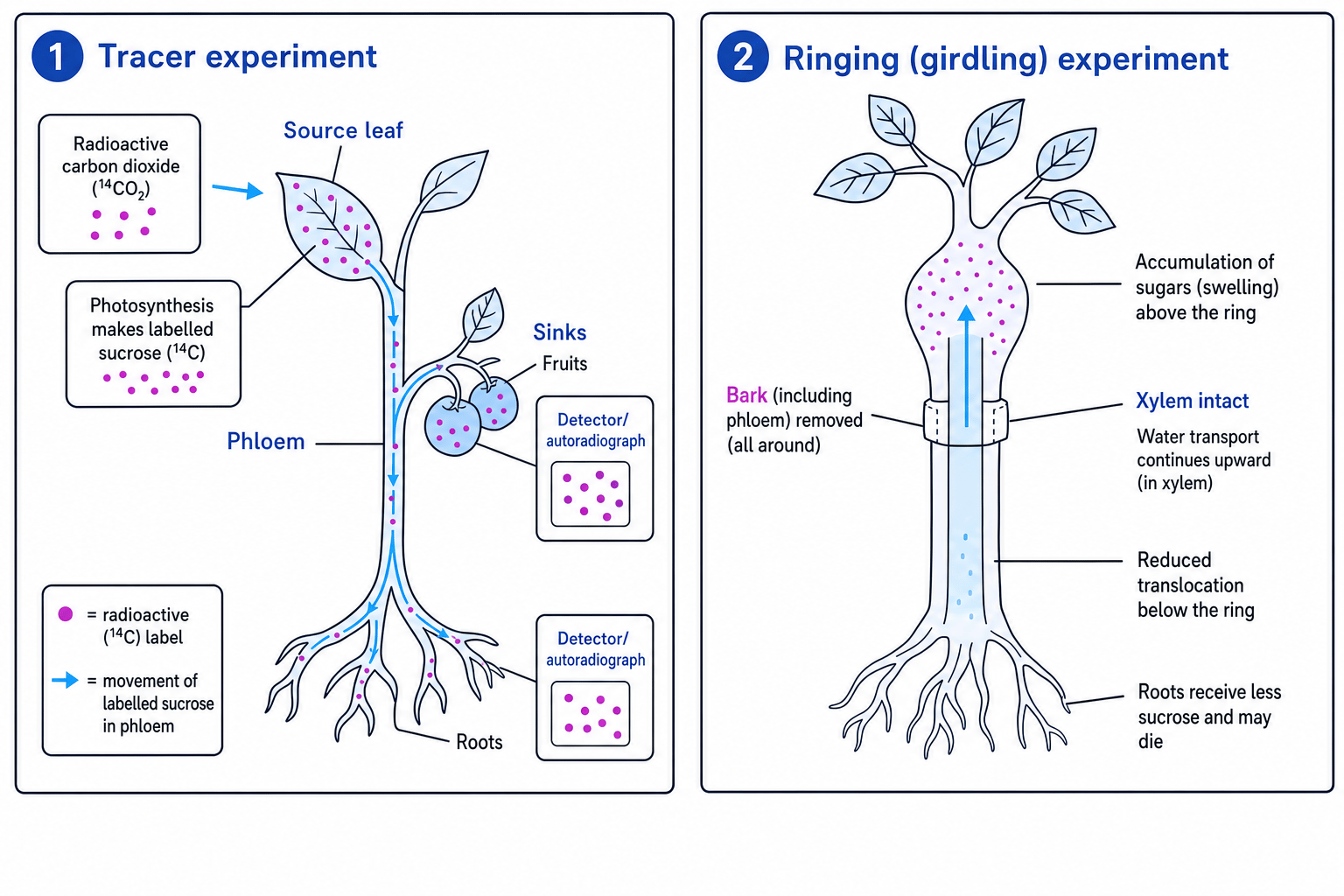
A tracer is a labelled substance that can be followed as it moves through an organism. In plant transport, radioactive carbon-14 can be supplied as carbon dioxide and then incorporated into labelled sucrose during photosynthesis.
In a tracer experiment, labelled sucrose is later detected in phloem and in sink tissues such as roots or fruits. This supports the idea that products of photosynthesis are transported in phloem from sources to sinks.
Ringing experiment
A ringing experiment, also called girdling, involves removing a complete ring of bark from a woody stem. This removes phloem but leaves xylem mostly intact.
If phloem is removed, sugars accumulate above the ring, causing swelling. Tissues below the ring receive less sucrose and may eventually die. Water can still move upwards through the xylem.
Interpreting a ringing experiment
A woody stem has a complete ring of bark removed. After several weeks, tissue above the ring is swollen, roots below the ring grow poorly, but leaves remain supplied with water.
-
Identify which transport tissue was removed: bark contains phloem, so removing the bark interrupts translocation of organic substances.
-
Link the swelling to movement direction: sugars made in leaves cannot pass the ring, so they accumulate above it, supporting movement through phloem from source leaves towards sinks below.
-
Use the water evidence to separate xylem from phloem: leaves still receive water because xylem remains intact, so the effect is not simply due to stopping all transport.
Correlation, causation and evaluating evidence
A correlation is when two variables change together. A causal relationship is when one variable directly produces a change in another.
Tracer experiments show a correlation between labelled sucrose and phloem tissue, but they are stronger when the label is tracked over time from source to sink.
Ringing experiments provide more causal evidence because removing phloem stops sugar transport below the ring. However, you should still evaluate limitations: cutting the stem may damage tissues, affect hormones, or trigger wound responses.
Evidence language
Use cautious wording: “This supports the mass flow hypothesis” is better than “This proves it”. Biological evidence is usually evaluated as stronger or weaker, not absolute proof.
Evidence for and against mass flow
Evidence supporting mass flow includes:
- Phloem sap contains high concentrations of sucrose.
- Tracer experiments show organic substances moving from sources to sinks.
- Ringing experiments show sugar accumulation when phloem is removed.
- Sucrose loading at sources and unloading at sinks can create pressure differences.
Possible limitations or challenges include:
- Living companion cells are needed, so translocation is not entirely passive.
- Sieve plates may create resistance to flow.
- Different substances in phloem may not always move at exactly the same rate.
- Experimental procedures may damage tissues and alter normal transport.
In the exam
- For xylem questions, link transpiration, tension, cohesion, and continuous water column in a clear chain.
- For phloem questions, use the sequence: active sucrose loading → water enters by osmosis → high hydrostatic pressure → mass flow → unloading at sink.
- When evaluating evidence, separate observations from conclusions, and use phrases such as “supports”, “suggests” and “is consistent with”.
Check yourself
- Why does lignin help xylem vessels function under tension?
- How does sucrose loading at a source lead to water entering the phloem?
- What would you expect to happen below a ringed section of stem, and why?
