

Welcome to the world of biological molecules! Carbohydrates are the primary fuel source for most living organisms and play vital structural roles in cells.
What you'll learn
- How simple sugars (monosaccharides) join together to form complex carbohydrates.
- The structural differences between α\alphaα-glucose and β\betaβ-glucose.
- How the structures of starch, glycogen, and cellulose perfectly suit their functions.
- How to test for reducing sugars, non-reducing sugars, and starch in the lab.
Monosaccharides and Disaccharides
To understand carbohydrates, we first need to understand how large biological molecules are built.
Monomers and Polymers
- Monomers are the smaller, basic molecular units from which larger molecules are made.
- Polymers are large, complex molecules composed of many similar or identical monomers joined together in a repeating chain.
For carbohydrates, the monomers are called monosaccharides. Common examples include glucose, galactose, and fructose. All of these are sweet-tasting, soluble substances.
Glucose is a six-carbon sugar (a hexose) and is the main energy source in plants and animals. It has two different structural forms, known as isomers.
Isomer
Molecules with the exact same chemical formula (like C6H12O6\text{C}_6\text{H}_{12}\text{O}_6C6H12O6 for glucose) but a different physical arrangement of atoms in space.
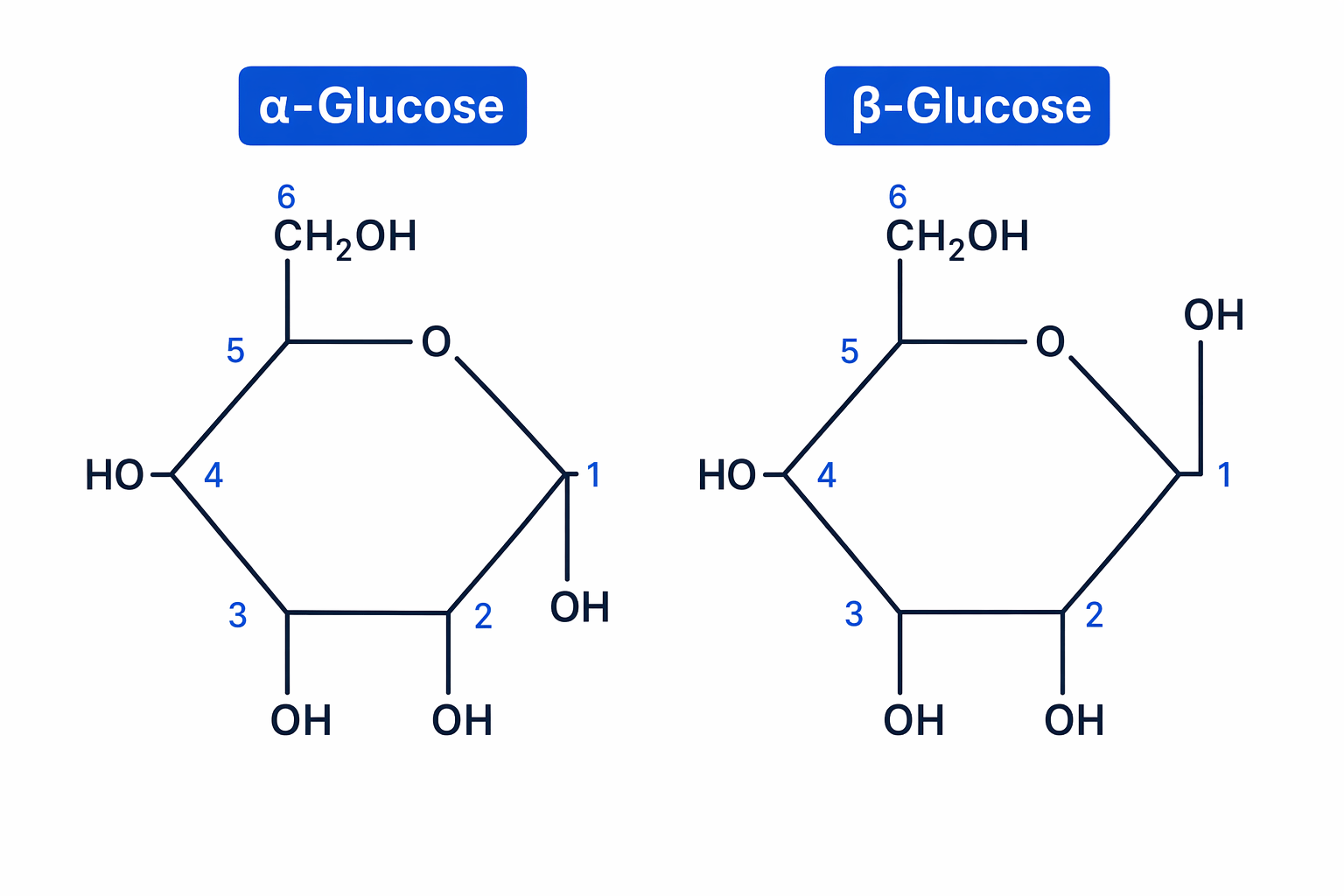
The two isomers of glucose are α\alphaα-glucose (alpha-glucose) and β\betaβ-glucose (beta-glucose). The only difference is the position of the hydroxyl (–OH) group attached to carbon 1.
Remembering glucose isomers
Look at carbon 1 on the far right of the ring. If the –OH group is pointing down, it's α\alphaα-glucose. If the –OH group is pointing up, it's β\betaβ-glucose.
Condensation and Hydrolysis
When two monosaccharides join together, they form a disaccharide. This happens via a condensation reaction.
A condensation reaction joins two molecules together with the formation of a chemical bond and involves the elimination of a molecule of water. In carbohydrates, the specific bond formed is called a glycosidic bond.
If you want to break a disaccharide back into two monosaccharides, you use a hydrolysis reaction. This breaks the glycosidic bond by adding a molecule of water.
Common Disaccharides
You need to know three specific disaccharides and the monomers they are made from:
- Maltose is formed by the condensation of two glucose molecules.
- Sucrose is formed by the condensation of a glucose molecule and a fructose molecule.
- Lactose is formed by the condensation of a glucose molecule and a galactose molecule.
Polysaccharides
When many monosaccharides join together via condensation reactions, they form a polysaccharide. Three essential polysaccharides you must know are starch, glycogen, and cellulose.
Starch
Starch is the main energy storage material in plants. It is a polymer of α\alphaα-glucose and is actually a mixture of two different polysaccharides:
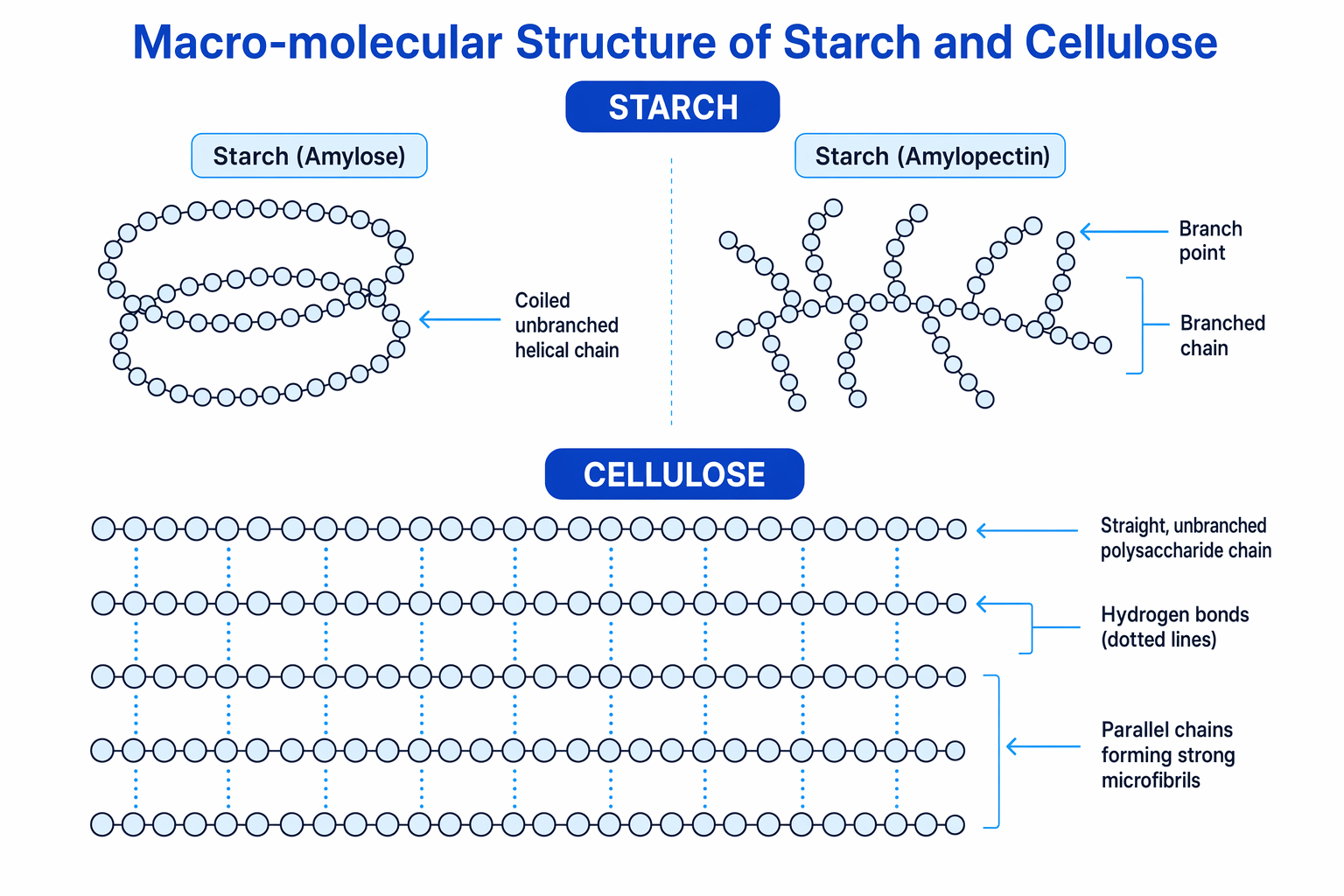
- Amylose: A long, unbranched chain of α\alphaα-glucose. The angles of the glycosidic bonds give it a coiled, spring-like structure. This makes it highly compact, so you can fit a lot of energy into a small space.
- Amylopectin: A long, branched chain of α\alphaα-glucose. The side branches allow enzymes to get at the glycosidic bonds easily, so glucose can be released rapidly when the plant needs energy.
Glycogen
Glycogen is the main energy storage material in animals. Like starch, it is a polymer of α\alphaα-glucose, but it has many more branches than amylopectin.
Because animals are highly mobile and have a higher metabolic rate than plants, they need glucose released even faster. The highly branched structure of glycogen means enzymes can rapidly hydrolyse the glycosidic bonds at the ends of all those branches simultaneously. It is also highly compact, making it excellent for storage in the liver and muscles.
Why store starch and glycogen?
Both starch and glycogen are large and insoluble in water. This is incredibly important because it means they do not affect the water potential of the cell, so water is not drawn into the cells by osmosis.
Cellulose
Cellulose is the major component of cell walls in plants. Unlike starch and glycogen, it is a polymer of β\betaβ-glucose.
When β\betaβ-glucose molecules bond, each alternate molecule must be inverted (flipped upside down) for the hydroxyl groups to align properly. This creates long, straight, unbranched chains rather than coiled structures.
These straight chains run parallel to one another, allowing many weak hydrogen bonds to form between adjacent chains. While individual hydrogen bonds are weak, thousands of them together provide massive structural strength. These cross-linked chains group together to form strong fibres called microfibrils, which provide rigidity to the plant cell wall and prevent the cell from bursting under osmotic pressure.
Biochemical Tests
You need to know how to practically identify carbohydrates in the lab using qualitative biochemical tests.
Testing for Reducing Sugars (Benedict's Test)
All monosaccharides and some disaccharides (like maltose and lactose) are reducing sugars.
- Add Benedict's reagent (which is blue) to the liquid sample in a test tube.
- Heat the mixture in a water bath that has been brought to a boil.
- If the test is positive, a coloured precipitate will form. The colour change moves from blue →\to→ green →\to→ yellow →\to→ orange →\to→ brick-red, depending on the concentration of reducing sugar.
Testing for Non-Reducing Sugars
If the result of the reducing sugar test is negative (stays blue), a non-reducing sugar like sucrose might be present.
- Take a fresh sample and add dilute hydrochloric acid.
- Carefully heat it in a boiling water bath. The acid will hydrolyse the glycosidic bonds, breaking the sugar down into its monosaccharides (which are reducing sugars).
- Cool the tube and neutralise it by adding sodium hydrogencarbonate.
- Re-run the standard Benedict's test. If the solution now turns red, a non-reducing sugar was originally present.
Forgetting to neutralise
Benedict's reagent requires alkaline conditions to work properly. If you forget to neutralise the acid with sodium hydrogencarbonate before adding the Benedict's reagent, the test will fail even if sugars are present!
Testing for Starch (Iodine Test)
To test for the presence of starch:
- Add a few drops of iodine dissolved in potassium iodide solution to the test sample.
- If starch is present, the sample changes from a browny-orange colour to a dark blue-black colour.
Determining Unknown Concentrations
While Benedict's test gives a rough qualitative idea of concentration (e.g. green vs red), you can make it quantitative by using a colorimeter. A colorimeter measures how much light passes through the solution after the precipitate is removed.
To find the concentration of an unknown sample, you first need to test a range of known glucose concentrations, measure their absorbance, and plot a calibration curve. You can create these known concentrations using a dilution series.
Calculating a simple dilution
You are provided with a stock solution of 1.0 mol dm−31.0 \text{ mol dm}^{-3}1.0 mol dm−3 glucose. You need to produce 20 cm320 \text{ cm}^320 cm3 of a 0.2 mol dm−30.2 \text{ mol dm}^{-3}0.2 mol dm−3 glucose solution to use for a calibration curve.
- Set up the concentration-volume formula, where C1C_1C1 and V1V_1V1 are the stock concentration and unknown volume, and C2C_2C2 and V2V_2V2 are the target concentration and target volume:
- Substitute your known values into the equation:
- Rearrange and solve for V1V_1V1:
- Calculate the volume of distilled water needed to reach the final target volume of 20 cm320 \text{ cm}^320 cm3:
- You would mix 4 cm34 \text{ cm}^34 cm3 of the stock glucose solution with 16 cm316 \text{ cm}^316 cm3 of distilled water.
Chromatography
You can also identify unknown monosaccharides using thin-layer or paper chromatography.
- Spot the unknown mixture alongside known standard sugar solutions on a pencil line drawn on the chromatography paper.
- Suspend the paper in a solvent. As the solvent moves up the paper, the different sugars travel at different speeds depending on their solubility.
- Because sugars are colourless, the dried chromatogram is sprayed with a reagent and heated to make the spots visible.
- You can then identify the unknown sugars by comparing the final positions against the known standard spots.
In the exam
- When asked how the structure of a polysaccharide relates to its function, explicitly link the structural property to the functional outcome (e.g. "Glycogen is highly branched, providing a large surface area for enzymes to rapidly hydrolyse it into glucose for respiration").
- Don't just say starch is "insoluble" — complete the thought by stating "so it does not affect the water potential of the cell".
- Remember that sucrose is the classic non-reducing sugar. If a question mentions sucrose, expect to have to describe the two-step boiling process involving acid hydrolysis followed by neutralisation.
Check yourself
- What are the three common monosaccharides, and which disaccharides do they form when joined with glucose?
- How does the structure of β\betaβ-glucose differ from α\alphaα-glucose?
- Which bonds connect the parallel chains of cellulose together to form microfibrils?
- Describe the exact steps taken to perform a Benedict's test for a non-reducing sugar.
