Chlamydomonas reinhardtii is a species of single-celled green alga found in freshwater environments. Heavy-metal-tolerant strains, which can survive high concentrations of copper ions, have become dominant in lakes contaminated by mining runoff.
Explain how the contamination of lakes with copper runoff has led to copper-tolerant strains of C. reinhardtii becoming the dominant population in these lakes.
Scientists suggested that environmental factors other than copper contamination led to the dominance of the copper-tolerant strain. One suggested factor is increased phosphate levels from agricultural runoff entering the lakes.
Phosphate is an inorganic ion containing phosphorus. Name another inorganic ion containing nitrogen that is absorbed by algal cells to produce proteins.
Describe how the scientists could use aseptic techniques to transfer 0.4 cm30.4\text{ cm}^30.4 cm3 of C. reinhardtii in liquid culture from a flask onto a sterile agar plate.
Scientists investigated the effect of phosphate on the growth rate of C. reinhardtii. They grew populations of wild-type and copper-tolerant strains on separate agar plates with:
They measured the growth rate of the algae. Figure 1 shows the scientists' results.
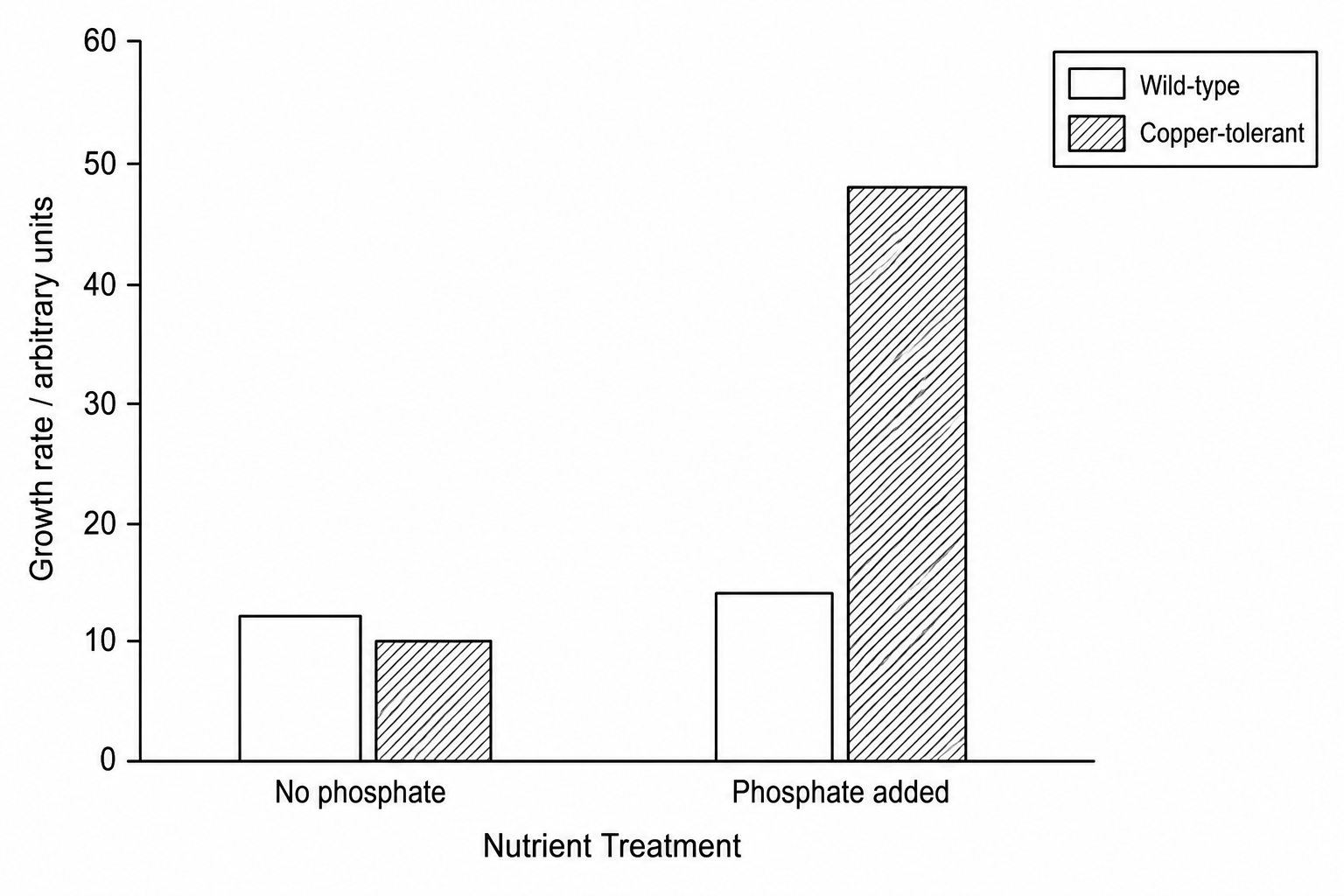
Use Figure 1 to evaluate whether increased phosphate levels in the water could be a factor in the dominance of copper-tolerant C. reinhardtii populations in these lakes.
Practise AQA A Level Biology Evolution may lead to speciation (A-level only) with exam-style questions for A Level Biology. 9 questions, matched to the AQA A Level Biology (7402) specification and written in Paper 1, Paper 2 and Paper 3 style. Every question includes a full worked solution and mark scheme, so you can see where marks are awarded rather than just whether you got the answer right.

