

What you'll learn
- What digestion means: breaking large food molecules into smaller soluble molecules.
- How carbohydrates, proteins and lipids are digested by specific enzymes.
- How cells lining the ileum absorb sugars, amino acids and lipid digestion products.
- How practical investigations can measure rates of digestive enzyme action.
The big picture: why digestion is needed
Food contains large biological molecules: molecules made by living organisms, such as carbohydrates, proteins and lipids. Many are too large and too insoluble to pass through cell-surface membranes.
Digestion happens in the alimentary canal, the tube running from the mouth to the anus. It is mostly extracellular, meaning enzymes are released into the gut lumen and act outside cells.
Digestion and hydrolysis
Digestion is the breakdown of large, insoluble food molecules into smaller, soluble molecules. Hydrolysis is the breaking of a chemical bond by adding water.
The products of digestion must be small enough to cross membranes and enter the blood or lymph. Absorption is the movement of these digested molecules from the gut lumen into cells lining the gut, then into transport systems.
Why digestion matters
Large molecules are hydrolysed into small molecules so they can be absorbed across cell membranes and used in metabolism.
The ileum: where most absorption happens
The ileum is the final part of the small intestine. Its lining is adapted for absorption by having:
- Villi: finger-like projections that increase surface area.
- Microvilli: tiny folds on epithelial cell membranes, forming the “brush border”.
- A thin epithelial layer, giving a short diffusion distance.
- Many capillaries to carry away glucose and amino acids.
- Lacteals, which are lymph vessels that carry absorbed lipid products away.
Carbohydrate digestion
A carbohydrate is a molecule made from sugars. A monosaccharide is a single sugar unit, such as glucose. A disaccharide contains two sugar units, such as maltose. A polysaccharide contains many sugar units, such as starch.
Carbohydrate digestion happens in two main stages:
| Stage | Enzyme | Where it acts | Product |
|---|---|---|---|
| Starch digestion | Amylase | Mouth and small intestine | Maltose |
| Disaccharide digestion | Membrane-bound disaccharidases | Brush border of ileum epithelial cells | Monosaccharides |
Amylase hydrolyses glycosidic bonds in starch to form maltose. Then disaccharidases hydrolyse disaccharides into monosaccharides. For example, maltase hydrolyses maltose into two glucose molecules.
Amylase does not finish the job
Amylase breaks starch into maltose, not directly into all the final monosaccharides. The final step is carried out by membrane-bound disaccharidases on the ileum epithelial cells.
Protein digestion
A protein is a polymer made from amino acids joined by peptide bonds. A protease is an enzyme that hydrolyses peptide bonds.
Protein digestion uses several types of protease:
- Endopeptidases hydrolyse peptide bonds within a polypeptide chain, producing shorter peptides.
- Exopeptidases remove single amino acids from the ends of peptide chains.
- Dipeptidases hydrolyse dipeptides into individual amino acids.
Dipeptidases are membrane-bound, meaning they are attached to the cell-surface membrane of epithelial cells in the ileum. This positions them close to where the amino acids will be absorbed.
Lipid digestion: bile salts, lipase and micelles
A lipid is a hydrophobic molecule, meaning it does not mix well with water. The main dietary lipids are triglycerides, which contain glycerol joined to three fatty acids by ester bonds.
Bile is made by the liver and stored in the gall bladder. It contains bile salts, which emulsify lipids. Emulsification means breaking large lipid droplets into many smaller droplets. This increases the surface area for enzyme action.
Lipase then hydrolyses ester bonds in triglycerides, producing fatty acids and monoglycerides. A monoglyceride is glycerol with one fatty acid still attached.
Bile salts are not enzymes
Bile salts do not hydrolyse lipids. They emulsify lipid droplets, increasing surface area so lipase can work faster.
The products of lipid digestion are carried in micelles. A micelle is a tiny structure formed by bile salts, with lipid digestion products held inside. Micelles bring fatty acids and monoglycerides close to the epithelial cell surface, helping maintain a concentration gradient for diffusion into the cell.
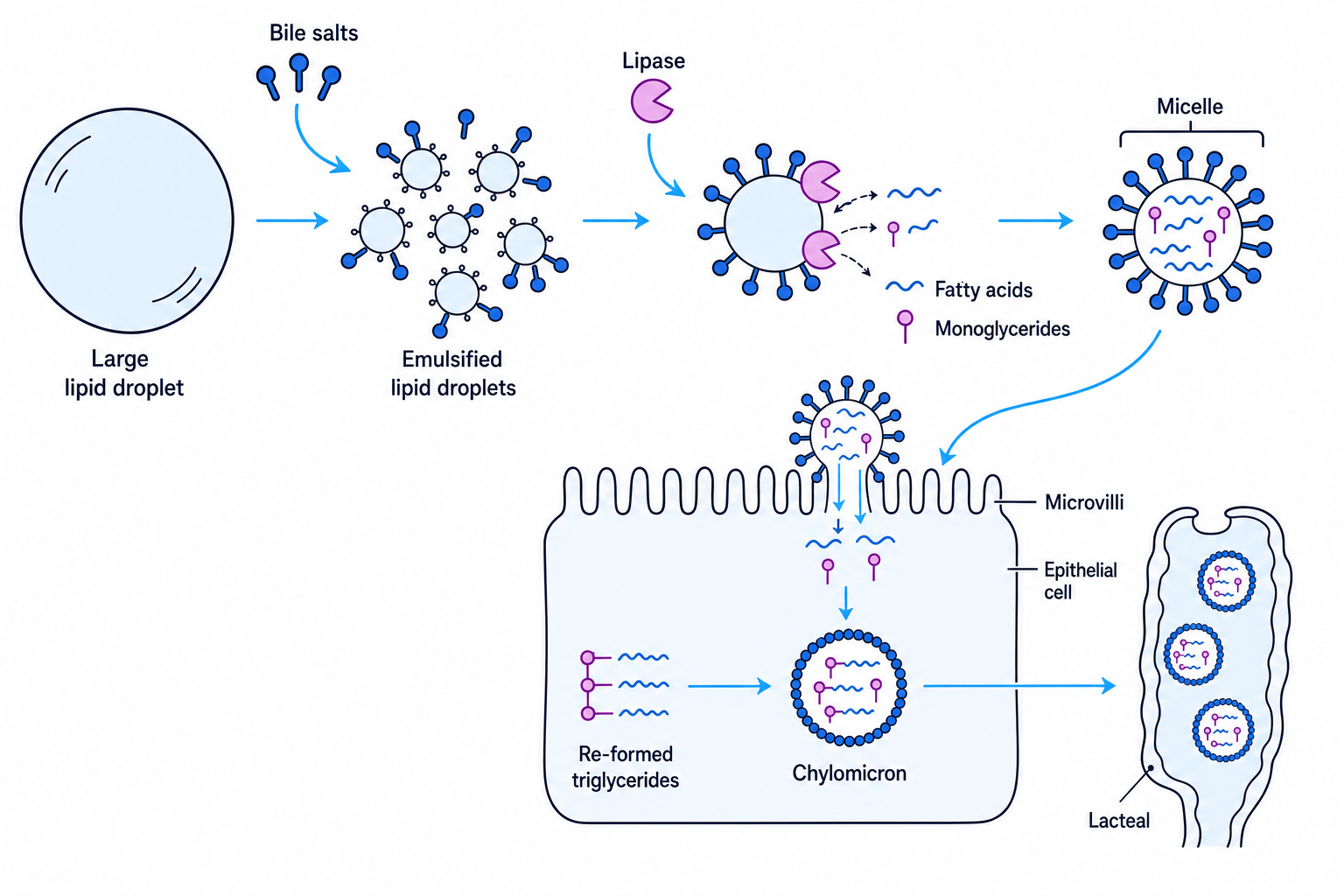
Inside the epithelial cell, fatty acids and monoglycerides are re-formed into triglycerides. These are packaged into chylomicrons, which leave the cell and enter lacteals.
Absorbing monosaccharides and amino acids
Glucose and amino acids are absorbed by co-transport. This relies on a concentration gradient, which is a difference in concentration between two places.
Co-transport
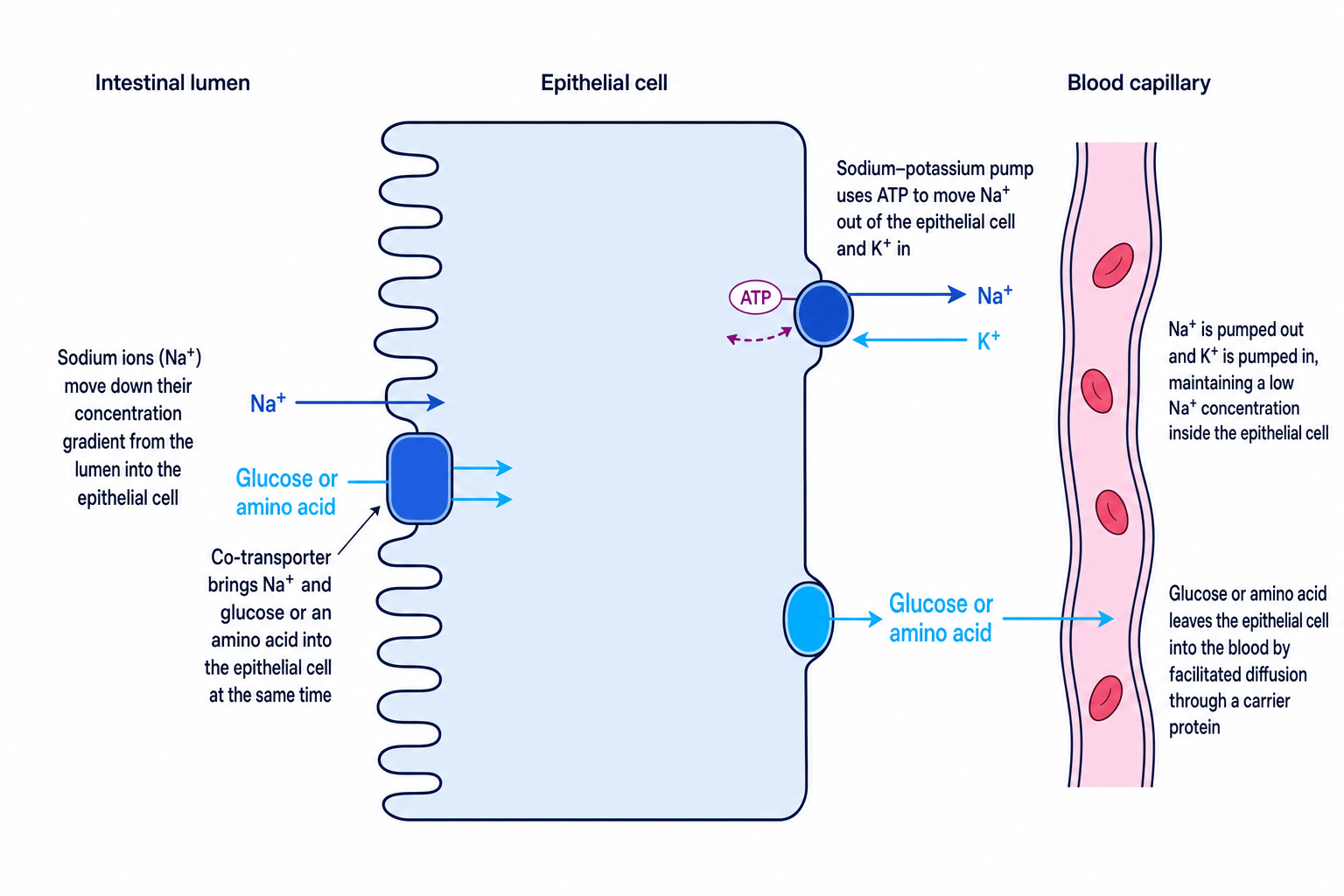
Co-transport is the movement of two substances across a membrane through the same carrier protein. In the ileum, sodium ions move down their concentration gradient and carry glucose or amino acids into epithelial cells with them.
The sequence is:
- Sodium ions are actively transported out of the epithelial cell into the blood by the sodium-potassium pump. Active transport uses ATP to move substances against a concentration gradient.
- This makes the sodium ion concentration lower inside the epithelial cell than in the gut lumen.
- Sodium ions diffuse from the lumen into the epithelial cell through a co-transporter protein.
- Glucose or amino acids bind to the same co-transporter and enter the epithelial cell with the sodium ions.
- Glucose and amino acids then move into the blood by facilitated diffusion, which is passive movement down a concentration gradient through a membrane protein.
Explaining reduced glucose absorption when ATP production falls
- If ATP production falls, the sodium-potassium pump works more slowly because it needs ATP for active transport.
- Fewer sodium ions are pumped out of the epithelial cell, so the sodium ion concentration gradient from the lumen into the cell becomes less steep.
- Less sodium diffuses into the cell through co-transporter proteins, so less glucose is carried into the epithelial cell.
- Therefore, glucose absorption into the blood decreases because co-transport depends indirectly on ATP.
Co-transport wording
For full-credit explanations, say that ATP is used to maintain the sodium ion gradient. The glucose or amino acid does not use ATP directly at the co-transporter.
Practical investigations you may meet
You could investigate how pH affects amylase activity using starch and iodine. Iodine turns blue-black if starch is present. As amylase digests starch, the blue-black colour eventually stops appearing.
Good controls include temperature, enzyme concentration, substrate concentration, volumes and mixing time. Use buffer solutions to set pH, and repeat results to calculate a mean.
You could also investigate the effect of bile salts on lipase using milk or cream as the lipid source. Lipase produces fatty acids, lowering pH. With phenolphthalein indicator, the solution changes from pink to colourless as pH falls.
Calculating rate from a digestion experiment
A starch-amylase reaction takes 80 s to reach the endpoint at pH 7, and 160 s at pH 5.
- Use the reciprocal of time because a shorter time means a faster reaction:
- Substitute the time at pH 7:
- Substitute the time at pH 5:
- Compare the rates:
The reaction at pH 7 is twice as fast as the reaction at pH 5.
Visking tubing is partially permeable tubing that can model absorption. Small digestion products such as glucose can diffuse through it, but larger molecules such as starch cannot.
Visking tubing is only a model
Visking tubing can model diffusion of small molecules, but it cannot model active transport, co-transport, micelles, villi, blood flow or living membrane proteins.
Summary table
| Food molecule | Main digestive agents | Products absorbed | Main absorption route |
|---|---|---|---|
| Starch and disaccharides | Amylase and membrane-bound disaccharidases | Monosaccharides | Sodium ion co-transport, then facilitated diffusion |
| Proteins and peptides | Endopeptidases, exopeptidases and membrane-bound dipeptidases | Amino acids | Sodium ion co-transport, then facilitated diffusion |
| Triglycerides | Bile salts and lipase | Fatty acids and monoglycerides | Micelles, diffusion into epithelial cells, then transport via lacteals |
In the exam
- Use precise verbs: enzymes hydrolyse bonds; bile salts emulsify lipids; micelles transport lipid products to the epithelial surface.
- For co-transport, start with the sodium-potassium pump, then the sodium ion gradient, then co-transport of glucose or amino acids.
- In practical questions, identify the independent variable, dependent variable, key control variables, repeats, and how rate is calculated.
Check yourself
- Why does emulsification increase the rate of lipid digestion?
- How does the sodium ion gradient help glucose enter ileum epithelial cells?
- Why is Visking tubing not a perfect model of absorption in the ileum?

