The generation time for a population of dividing bacterial cells is defined as the time taken for the population to double in size via binary fission.
A microbiologist tracks the growth of a Pseudomonas aeruginosa biofilm in a lab culture using a semi-logarithmic graph.
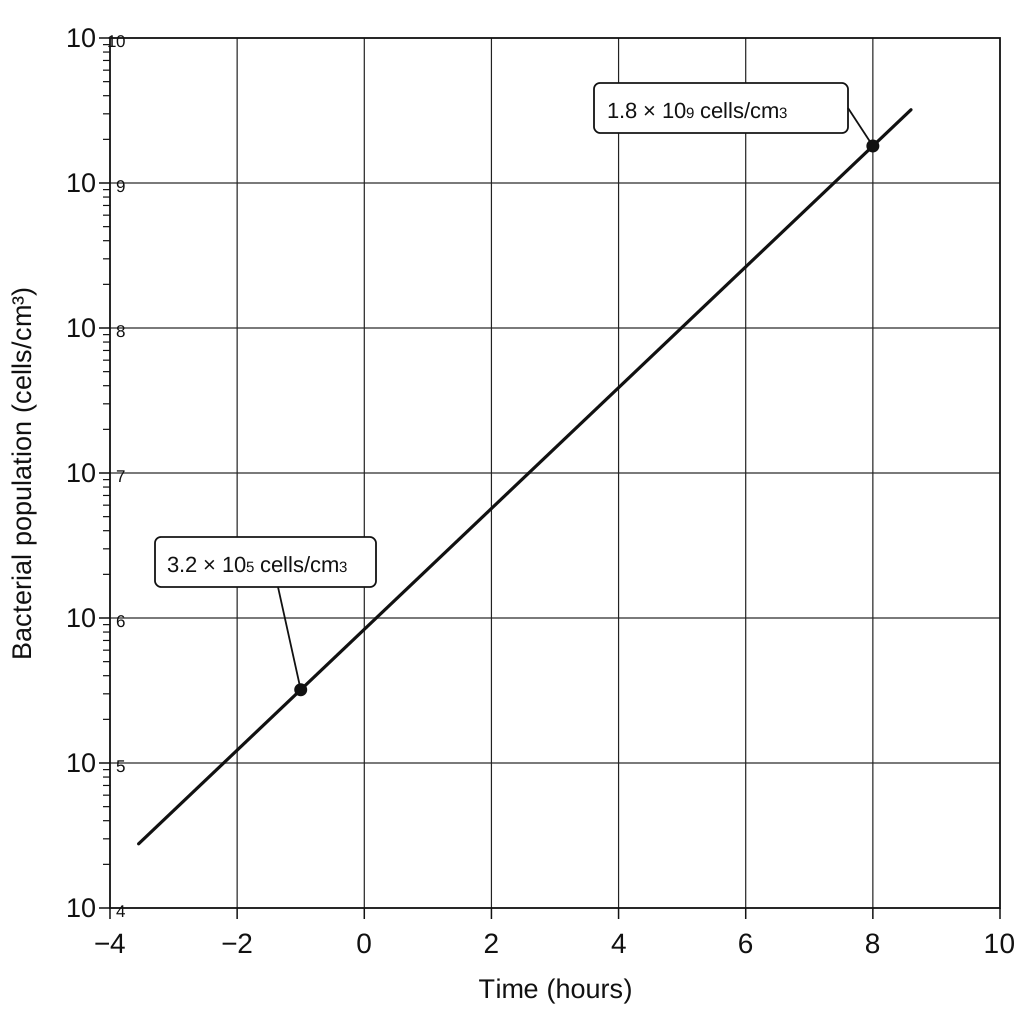
Use the semi-logarithmic graph and the following equation to calculate the generation time for the population of bacteria between t=−1 hourt = -1\text{ hour}t=−1 hour and t=8 hourst = 8\text{ hours}t=8 hours.
Number of generations=log10(size of population at t=8 hourssize of population at t=−1 hour)log102 \text{Number of generations} = \frac{\log_{10}\left(\frac{\text{size of population at } t = 8\text{ hours}}{\text{size of population at } t = -1\text{ hour}}\right)}{\log_{10} 2} Number of generations=log102log10(size of population at t=−1 hoursize of population at t=8 hours)Give your answer in hours to two decimal places.
Practise AQA A Level Biology Cell structure with exam-style questions for A Level Biology. 35 questions covering Structure of eukaryotic cells, Structure of prokaryotic cells and of viruses, and Methods of studying cells, matched to the AQA A Level Biology (7402) specification and written in Paper 1, Paper 2 and Paper 3 style. Every question includes a full worked solution and mark scheme, so you can see where marks are awarded rather than just whether you got the answer right.

