

What you'll learn
- Why very different organisms share a similar biochemical basis.
- What monomers and polymers are, with key A-Level Biology examples.
- How condensation reactions join molecules by releasing water.
- How hydrolysis reactions break molecules by using water.
The big idea: life is diverse, but the chemistry is shared
Life is incredibly varied: bacteria, oak trees, mushrooms, insects, humans, and extinct organisms all look and function very differently. However, at the molecular level, living things are built from a relatively small set of similar chemical building blocks.
This matters because A-Level Biology often asks you to connect structure and function. If you understand how small biological molecules join together, you can explain larger topics later, such as carbohydrates, proteins, DNA, enzymes, digestion, and cell structure.
Unity underneath diversity
The variety of life is huge, but all living organisms use similar biological molecules, such as carbohydrates, proteins and nucleic acids, built from smaller repeating units.
Starting from the basics
Before monomers and polymers, it helps to be clear about a few chemistry words.
An atom is the smallest part of an element that still has the properties of that element. An element is a substance made of only one type of atom, such as carbon, hydrogen, oxygen or nitrogen.
A molecule is made when two or more atoms are chemically bonded together. Biological molecules are the molecules found in living organisms, such as glucose, amino acids, proteins and DNA.
A chemical bond is an attraction that holds atoms or molecules together. In this topic, the important idea is that bonds can be formed to build larger molecules, or broken to split them into smaller molecules.
Monomers: the small units
Monomer
A monomer is a smaller unit from which larger molecules are made.
The word monomer comes from ideas meaning “one part”. In biology, monomers are small molecules that can be joined to other similar molecules.
Important biological examples include:
- Monosaccharides: single sugar units, such as glucose.
- Amino acids: the monomers used to build polypeptides and proteins.
- Nucleotides: the monomers used to build nucleic acids, such as DNA and RNA.
Each type of monomer has its own detailed structure, which you will study later. For now, focus on the general pattern: small units can be joined to make larger molecules.
Monosaccharide, amino acid and nucleotide
A monosaccharide is a single sugar molecule. An amino acid is the basic monomer of proteins. A nucleotide is the basic monomer of nucleic acids such as DNA and RNA.
Polymers: large molecules made from many monomers
Polymer
A polymer is a molecule made from a large number of monomers joined together.
The word polymer comes from ideas meaning “many parts”. A polymer is not just any large molecule: it must be made from many repeating or similar smaller units joined by chemical bonds.
Examples you will meet throughout biological molecules include:
- Many monosaccharides joined together form a polysaccharide, such as starch, glycogen or cellulose.
- Many amino acids joined together form a polypeptide; one or more polypeptides can make a protein.
- Many nucleotides joined together form a polynucleotide, such as a DNA strand or RNA strand.
Polymer does not just mean big molecule
A large molecule is not automatically a polymer. A polymer must be made from many monomers joined together. For example, triglycerides are large biological molecules, but they are not true polymers because they are not made from a long chain of repeating monomers.
Classifying biological molecules
Suppose you are given this list: glucose, glycogen, amino acid, protein, nucleotide and DNA. Classify each as a monomer or polymer.
- Identify the small building-block molecules: glucose is a monosaccharide, so it is a monomer; an amino acid is a monomer; a nucleotide is a monomer.
- Identify molecules made from many joined units: glycogen is made from many glucose molecules, so it is a polymer; DNA is made from many nucleotides, so it is a polymer.
- Decide how to handle protein carefully: proteins are made from one or more polypeptides, and polypeptides are polymers of amino acids, so protein can be treated as a polymer-based biological molecule.
Condensation reactions: joining molecules
To build polymers, cells must join monomers together. This happens using condensation reactions.
Condensation reaction
A condensation reaction joins two molecules together with the formation of a chemical bond and involves the elimination of a molecule of water.
“Elimination” simply means that the water molecule is removed or released as a product of the reaction.
A simple way to show this is:
monomer+monomer→dimer+water\text{monomer} + \text{monomer} \to \text{dimer} + \text{water}monomer+monomer→dimer+water
A dimer is a molecule made from two monomers joined together. If more monomers keep joining, the chain becomes a polymer.
The water molecule usually forms because one molecule contributes a hydrogen atom and the other contributes a hydroxyl group. These combine to form water, H2O. At the same time, a new chemical bond forms between the two molecules.
The diagram below shows the overall logic: condensation builds a polymer and releases water, while hydrolysis does the reverse.
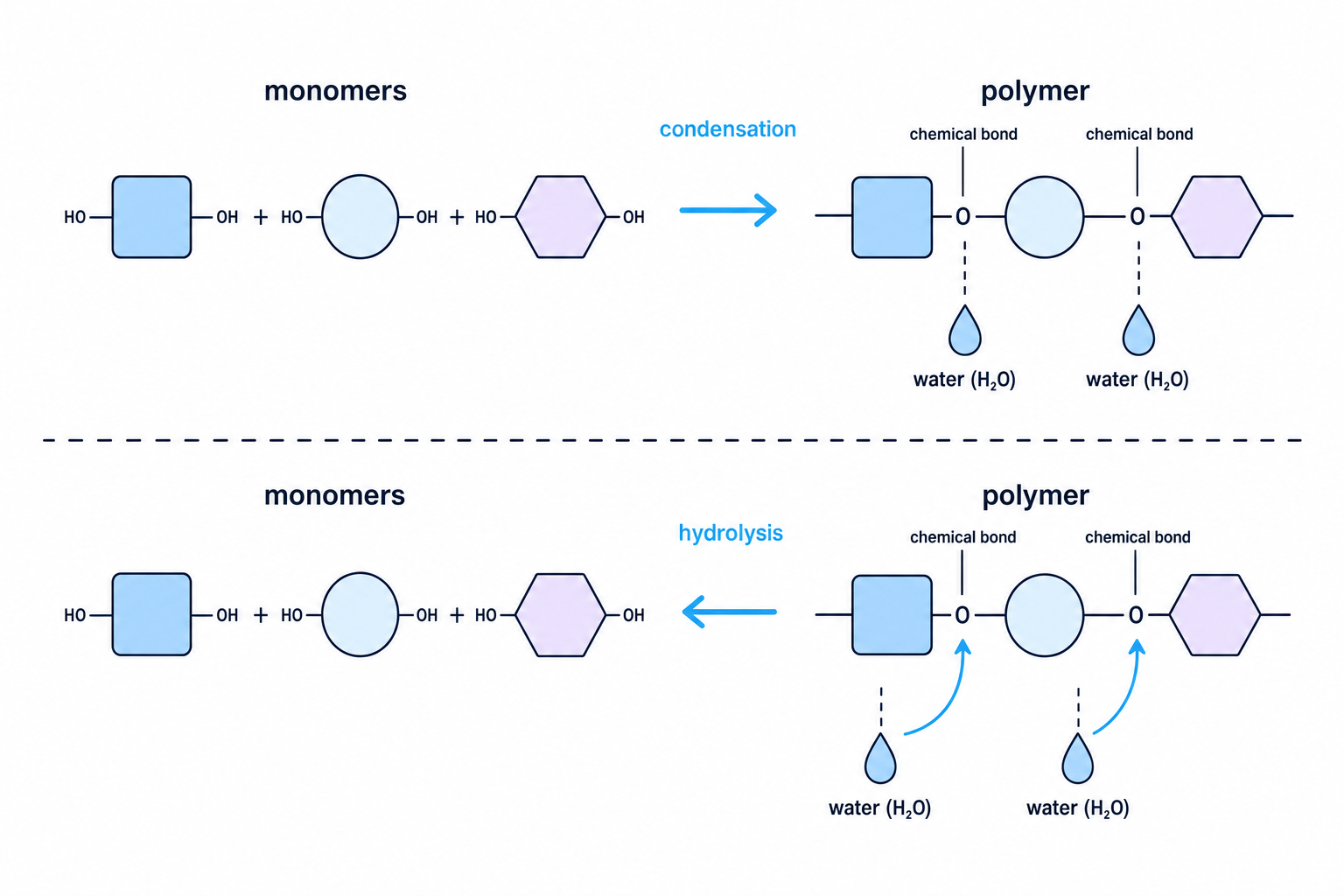
Condensation builds
Condensation reactions build larger biological molecules from smaller ones. Each new bond formed between monomers releases one molecule of water.
Hydrolysis reactions: breaking molecules
The reverse of condensation is hydrolysis.
Hydrolysis reaction
A hydrolysis reaction breaks a chemical bond between two molecules and involves the use of a water molecule.
The word hydrolysis is useful: hydro refers to water, and lysis means splitting.
A simple way to show this is:
dimer+water→monomer+monomer\text{dimer} + \text{water} \to \text{monomer} + \text{monomer}dimer+water→monomer+monomer
In cells, hydrolysis is important in digestion. Large food molecules, such as starch and proteins, are too large to be absorbed directly, so they are hydrolysed into smaller molecules such as glucose and amino acids.
Hydrolysis breaks
Hydrolysis reactions break larger biological molecules into smaller molecules by adding water across a chemical bond.
Mixing up condensation and hydrolysis
Do not write that condensation “uses water” or that hydrolysis “releases water”. Condensation releases water when forming a bond; hydrolysis uses water when breaking a bond.
Counting bonds and water molecules
When monomers join in a straight, unbranched chain, each new bond forms between two neighbouring monomers. The first two monomers form one bond. Adding a third monomer forms one more bond, and so on.
For a straight chain of nnn monomers:
number of bonds=n−1\text{number of bonds} = n - 1number of bonds=n−1Because each condensation reaction forms one bond and releases one water molecule:
water molecules released=n−1\text{water molecules released} = n - 1water molecules released=n−1For complete hydrolysis of that same chain:
water molecules used=n−1\text{water molecules used} = n - 1water molecules used=n−1Counting water molecules in polymer formation
A polypeptide chain is made from 18 amino acids. Work out how many water molecules are released when the chain forms, and how many water molecules are needed to hydrolyse it completely.
- Model the polypeptide as one straight chain, so the number of bonds between amino acids is n−1n - 1n−1.
- Substitute n=18n = 18n=18: number of bonds is 18−1=1718 - 1 = 1718−1=17.
- Link bonds to water molecules: forming 17 bonds releases 17 water molecules during condensation, and breaking all 17 bonds uses 17 water molecules during hydrolysis.
When the simple count may not apply
The n−1n - 1n−1 rule assumes one straight chain made by joining monomers end-to-end. More complex branching or cross-linking can change the number of bonds, so always use the structure given in the question.
The main biological polymer groups
Carbohydrates
Carbohydrates include sugars and polysaccharides. The monomers are monosaccharides, such as glucose. When many glucose molecules join, they can form polysaccharides such as starch, glycogen or cellulose.
You will later learn that the bonds between monosaccharides are called glycosidic bonds.
Proteins
Proteins are built from amino acids. When amino acids join, they form polypeptides. Proteins may contain one polypeptide chain or several polypeptide chains folded into a specific shape.
You will later learn that the bonds between amino acids are called peptide bonds.
Nucleic acids
Nucleic acids include DNA and RNA. Their monomers are nucleotides. A DNA molecule is made from two polynucleotide strands, while RNA is usually single-stranded.
You will later learn that the bonds within a polynucleotide strand are called phosphodiester bonds.
Three monomer-polymer pairs to memorise
Remember these core pairs: monosaccharides form polysaccharides, amino acids form polypeptides or proteins, and nucleotides form polynucleotides such as DNA and RNA.
Why this topic matters later
This section is short, but it underpins a lot of the Biological molecules unit.
When you study carbohydrates, you will use condensation and hydrolysis to explain how disaccharides and polysaccharides form and break down. When you study proteins, you will apply the same reaction logic to peptide bonds. When you study DNA, you will see nucleotides joined into polynucleotide strands.
So the important skill is not just memorising the definitions. You need to be able to recognise whether a reaction is building a larger molecule or breaking it down, and then connect that to water being released or used.
In the exam
- If a question asks for a definition, include both parts: condensation forms a bond and releases water; hydrolysis breaks a bond and uses water.
- When naming examples, keep the pairs matched correctly: monosaccharides to polysaccharides, amino acids to polypeptides, nucleotides to polynucleotides.
- For water-counting questions, count the bonds, not just the monomers. In a straight chain of nnn monomers, there are n−1n - 1n−1 bonds.
Check yourself
- What is the difference between a monomer and a polymer?
- Which reaction releases water: condensation or hydrolysis?
- How many water molecules are needed to completely hydrolyse a straight polymer made from 25 monomers?

