A student prepared a stained squash of cells from the root tips of an onion bulb (Allium cepa) to calculate a mitotic index. She:
- Cut the terminal 4 mm4\text{ mm}4 mm from 8 onion8\text{ onion}8 onion roots.
- Placed the root tips into a watch glass containing 5 cm35\text{ cm}^35 cm3 of 1 M1\text{ M}1 M hydrochloric acid for 10 minutes10\text{ minutes}10 minutes.
- Rinsed the root tips thoroughly in distilled water.
- Placed one of the root tips on a microscope slide and added a few drops of aceto-orcein stain.
- Placed a coverslip onto the slide, covered it with a paper towel, and pressed gently but firmly downwards on the root tip.
- Observed the prepared slide using an optical microscope.
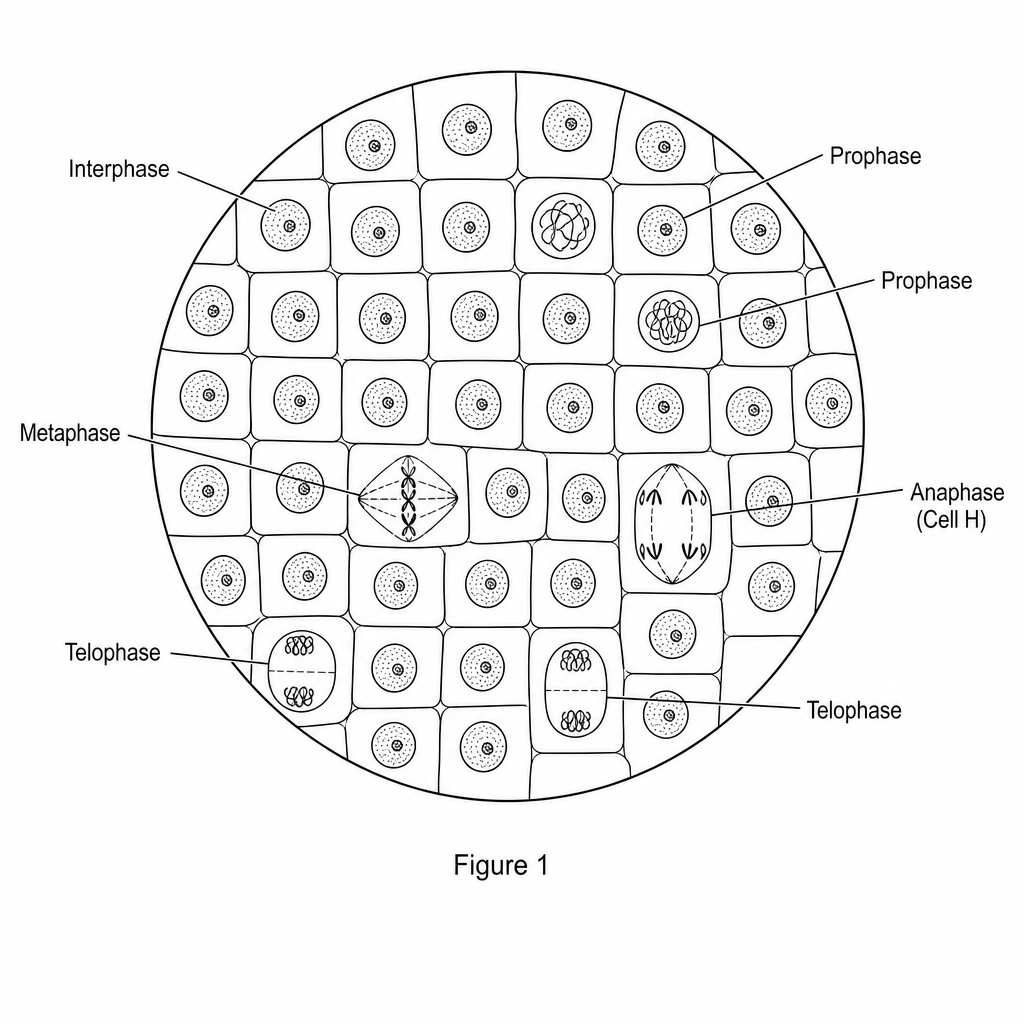
Figure 1
1.[2]
Suggest why the student soaked the root tips in hydrochloric acid in step 2.
2.[2]
Pressing the coverslip downwards enabled the student to observe the stages of mitosis clearly. Explain why.
3.[2]
Name the stage of mitosis shown in Cell H in Figure 1. Explain the appearance of this cell.
4.[1]
Use Figure 1 to calculate a mitotic index for the cells in this field of view.
5.[2]
Other students in the class followed the same protocol, but calculated different mitotic indices. Apart from student errors, suggest two explanations why.