Imperfect Labour Markets
Definition
Monopsony: a labour market with a single, dominant buyer of labour that can influence the wage it pays.
- In imperfect labour markets one side has wage-setting power, so the wage need not equal the competitive level.
- A trade union can raise the wage above the competitive rate through collective bargaining.
- A monopsony employer can push the wage below a worker's marginal revenue product.
- Government can impose a national minimum wage to set a legal floor on pay.
Key Idea
- Wage-setting power on either side moves the wage away from the competitive equilibrium.
- The effect on employment depends on which side holds the power and how demand for labour responds.
Trade Unions
Definition
Trade union: an organised association of workers that bargains collectively with employers over wages and working conditions.
- A trade union raises wages by bargaining collectively or by restricting the supply of labour.
- In a competitive market a higher union wage moves firms up the labour demand curve, so employment falls; the pay rise for those still hired is a trade-off against the jobs lost.
- The size of the job loss depends on the elasticity of labour demand: it depends on how easily firms substitute capital for labour or cut output.
- Against a monopsony a union can raise the wage and employment at the same time, because it offsets the employer's wage-setting power.
Example
- In a competitive factory labour market clearing at £14, a union that bargains an £18 wage floor moves firms up the demand curve, so employment falls from, say, 100 to 80 workers.
- In the nurses' monopsony below, a union wage of £16 set between the £14 monopsony wage and the £18 marginal revenue product raises both the wage, £14 → £16, and employment, 3 → 4 nurses, just as a minimum wage can.
Are trade unions good or bad for the labour market?
- In favour: a union can raise wages and improve working conditions, and where the employer is a monopsony it can raise both the wage and employment by offsetting the firm's wage-setting power. It also gives workers a collective voice that can lower quit rates, and through productivity deals and training it can raise output per worker, which helps offset the higher wage.
- Against: in a competitive labour market a union wage above equilibrium pushes firms up the labour demand curve, so employment falls; higher labour costs can raise prices and erode competitiveness; strikes cause lost output; and insider-outsider effects protect those already in work at the expense of the unemployed outsiders who would take the job at a lower wage.
- How much impact a union has depends on union density and bargaining power (a union covering few workers, or facing a firm that can easily replace them, changes little), the elasticity of labour demand (elastic demand means a large job loss for a given wage rise), and product-market competition (a firm earning supernormal profit can absorb higher wages, whereas a firm in a competitive product market cannot).
- On balance, a union is most beneficial where it counters monopsony power in low-wage sectors, raising pay and jobs together; it is more likely to cost jobs in a competitive, price-sensitive industry with elastic labour demand, and its real effect is modest where union density and bargaining power are low.
Monopsony Employers
Definition
Marginal cost of labour: the addition to a firm's total labour cost from employing one more worker.
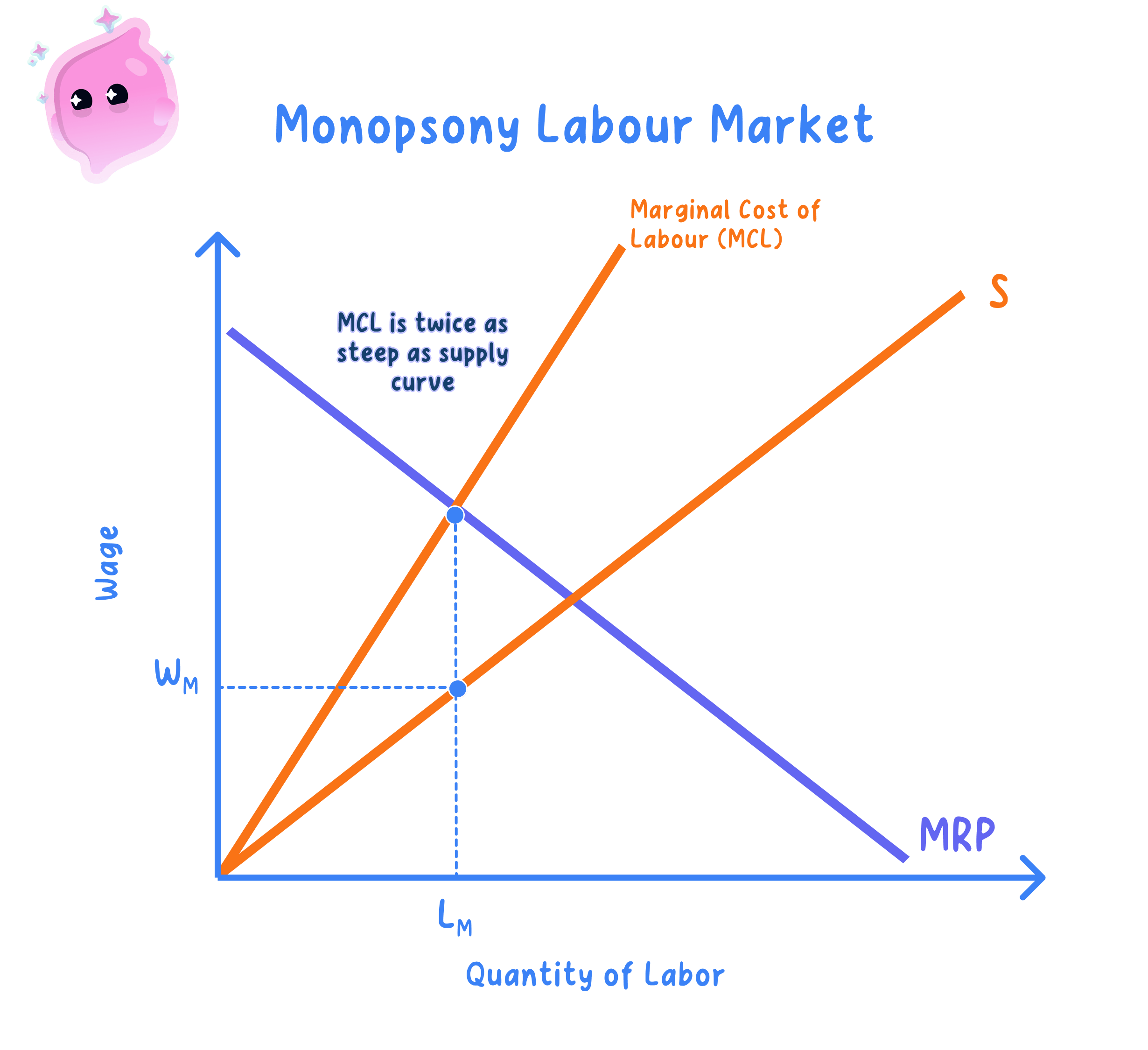
- A monopsony is the sole or dominant buyer of a type of labour, so it faces the whole upward-sloping supply curve.
- To hire an extra worker it must raise the wage paid to all workers, so the marginal cost of labour exceeds the wage.
- It maximises profit by hiring where the marginal cost of labour equals marginal revenue product.
- It then pays only the wage read off the supply curve, which lies below marginal revenue product.
- Both the wage and employment are lower than in a competitive market, so workers are exploited relative to their marginal revenue product.
Example
- A single hospital is the only employer of nurses in a town, so it is a monopsony.
- The wage needed to attract nurses is £10 for 1, then £12, then £14, then £16 for 4 nurses.
- Because the higher wage is paid to everyone, the marginal cost of the third nurse is (3 × £14) − (2 × £12) = £42 − £24 = £18, above her £14 wage.
- Her marginal revenue product is also £18, so the firm hires 3 nurses and pays the £14 supply wage.
- The £14 wage sits below the £18 marginal revenue product, the sign of monopsony wage-setting power.
National Minimum Wage
Definition
National minimum wage: a legally enforced wage floor below which employers may not pay workers.
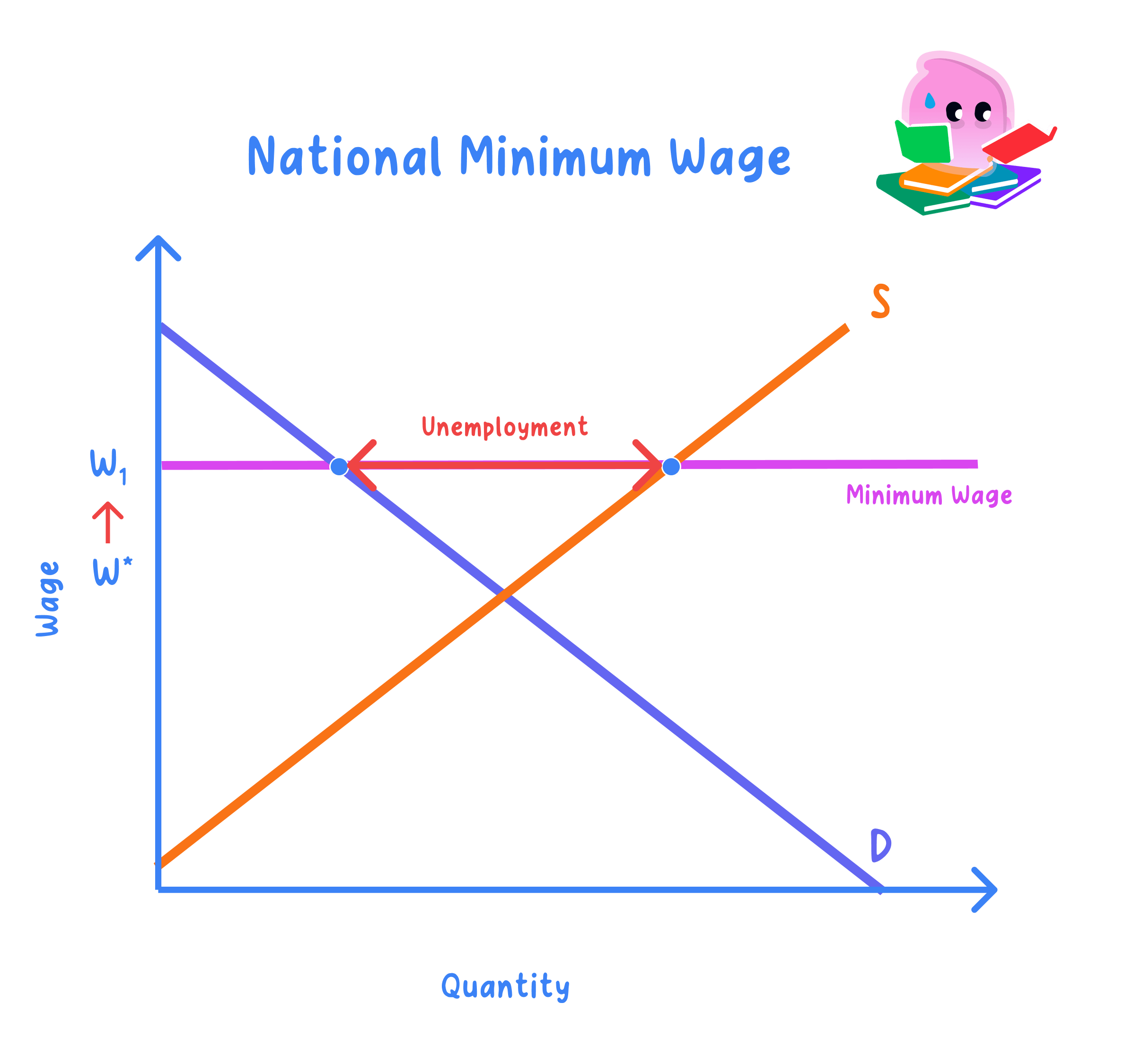
- In a competitive market a floor above equilibrium creates excess supply of labour, so unemployment rises.
- In a monopsony a floor set above the monopsony wage but no higher than the competitive wage flattens the firm's marginal cost of labour.
- This can raise both the wage and employment at the same time, so the outcome depends on the market structure.
Example
- A competitive market for the same nurses would clear at a wage of £16 and 4 nurses.
- A national minimum wage of £16 flattens the supply the monopsony faces up to 4 nurses, so its marginal cost of labour becomes £16.
- The firm now hires where £16 equals marginal revenue product, at 4 nurses.
- Both the wage, £14 → £16, and employment, 3 → 4 nurses, rise together.
Does a minimum wage destroy jobs?
- The competitive model supports the jobs-cost fear: a floor set above the market-clearing wage pushes firms up the labour demand curve, creating excess supply, and the more elastic labour demand is, the larger the fall in employment.
- But where a single dominant employer holds monopsony power, a floor set between the monopsony wage and the marginal revenue product caps the marginal cost of labour, so it can raise the wage and employment together; much low-paid work in care, retail and farm labour has monopsony features.
- The evidence is mixed rather than settled: studies of Germany's 2015 statutory minimum wage and of the United States federal minimum wage found only small employment effects, yet floors set far above local productivity, as in parts of South Africa, have priced some workers out.
- On balance, whether a minimum wage costs jobs depends on market structure and the elasticity of labour demand: a modest floor in monopsonistic, low-wage sectors can lift pay and jobs, while a floor set well above productivity in competitive, labour-intensive industries risks unemployment.
Exam technique
- For monopsony, draw the marginal cost of labour curve above the supply curve and set employment where it meets marginal revenue product.
- Read the wage off the supply curve, below marginal revenue product, not off the marginal cost of labour curve.
Common Mistake
- Do not assume a minimum wage always cuts jobs, because in a monopsony it can raise employment.
- Do not read the monopsony wage off the marginal cost of labour curve; read it off the supply curve.
Self review
- Define a monopsony.
- Define a trade union.
- Why does a monopsony pay a wage below marginal revenue product?
- How can a national minimum wage raise employment in a monopsony?
- What determines the job loss when a union raises wages in a competitive market?
- When is a trade union beneficial rather than harmful, and what determines the size of its impact?
