Perfect Labour Markets
Definition
Equilibrium wage rate: the wage at which the demand for labour equals the supply of labour, so there is no pressure for the wage to change.
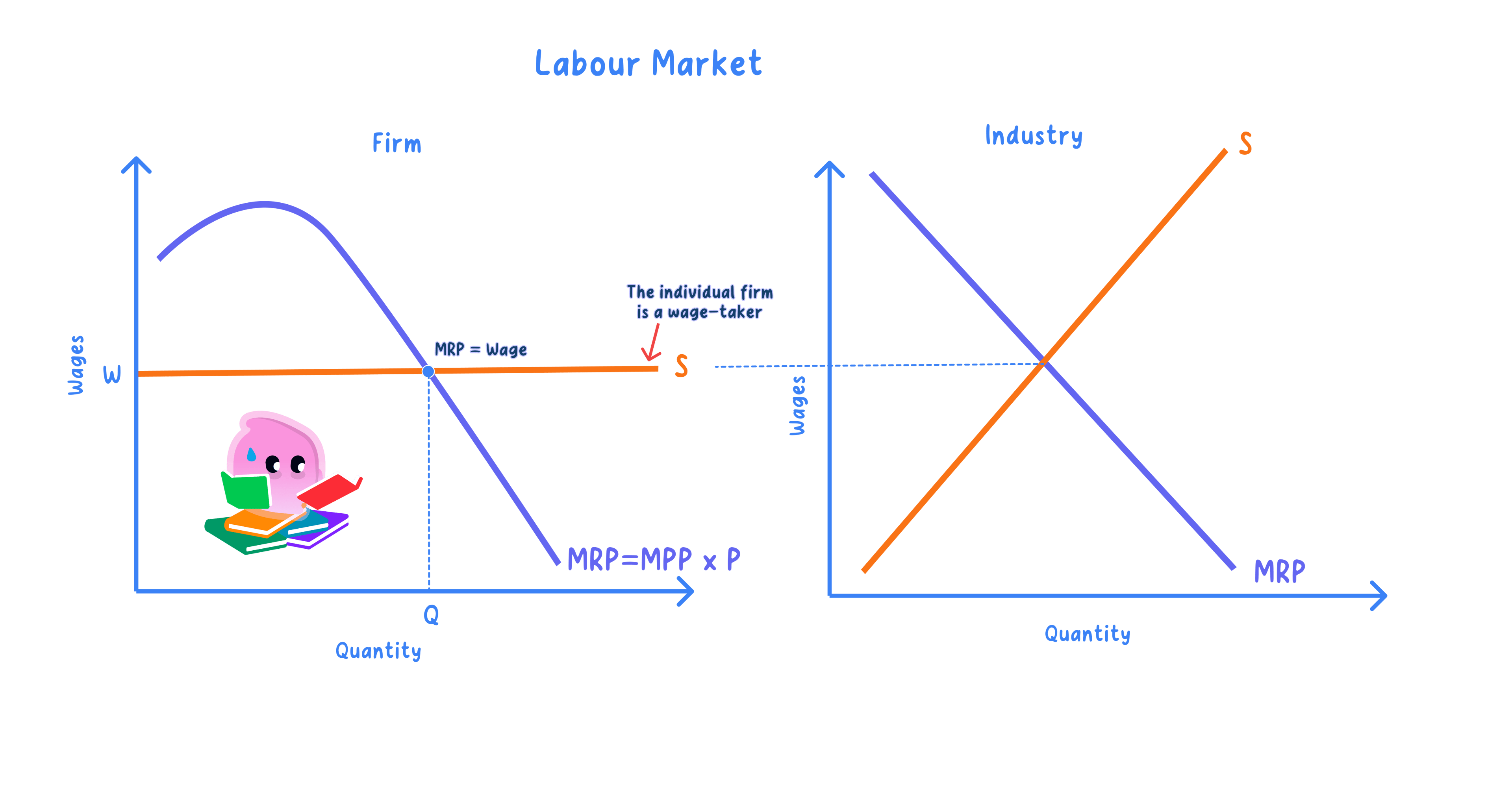
Wage taker: a firm too small to influence the market wage, so it takes the equilibrium wage as given.
- In a perfectly competitive labour market many small firms and many workers each take the market wage as given.
- The market demand for labour slopes downward and reflects the marginal revenue product of workers.
- The market supply of labour slopes upward because a higher wage attracts more workers into the occupation.
- The equilibrium wage and level of employment are set where the two curves cross.
Key Idea
- The wage settles where labour demand equals labour supply.
- The single firm is a wage taker and faces a perfectly elastic supply of labour at that wage.
Reaching Equilibrium
- If the wage is above equilibrium, the quantity of labour supplied exceeds the quantity demanded.
- This excess supply of labour pushes the wage back down.
- If the wage is below equilibrium, the quantity demanded exceeds the quantity supplied.
- This excess demand for labour pulls the wage back up until the market clears.
Example
- Plot the wage on the vertical axis and the quantity of labour on the horizontal axis.
- Demand and supply cross at a wage of £15 per hour and employment of 5,000 workers.
- At £18, supply of 6,000 exceeds demand of 4,000, so an excess supply of 2,000 workers drives the wage back to £15:
- At £12, demand of 6,000 exceeds supply of 4,000, so a shortage of 2,000 workers pushes the wage back up to £15.
Shifts And New Wages
- A rise in labour demand, from higher product demand or higher productivity, shifts demand right and raises both the wage and employment.
- A rise in labour supply, from migration or lower training barriers, shifts supply right and lowers the wage but raises employment.
- It depends on elasticity: the size of each effect on wage and employment depends on how elastic the other curve is.
Example
- A technology firm sees product demand jump, so the marginal revenue product of coders rises and labour demand shifts right.
- The equilibrium wage climbs from £15 to £18 and employment rises from 5,000 to 5,800:
Exam technique
- Always label the axes wage and quantity of labour, and mark the equilibrium wage and employment.
- When a curve shifts, state the new wage and employment, not just the direction of change.
Common Mistake
- Do not confuse the market supply curve, which slopes up, with the flat labour supply faced by a single wage-taking firm.
- In perfect competition the firm cannot set its own wage, so it pays the market wage.
Self review
- Define the equilibrium wage rate.
- How does excess supply of labour move the wage?
- What happens to wage and employment when labour demand shifts right?
- Why is a single competitive firm a wage taker?
