Four externality cases
Definition
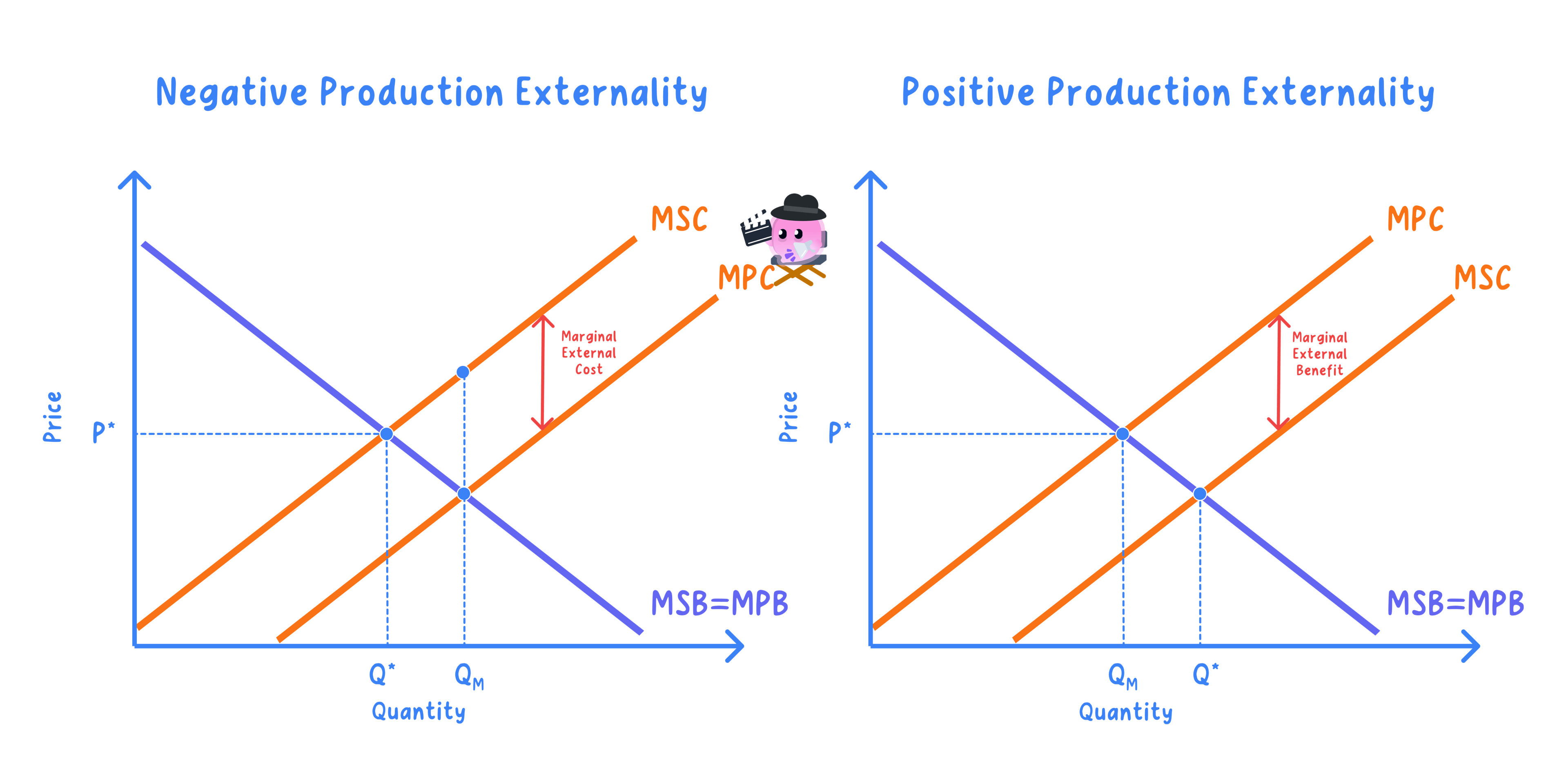
Negative production externality: a spillover cost from producing a good, so MSC lies above MPC.
Positive production externality: a spillover benefit from producing a good, so MSC lies below MPC.
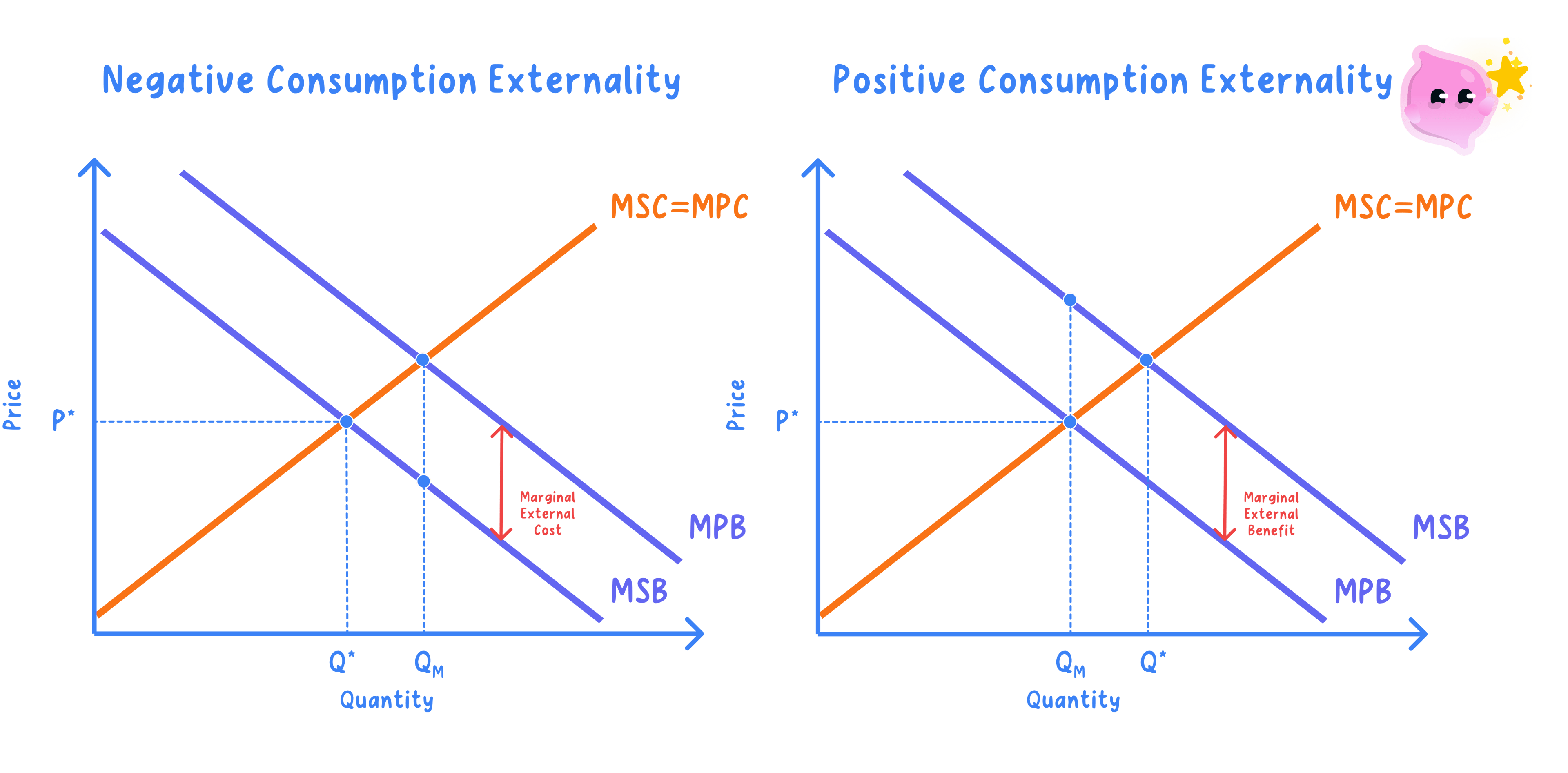
Negative consumption externality: a spillover cost from consuming a good, so MSB lies below MPB.
Positive consumption externality: a spillover benefit from consuming a good, so MSB lies above MPB.
Negative production externality
- Production imposes a spillover cost, so MSC lies above MPC and the vertical gap = the marginal external cost → the firm's supply understates the true cost.
- Demand reflects MPB = MSB, so the free market produces where MPC = MPB, beyond the optimum where MSC = MSB.
- The result is over-production; it depends on how dirty the process is, since a wider MSC − MPC gap means a larger welfare loss.
Example
- A coal plant's marginal private cost = £30 per MWh; smoke imposes a marginal external cost equal to 40% of that, so MEC = £12.
- Marginal social cost = £30 + £12 = £42, while marginal social benefit = £35 at the market output.
- MSC £42 > MSB £35, so the last MWh costs society £7 more than it is worth → electricity is over-produced.
Positive production externality
- Production confers a spillover benefit, so MSC lies below MPC and the gap = the marginal external benefit → society's true cost is lower than the firm's.
- Demand reflects MPB = MSB, so the free market produces where MPC = MPB, below the optimum where MSC = MSB.
- The result is under-production; it depends on how far the benefit leaks out, since a firm capturing more of it would supply closer to the optimum.
Example
- A firm that trains workers creates skills rival employers gain from once staff move on.
- Research and development generates knowledge spillovers that other firms can build on.
Negative consumption externality
- Consumption imposes a spillover cost, so MSB lies below MPB and the gap = the marginal external cost → private demand overstates social value.
- Supply reflects MPC = MSC, so the free market consumes where MPB = MPC, above the optimum where MSB = MSC.
- The result is over-consumption; it depends on the harm to others, which is why alcohol is taxed more heavily than most goods.
Example
- Passive smoking damages the health of people near the smoker who never bought the cigarettes.
- Heavy alcohol use raises healthcare costs and disorder that fall on wider society.
Positive consumption externality
- Consumption confers a spillover benefit, so MSB lies above MPB and the gap = the marginal external benefit → private demand understates social value.
- Supply reflects MPC = MSC, so the free market consumes where MPB = MPC, below the optimum where MSB = MSC.
- The result is under-consumption; it depends on the size of the spillover, which is why governments subsidise vaccination and education.
Example
- A person who is vaccinated lowers the chance of others catching the disease.
- An educated worker raises the productivity of colleagues and the wider economy.
Key Idea
- A production externality shifts a cost curve (MSC away from MPC), while a consumption externality shifts a benefit curve (MSB away from MPB).
- Negative externalities cause over-provision and positive externalities cause under-provision.
How large is the welfare loss, and can it be corrected?
- The four cases are real and widespread, so the divergence between the private and social optima is a genuine inefficiency that gives a strong case for correction through taxes, subsidies or regulation.
- However, the size of the loss is easy to overstate. Many spillovers are small or localised, and valuing an external cost or benefit in £ involves estimation, so the true MSC − MPC or MSB − MPB gap is uncertain rather than precise.
- Whether correction works depends on getting the size right and on elasticity. A tax or subsidy set at the wrong level, or aimed at inelastic demand, shifts output only slightly and may still leave a welfare loss, while over-correction creates a new distortion.
- On balance, these externalities justify action where the external cost or benefit is large and can be valued with reasonable confidence, such as pollution or vaccination; where the spillover is small or hard to measure, intervention may not be worth the risk of government failure. The judgement depends on the size of the externality, how accurately it can be valued and how responsive agents are.
Exam technique
- Label both axes, with costs and benefits in £ on the vertical axis and quantity on the horizontal.
- Identify which single curve diverges, whether MSC or MSB, and in which direction.
- Mark the free-market output and the social optimum, then state whether the market over- or under-provides.
Common Mistake
- Do not confuse a production externality, which shifts a cost curve, with a consumption externality, which shifts a benefit curve.
- Positive externalities are still market failures, because the market under-provides.
Self review
- For a negative production externality, which curve diverges and does the market over- or under-produce?
- For a positive production externality, where does MSC lie relative to MPC and what is the outcome?
- For a negative consumption externality, how does MSB relate to MPB and is the good over- or under-consumed?
- State the general rule linking the sign of an externality to over- or under-provision.
