Consumer surplus
Definition
Consumer surplus: the gap between the maximum price a consumer is willing to pay for a good and the lower price actually paid.
Willingness to pay: the most a buyer would hand over for a unit rather than go without it, shown by the height of the demand curve.
CS=12×base×height \text{CS} = \tfrac{1}{2} \times \text{base} \times \text{height} CS=21×base×height- The demand curve maps every buyer's willingness to pay, from the keenest fan down to the marginal buyer, because its height measures the value placed on each extra unit.
- Picture a gig you would happily pay £80 to attend, yet every fan pays the same £45 market price; the £80 − £45 = £35 you keep is your personal consumer surplus.
- Because the single market price sits below what most buyers would have paid, every keener buyer pockets that difference, so a lower price feeds through into a larger welfare gain.
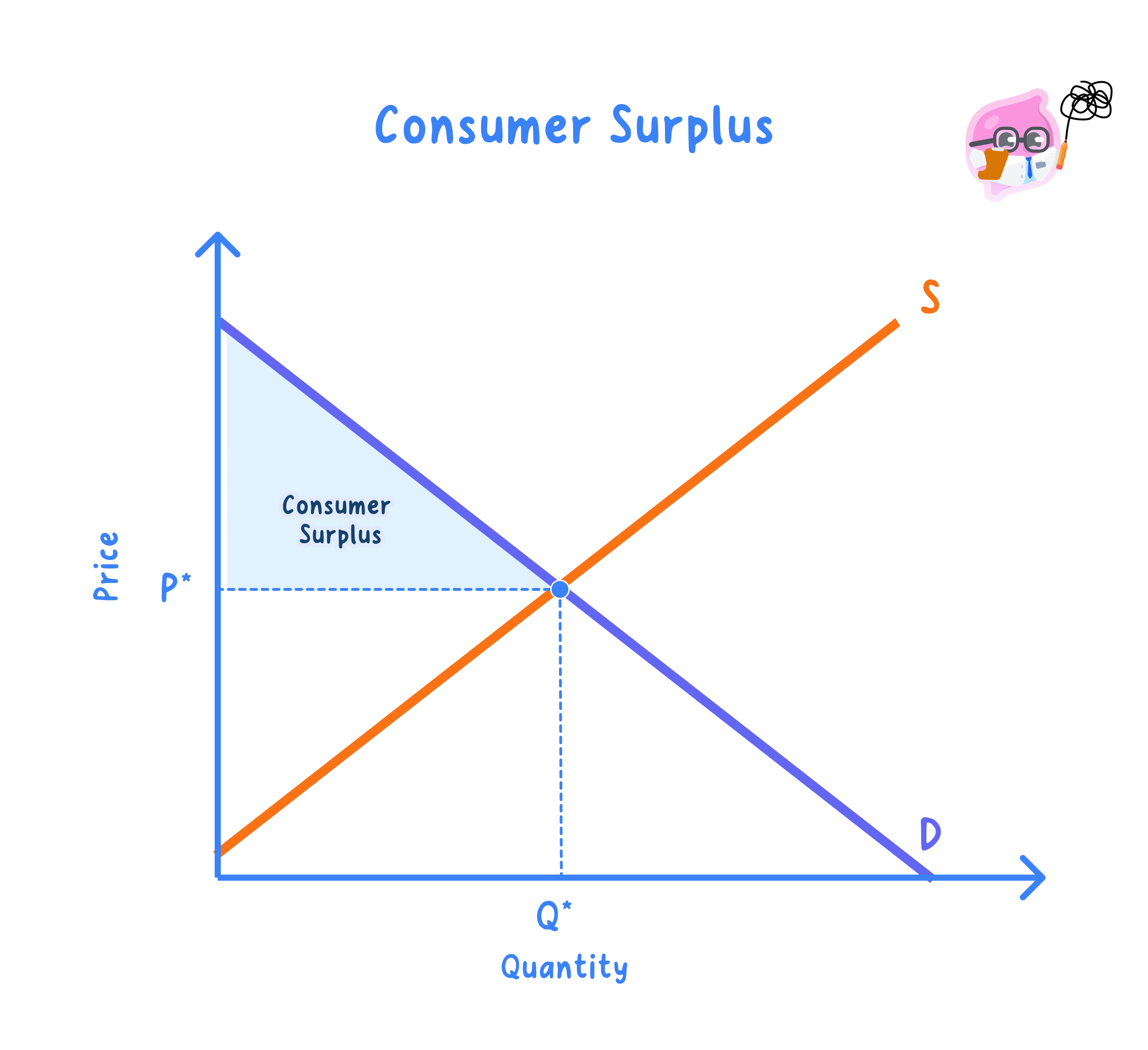
- On a diagram this gain is the area below the demand curve and above the market price, so it can be measured in £ directly.
- Summed across all buyers, it measures the net benefit, or welfare, that consumers draw from taking part in the market.
Key Idea
- Consumer surplus is the extra value buyers receive over and above what they pay.
- It is shown as the area below the demand curve and above the price.
- A lower price makes this area larger, so cheaper goods raise buyer welfare.
Reading the diagram
- Price sits on the vertical axis and quantity on the horizontal axis, so vertical distances represent money values.
- The height of the demand curve at each unit shows the most a buyer would pay for that unit.
- The gap between that height and the market price is the surplus earned on that unit.
- Adding this gap across every unit bought gives total consumer surplus.
Measuring the area
Definition
Choke price: the price at the top of the demand curve at which quantity demanded is choked off to zero.
- With a straight-line demand curve the surplus is a triangle, so simple geometry gives its size.
- The height of the triangle is the choke price − the market price.
- The base of the triangle is the quantity actually bought.
- Multiplying half the base by the height converts this area into a £ figure.
Consumer surplus (linear demand):
CS=12×b×h CS = \tfrac{1}{2} \times b \times h CS=21×b×h h=Pchoke−Pb=Q h = P_{\text{choke}} - P \qquad b = Q h=Pchoke−Pb=QExample
- A promoter cuts festival tickets by 50% to £30, while die-hard fans would have paid up to £90 (the choke price), and 50,000 tickets sell.
- The £1.5 million triangle is the welfare fans gain beyond the price, so the discount hands buyers a real benefit even though no extra cash is collected for it.
What changes it
- A fall in price raises consumer surplus, because existing buyers keep more of their willingness to pay and extra buyers are drawn in.
- A rise in price lowers it, as the top slice of the triangle is transferred to producers and marginal buyers drop out.
- A rightward shift in demand, say a new fashion for the good, raises willingness to pay at each quantity and tends to enlarge the surplus, other things equal.
Why it matters
Definition
Community surplus: consumer surplus + producer surplus, the standard measure of the total welfare a market generates.
- It gives economists a £ measure of consumer welfare, so the gain or loss from a price change, a tax or a subsidy can be compared directly.
- Set against producer surplus, it becomes the yardstick for judging whether a market or policy raises total welfare or destroys it.
Evaluation
- It gives a clear, visual £ measure of the benefit consumers draw from a market, which is why it dominates welfare analysis.
- But willingness to pay reflects ability to pay as well as need, so a wealthy buyer's high bid can dwarf a poorer buyer's urgent need.
- So it depends on the income distribution: the measure can understate the welfare of poorer consumers, who cannot afford to signal how much they truly value a good.
Exam technique
- Identify consumer surplus as the area below demand and above price.
- For a linear demand curve, calculate it as ½ × base × height.
- Always tie the number back to the welfare gained by buyers.
Common Mistake
- Do not confuse consumer surplus with producer surplus.
- Consumer surplus lies below demand and above price, not above the supply curve.
- Never shade the area above the demand curve.
Self review
- Define consumer surplus.
- Where is consumer surplus shown on a demand and supply diagram?
- With a choke price of £30, a market price of £10 and quantity 20, what is consumer surplus?
- How does a fall in price change consumer surplus, and why?
- Why might consumer surplus understate the welfare of poorer consumers?
