Functions Of Price
Definition
Price mechanism: the system by which changes in price ration scarce goods, signal preferences and create incentives, so that resources are allocated without central planning.
- Together they coordinate millions of independent decisions, answering what, how and for whom to produce.
- No central planner is needed, because price alone carries both the information and the motivation to act on it.
Rationing
- When a good becomes scarcer, its price rises and rations it to those willing and able to pay.
- The higher price reduces quantity demanded until it matches the limited quantity supplied, so the shortage is removed.
Signalling
- A price change acts as a signal that transmits consumer preferences to producers.
- A rising price signals where resources should flow in, and a falling price signals where they should flow out.
Incentivising
- A higher price, and the extra profit it brings, incentivises producers to supply more.
- The same higher price incentivises consumers to economise and to look for cheaper substitutes.
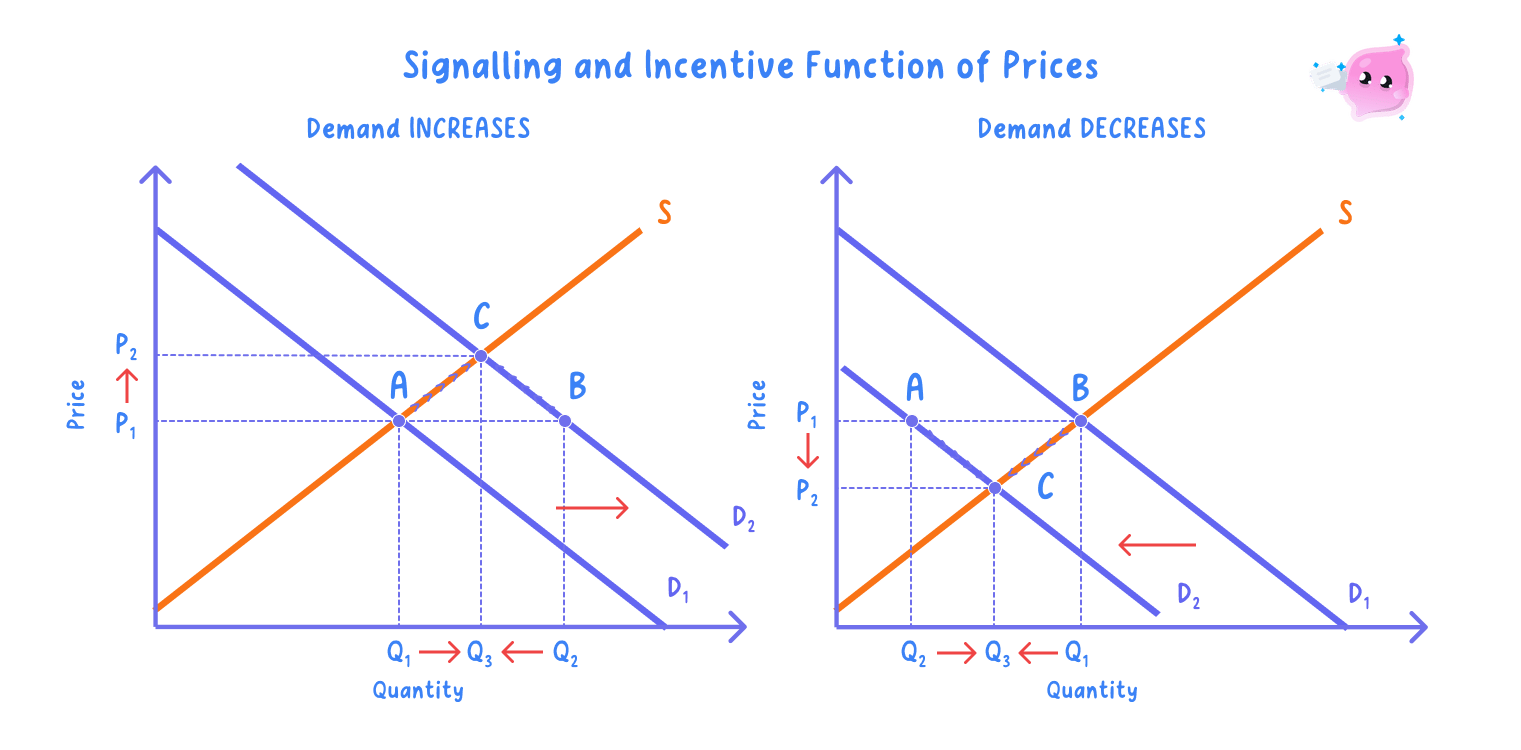
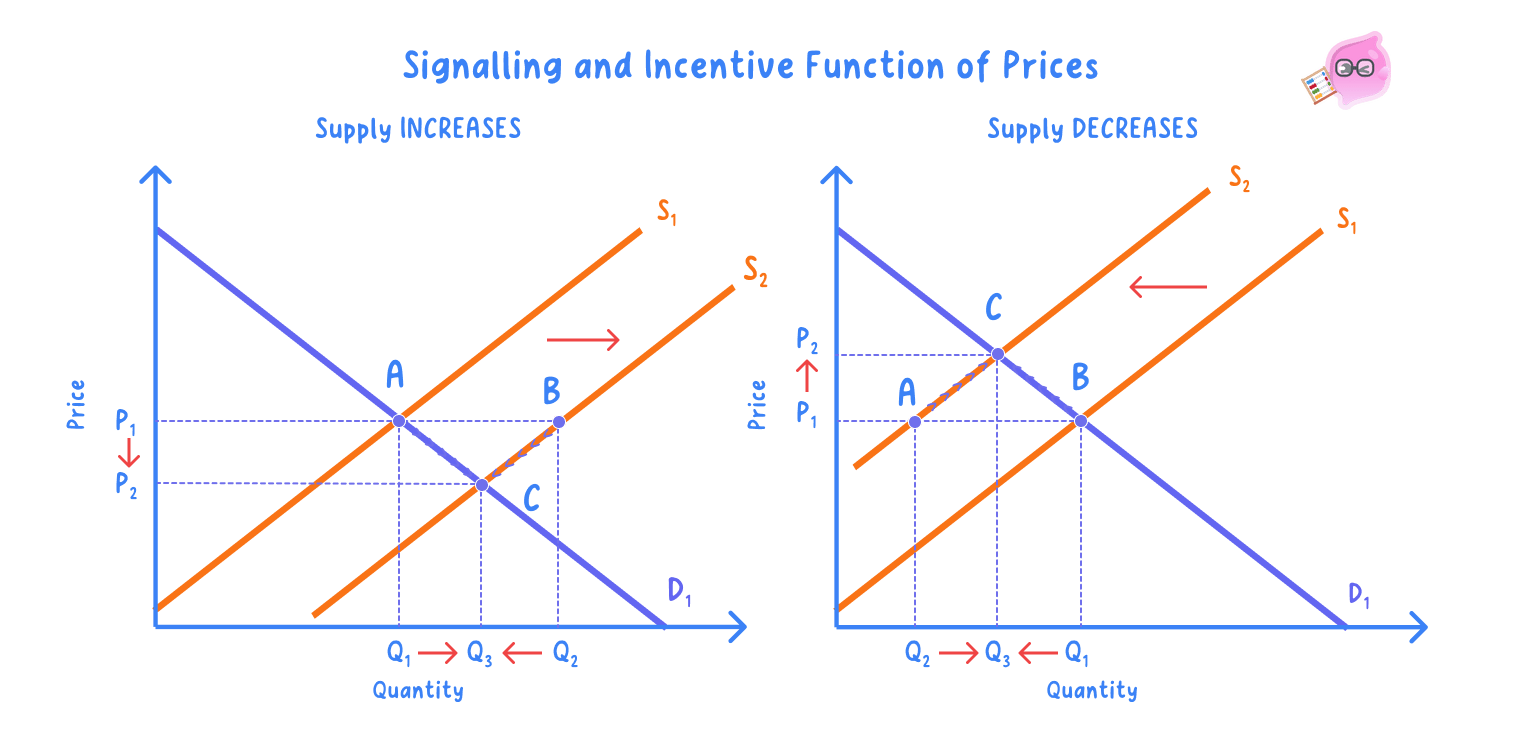
Example
- Suppose a cold winter raises demand for natural gas, pushing its price from £30 to £50 per unit, a +67% rise.
- Rationing: the higher price prices out lower-value uses, so the scarce gas goes to those who value it most.
- Signalling: the rising price tells producers that buyers now want more gas.
- Incentivising: the higher price and profit reward suppliers for raising output, so the market moves to a new equilibrium.
Role Of Profit
- Profit is the reward that ties the three functions together.
- Firms move resources towards goods where prices and profits are high and away from where they are low.
- The mechanism operates at local, national and global levels at the same time.
Limits Of The Mechanism
- The mechanism is efficient and responsive, coordinating vast numbers of decisions automatically.
- But it can fail with public goods, externalities or missing markets, where price fails to capture the true value.
- It allocates by ability to pay, which may be efficient but not equitable, so some state role usually remains.
Does the price mechanism always allocate resources efficiently?
- In competitive markets the mechanism is a remarkably efficient allocator: prices adjust automatically, no planner can match the speed with which rationing, signalling and incentivising clear a shortage, and self-interest does the coordinating.
- But efficiency is only guaranteed when price reflects the full social costs and benefits; with negative externalities, public goods or imperfect information the private price diverges from social value, so the quantity that is right for the market is the wrong quantity for society.
- A separate limit is distributional: even a perfectly working mechanism allocates by willingness and ability to pay, so a rise in the price of a staple food can ration it away from the low-income households who need it most.
- On balance, the price mechanism allocates efficiently in well-functioning competitive markets but not universally; whether it should be left alone or corrected depends on how large the market failures and equity concerns are in the particular market, which is exactly why most economies are mixed rather than purely market-based.
Exam technique
- Always identify rationing, signalling and incentivising by name.
- Trace a demand or supply change through all three functions to the new equilibrium.
- Evaluate with the limits of the mechanism, such as market failure and equity.
Common Mistake
- Do not list only one or two functions; examiners expect all three of rationing, signalling and incentivising.
- Do not assume the price mechanism always allocates fairly, since it allocates by ability to pay and can leave essentials out of reach for the poorest.
Self review
- Name the three functions of price.
- Explain the rationing function.
- Explain the signalling function.
- What role does profit play in the price mechanism?
- Give one limitation of the price mechanism.
