Marginal Revenue Product
Definition
Marginal revenue product (MRP): the addition to a firm's total revenue from employing one more unit of labour, ceteris paribus.
Marginal physical product (MPP): the extra physical output produced when one more unit of labour is employed.
MRP formula:
MRP=MPP×MR MRP = MPP \times MR MRP=MPP×MRCalculating MRP
- In a perfectly competitive product market marginal revenue equals the product price, because the firm sells all it wants at that price.
- So MRP = MPP × MR, which equals MPP × price under perfect competition; in imperfect competition MR < price, so MRP is lower at every level of employment.
Example
- An extra worker raises output by 10 units, so MPP = 10 units, and each unit sells for £5, so MR = £5.
- Reading a short table: worker 1 adds 12 units, worker 2 adds 10 units and worker 3 adds 8 units, each selling at £5.
- Their MRPs are therefore £60, £50 and £40, as the third worker's product shows:
- MRP falls as employment rises because extra workers add less output under diminishing returns.
MRP And Diminishing Returns
- As a firm adds workers to a fixed stock of capital, MPP eventually falls under the law of diminishing returns.
- Because MRP = MPP × MR, a falling MPP drags MRP down as employment rises.
- So the MRP curve slopes downward, which is exactly why the firm's labour demand curve slopes downward too.
Deriving Labour Demand
Profit-maximising employment:
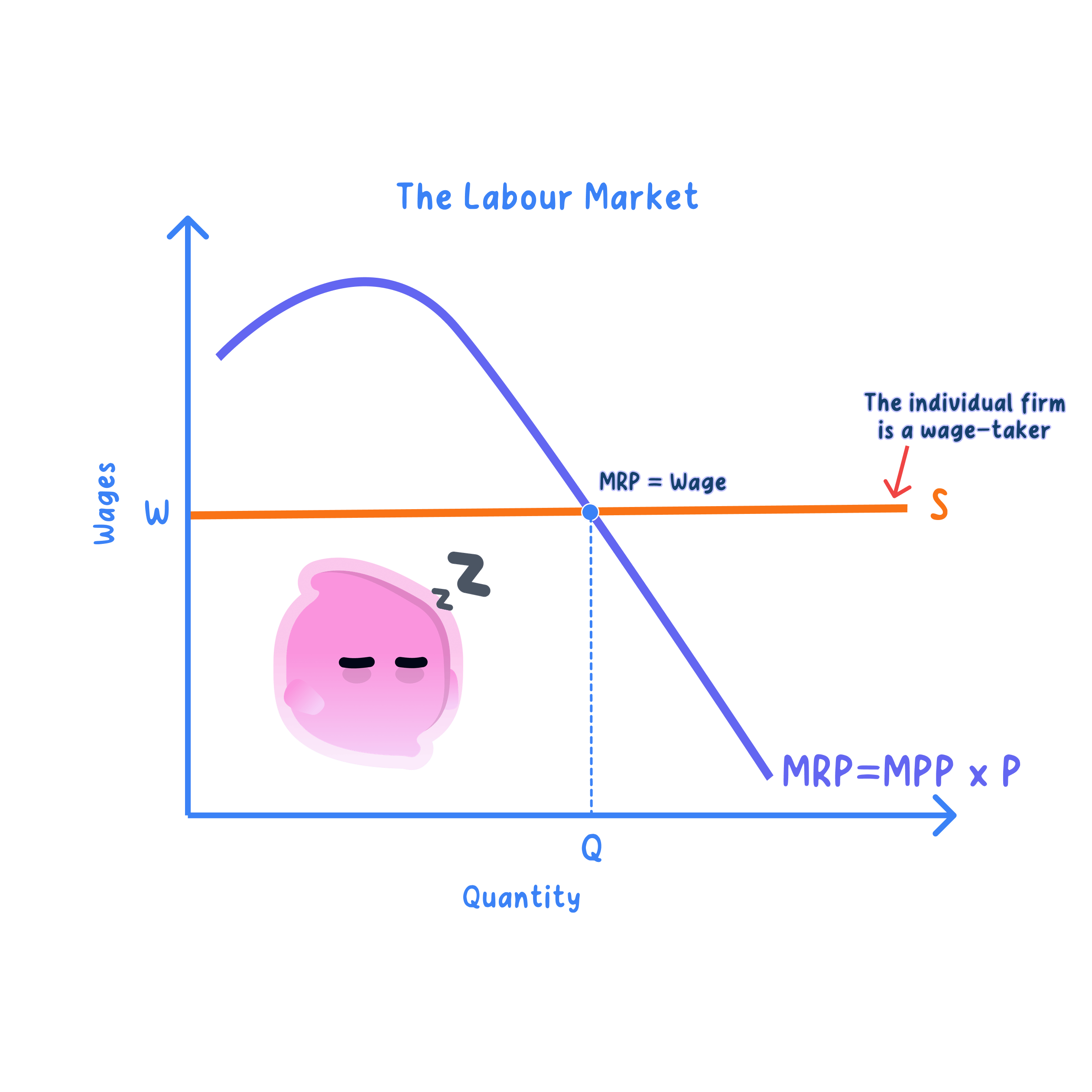
W=MRP W = MRP W=MRP- A profit-maximising firm hires workers up to the point where the wage equals MRP.
- If MRP > wage, the extra worker adds more to revenue than to cost, so hiring raises profit.
- If MRP < wage, the last worker costs more than they add, so the firm cuts employment.
- Because the firm equates wage and MRP, the downward-sloping MRP curve is its labour demand curve.
- It depends, though: MRP assumes output is measurable and the wage is given, so where teamwork makes individual output hard to isolate the theory is only an approximate guide.
Example
- If the wage is £50, the firm employs workers up to the one whose MRP is £50.
- It stops before the worker whose MRP is £40, because the wage would exceed that worker's contribution.
- If the wage fell to £40, that worker now adds £40 of revenue for £40 of cost, so employment rises to the point where:
Key Idea
- MRP = MPP × MR, which equals MPP × price in perfect competition.
- A firm hires where the wage equals MRP, so the MRP curve is its labour demand curve.
Exam technique
- Show the MRP calculation with numbers and state the units in £ clearly.
- Explain the wage = MRP hiring rule when deriving the labour demand curve.
Common Mistake
- Do not confuse MPP, measured in units, with MRP, measured in £.
- Marginal revenue equals price only in a perfectly competitive product market; elsewhere MR < price.
Self review
- Define marginal revenue product.
- Calculate the MRP of a worker who adds 10 units each selling for £5.
- Why does MRP fall as more workers are employed?
- State the rule a profit-maximising firm uses to decide how much labour to hire.
