Shifts and Movements
Definition
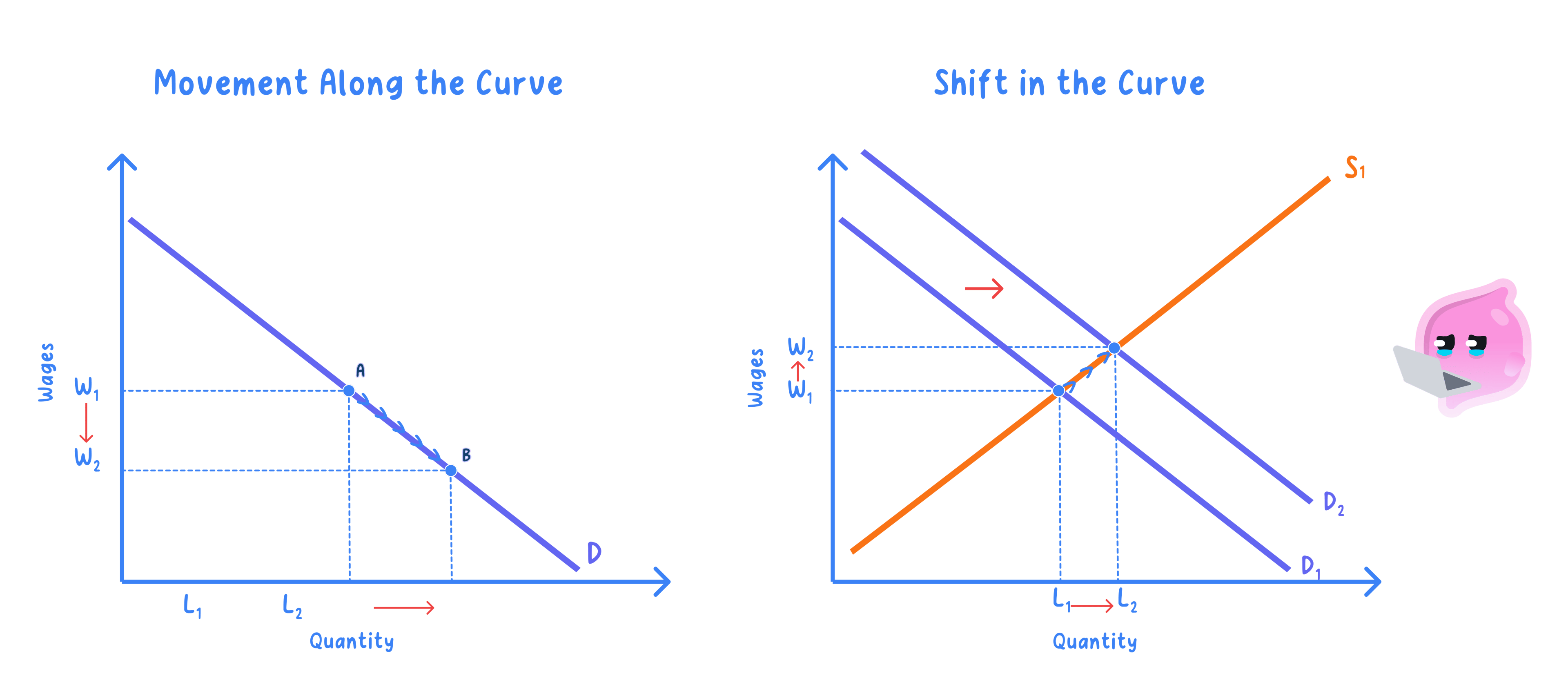
Movement along the labour demand curve: a change in the quantity of labour demanded caused only by a change in the wage rate.
Shift of the labour demand curve: a change in the quantity demanded at every wage, caused by any factor other than the wage rate.
Movement Along the Curve
- A rise in the wage raises the cost per worker → a contraction, moving up to a smaller quantity of labour.
- A fall in the wage lowers the cost per worker → an extension, moving down to a larger quantity of labour.
- How large the change is depends on how easily labour can be substituted for capital in that job.
Example
- When the wage falls from £20 to £16 an hour, a firm expands employment from 50 to 65 workers.
- Employment rises 30% purely because the wage fell, so this is an extension down the same curve, not a shift.
Shifts of the Curve
- A shift is caused by any factor other than the wage rate.
- A rightward shift means more labour is demanded at every wage.
- A leftward shift means less labour is demanded at every wage.
Causes of Shifts
- A rise in the demand for or price of the final product raises the revenue each worker earns → curve shifts right.
- A rise in labour productivity raises output and revenue per worker → curve shifts right.
- A change in the price of substitute or complementary factors changes how much labour is worth employing → curve shifts.
- The size of the shift depends on how large the change in product demand, productivity or factor prices is.
Example
- A rise in demand for smartphones raises the value of assembly workers' output.
- The labour demand curve shifts rightward, raising employment at every wage, even though the wage itself has not changed.
Key Idea
- Only a change in the wage moves the firm along the labour demand curve.
- Every other influence shifts the whole curve left or right.
Exam technique
- Decide first whether the wage has changed or whether something else has.
- Use the words extension and contraction for movements, and shift for the rest.
Common Mistake
- Do not describe a productivity or product-demand change as a movement along the curve.
- Do not draw a shift when only the wage rate has changed.
Self review
- What causes a movement along the labour demand curve?
- What is the difference between a shift and a movement?
- Name two causes of a rightward shift in labour demand.
- Does a fall in the wage rate shift the curve or cause a movement along it?
