Supply of Labour
Definition
Supply of labour: the number of workers willing and able to work in a firm or occupation at each wage rate over a given period.
Elasticity of labour supply: the responsiveness of the quantity of labour supplied to a change in the wage rate.
Elasticity of labour supply:
%ΔQL%ΔW \dfrac{\%\Delta Q_L}{\%\Delta W} %ΔW%ΔQLThe Wage Rate
- The wage rate is the main influence on labour supply to an occupation.
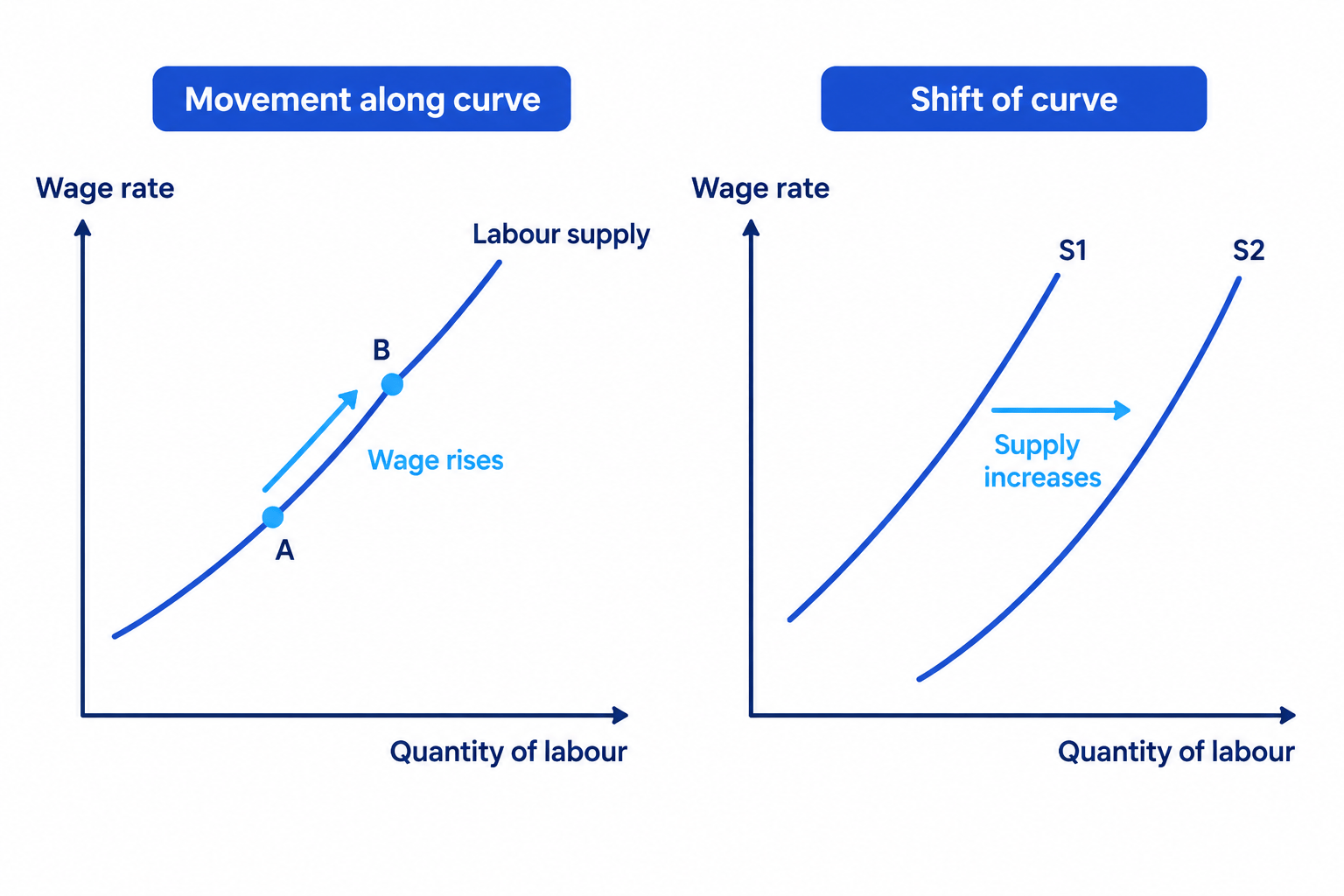
- A higher wage attracts more workers, so the supply curve slopes upward, with the wage on the vertical axis and the quantity of labour on the horizontal axis.
- How strongly supply responds is captured by the elasticity of labour supply, which is larger when workers can enter the occupation quickly.
Example
- Software developer wages rise by 20% and the quantity of labour supplied rises by 30%.
- An elasticity of 1.5 (> 1) means supply is elastic, so the wage rise draws in proportionately more workers.
- A fall in wages does the reverse, encouraging some workers to leave for better-paid work elsewhere.
Non-Wage Factors
- Non-wage factors also affect how many people are willing to supply their labour at any given wage.
- Better working conditions, job security, career prospects and job satisfaction raise supply.
- Long training requirements, dangerous conditions or unsocial hours reduce supply.
Example
- Two jobs pay the same £30,000 a year, but one offers safer conditions and paid holidays.
- More workers supply their labour to the job with the better non-wage benefits, so its supply is higher at that same wage.
Other Influences
- The size and age structure of the population set the pool of available workers.
- The qualifications and training needed for an occupation limit who can enter it.
- Migration and the wages available in alternative jobs also change supply.
- It depends on the time period: supply is more elastic in the long run, when workers can retrain and relocate, than in the short run.
Key Idea
- The labour supply curve slopes upward because a higher wage attracts more workers.
- Non-wage factors such as conditions, security and training needs shift the whole supply curve.
Exam technique
- Separate wage factors, which cause a movement along supply, from non-wage factors, which cause a shift.
- Support each point with a clear reason why workers would enter or leave the occupation.
Common Mistake
- Do not assume pay is the only thing that determines labour supply.
- Do not confuse a movement along the supply curve with a shift caused by non-wage factors.
Self review
- Define the supply of labour to an occupation.
- Why does the labour supply curve slope upward?
- Calculate the elasticity of labour supply when a 20% wage rise raises the quantity supplied by 30%.
- Explain how longer training requirements affect the supply of labour to an occupation.