Income and substitution effects
Substitution effect: the change in quantity demanded caused by the change in a good's relative price, holding satisfaction constant on the original indifference curve.
Income effect: the change in quantity demanded caused by the change in real income that a price change brings, shown as a move to a new indifference curve.
Normal good: a good whose quantity demanded rises when real income rises.
Inferior good: a good whose quantity demanded falls when real income rises.
Giffen good: a strongly inferior staple whose negative income effect outweighs its substitution effect, so quantity demanded rises when its price rises.
- A price change can be broken down into a substitution effect and an income effect.
- The substitution effect always favours the good that has become relatively cheaper.
- The direction of the income effect depends on whether the good is normal, inferior or Giffen.
- A price change has a substitution effect and an income effect.
- The substitution effect always favours the good that has become relatively cheaper.
- The direction of the income effect depends on the type of good.
Decomposing a price change
- A fall in a good's price makes it cheaper relative to other goods, which drives the substitution effect.
- The substitution effect always raises the quantity of the good that has become relatively cheaper.
- On a diagram it is a move along the original indifference curve to where its slope matches the new price ratio.
- A lower price also raises real income, because the same money income now buys more.
- The income effect is shown as a shift to a new indifference curve.
- The total price effect is the sum of the substitution and income effects.
Price effect:
PE=SE+IE \text{PE} = \text{SE} + \text{IE} PE=SE+IE- Good X falls from £4 to £2 (−50%) while money income stays at £20.
- The substitution effect alone raises X from 3 to 4 units, a move along the original indifference curve.
- For a normal good the income effect then raises X further, say from 4 to 5 units.
- Adding the two effects gives the overall rise of 2 units in quantity demanded.
Normal and inferior goods
- For a normal good, higher real income raises quantity demanded, so the income effect reinforces the substitution effect.
- Both effects push the same way, so quantity demanded clearly rises as price falls.
- For an inferior good, higher real income lowers quantity demanded, so the income effect works against the substitution effect.
- For most inferior goods the substitution effect still dominates, so quantity demanded rises as price falls and demand slopes downward.
- So the net direction depends on the relative size of the two opposing effects.
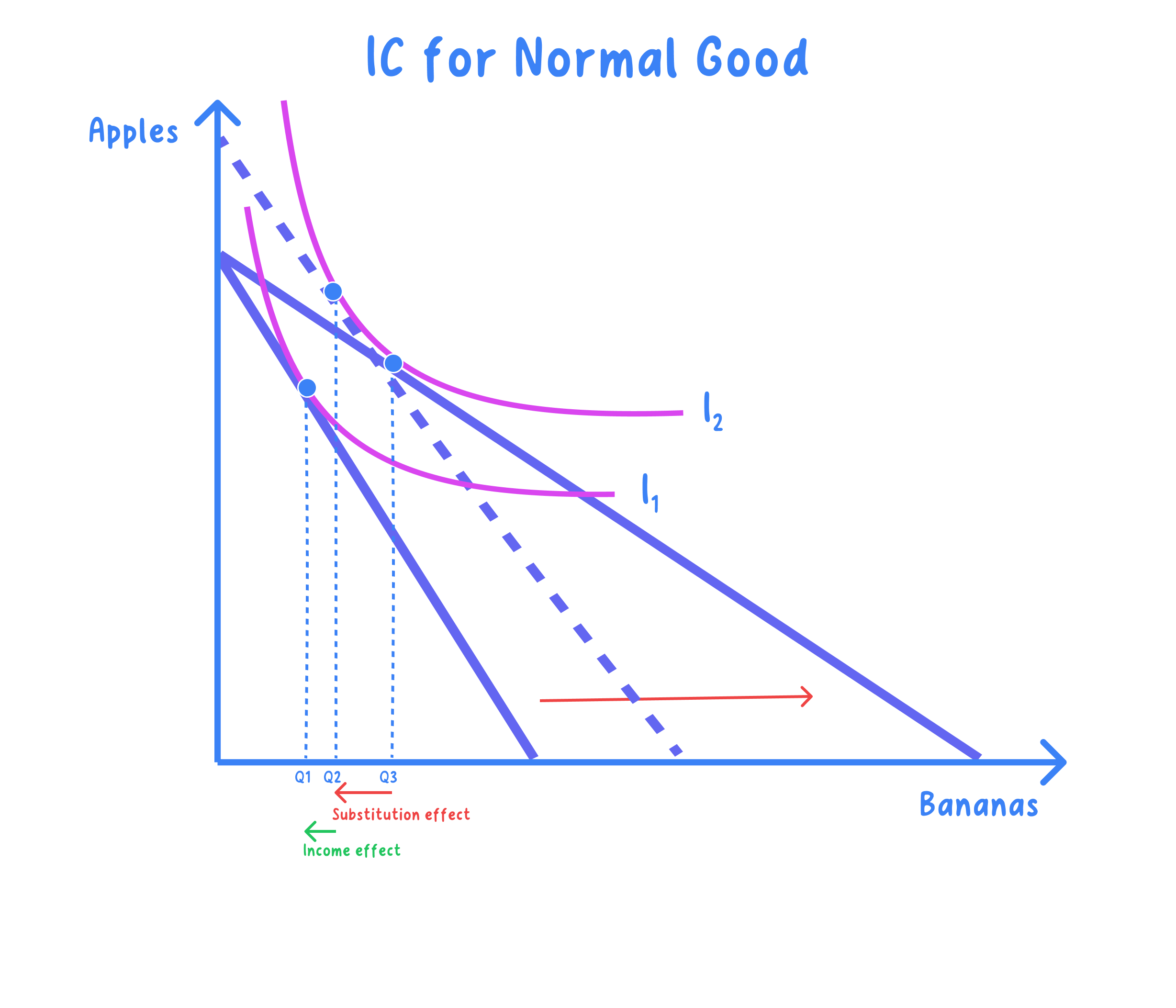
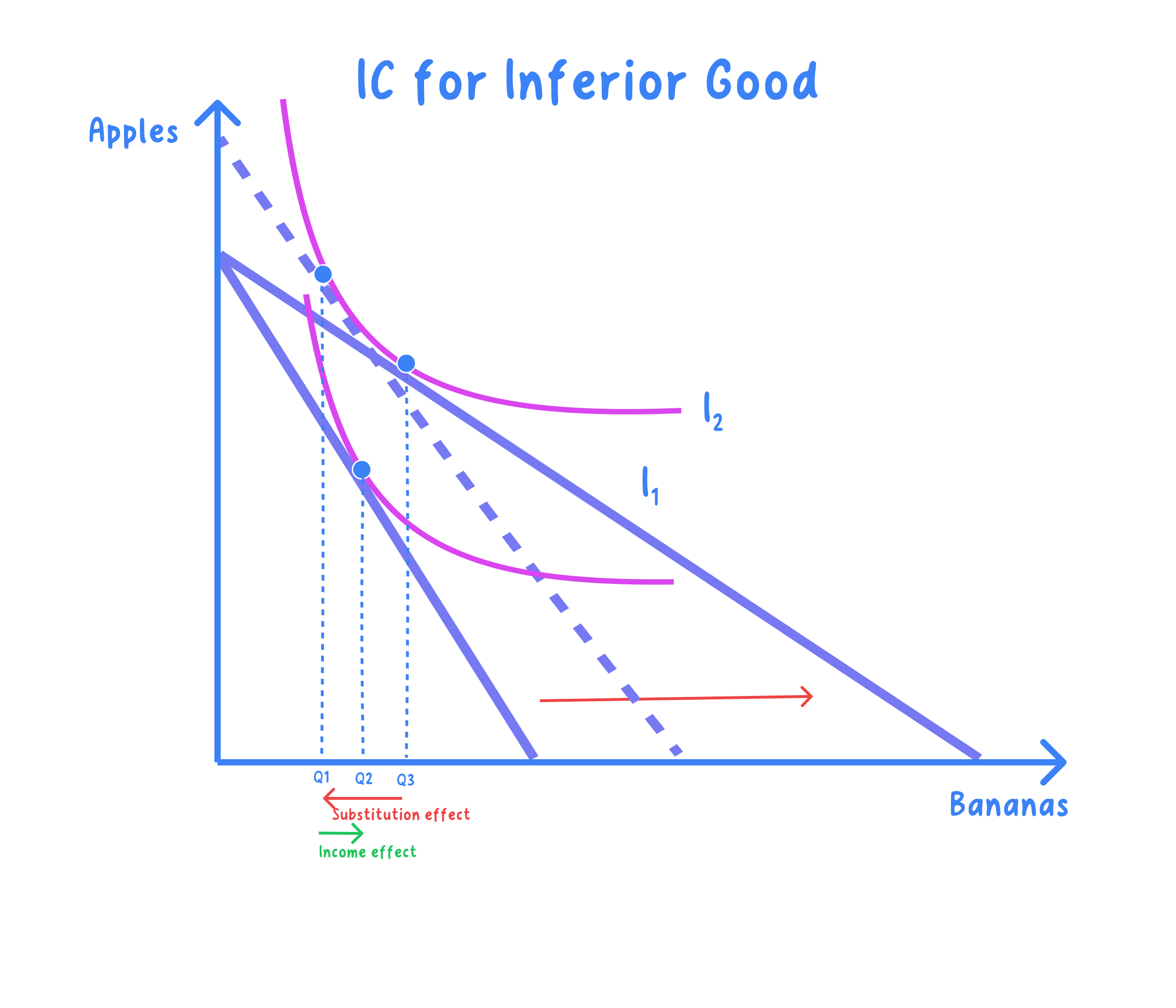
- For a normal good such as restaurant meals, cheaper meals and higher real income both raise the quantity bought.
- For an ordinary inferior good such as bus travel, cheaper fares raise quantity through substitution even though higher real income slightly reduces it.
- The net effect is still that quantity rises as price falls.
The Giffen case
- A Giffen good is a strongly inferior staple with few substitutes that takes a large share of income.
- When its price rises, real income falls sharply, and the strong negative income effect can outweigh the substitution effect.
- So quantity demanded rises as price rises, giving an upward-sloping demand response.
- Every Giffen good is inferior, but very few inferior goods are Giffen, so it is a rare special case.
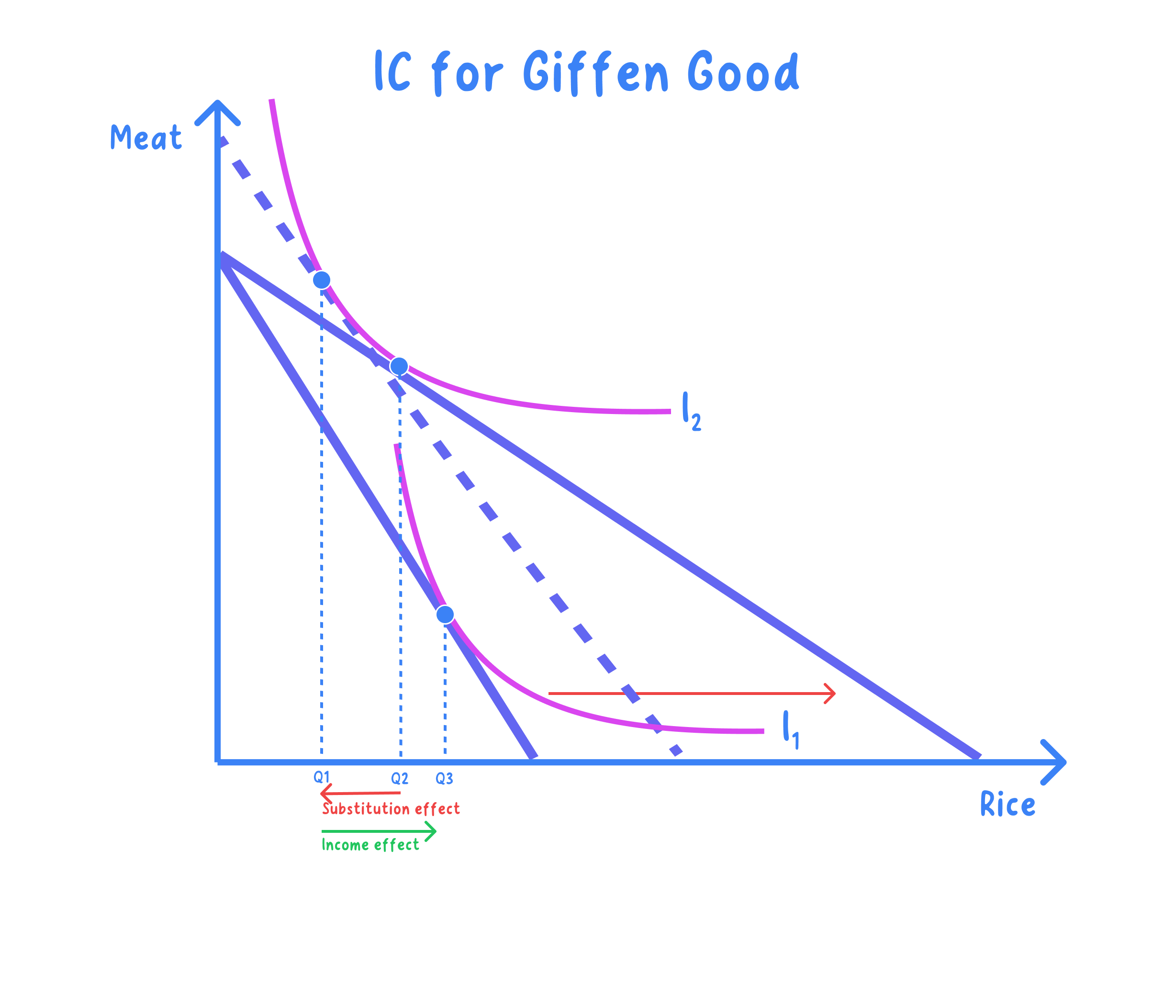
- Consider a cheap grain staple that takes a large share of a low-income household's budget.
- When its price rises, the household can no longer afford more expensive foods, so it buys even more of the cheap staple.
- Here the negative income effect outweighs the substitution effect, the rare Giffen result.
The three cases at a glance
Taking a price fall as the reference case, the substitution effect always raises quantity demanded; only the income effect changes direction, and whether it reinforces or opposes decides the result.
- Normal good: substitution effect raises quantity, income effect also raises it, so the two reinforce and quantity demanded rises strongly; demand slopes downward.
- Ordinary inferior good: substitution effect raises quantity, income effect lowers it, but the substitution effect dominates, so quantity demanded still rises; demand slopes downward.
- Giffen good: substitution effect raises quantity, but the strong negative income effect lowers it and dominates, so quantity demanded falls; demand slopes upward.
- Show the substitution effect as a move along the original indifference curve.
- Show the income effect as a shift to a new indifference curve.
- State clearly which effect dominates for the good in question.
- Do not mislabel which effect drives the perverse result for a Giffen good.
- It is the strong negative income effect that outweighs the substitution effect.
- What is the substitution effect?
- What is the income effect?
- How do the two effects combine for a normal good?
- Why does demand still slope down for most inferior goods?
- What makes a Giffen good a special case?
