Specific indirect taxes
Definition
Indirect tax: a tax on spending on a good, legally paid to the government by the producer, who can pass part of the burden to the consumer through a higher price.
Incidence: the way the burden of a tax is shared between consumers and producers, as opposed to who legally hands the money over.
- A specific tax is a fixed amount charged per unit of a good, such as a duty of £3 per litre.
- An ad valorem tax differs because it is charged as a % of the price, so the money value of the tax rises with price.
- The impact of the tax is on whoever is legally liable to pay it, which for an indirect tax is the producer.
- The incidence is who actually bears the burden, which is usually shared between producers and consumers.
Shifting the supply curve
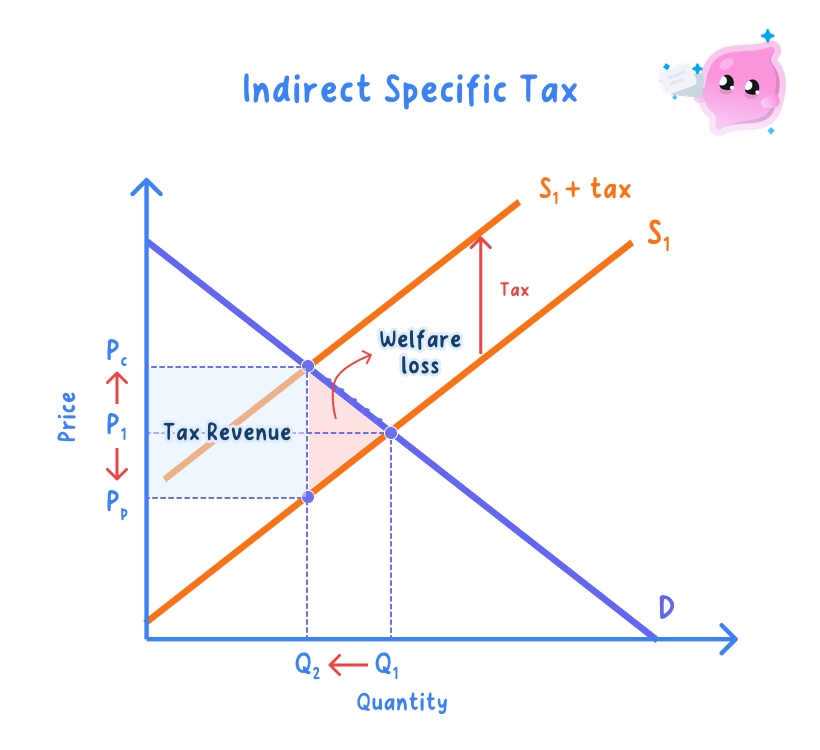
- A specific tax raises the cost of supplying each unit, so the supply curve shifts vertically upwards by the full amount of the tax.
- At the new equilibrium the price consumers pay rises and the quantity traded falls.
- The price producers keep after handing over the tax is the new consumer price − the tax per unit.
Key Idea
- The vertical gap between the old and new supply curves is always exactly the tax per unit.
- The rise in the consumer price is almost always smaller than the tax, because producers absorb part of it.
Working out the split
- To find the incidence, compare the original price with the new consumer price and the new producer price.
- The consumer share is the rise (+) in the price they pay, and the producer share is the fall (−) in the price producers keep.
- Government revenue equals the tax per unit multiplied by the quantity still sold after the tax.
Incidence shares
Consumer share=ΔPctax per unitProducer share=ΔPptax per unit \text{Consumer share}=\dfrac{\Delta P_{c}}{\text{tax per unit}}\qquad\text{Producer share}=\dfrac{\Delta P_{p}}{\text{tax per unit}} Consumer share=tax per unitΔPcProducer share=tax per unitΔPpTax revenue
Tax revenue=tax per unit×Q \text{Tax revenue}=\text{tax per unit}\times Q Tax revenue=tax per unit×QExample
- Before the tax the market clears at a price of £10 with 100 units sold.
- The government imposes a specific tax of £3 per unit, shifting supply up by £3.
- The new equilibrium price consumers pay rises to £12 and quantity falls to 80 units.
- Consumers bear £12 − £10 = £2 per unit.
- Producers keep £12 − £3 = £9, so they bear £10 − £9 = £1 per unit.
- Because the consumer share (≈ 67%) exceeds the producer share (≈ 33%), demand is more inelastic than supply here.
- Government revenue is £3 × 80 = £240.
Elasticity and incidence
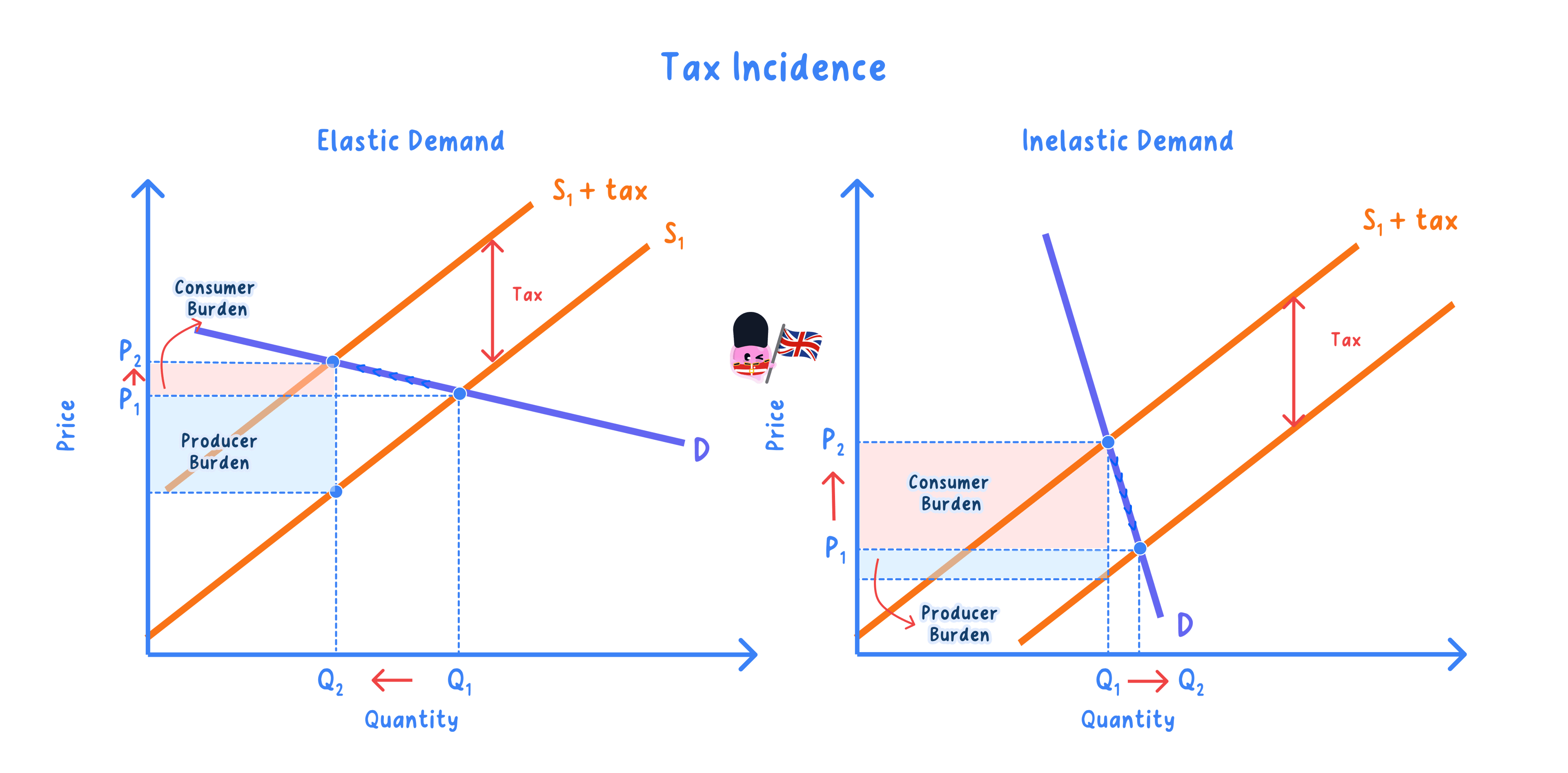
- The split depends on the relative price elasticity of demand and price elasticity of supply.
- The more inelastic side of the market bears the larger share, because it is less able to escape the tax by changing quantity.
- When demand is perfectly inelastic the consumer bears the whole tax; when demand is perfectly elastic the producer bears it all.
Example
- Tobacco has inelastic demand, so a duty falls mainly on consumers as a higher price and quantity barely falls.
- This is why governments tax cigarettes and fuel to raise reliable revenue, though it does little to cut consumption.
How effective is an indirect tax?
- As a revenue-raiser it is highly effective, because the more inelastic demand is the less quantity falls, so a duty on tobacco, alcohol or fuel yields a large and reliable revenue stream, and where the good carries negative externalities the tax internalises the external cost and moves output towards the social optimum.
- As a tool to change behaviour it is far weaker for the same reason, because when demand is inelastic even a large tax cuts quantity only slightly in the short run, so consumption of a demerit good barely falls, and setting the tax exactly equal to the hard-to-value external cost is difficult, so the correction is often imprecise.
- It is also usually regressive, taking a larger share of income from poorer consumers, and a very high duty can drive cross-border shopping or a black market that escapes the tax altogether, so efficiency gains can come at a cost to equity and enforcement.
- On balance an indirect tax is an effective, low-cost way to raise revenue and, over a longer horizon, to nudge consumption of externality-generating goods downwards, but how far it corrects the market depends on the elasticity of demand, whether the aim is revenue or behaviour change, how accurately the tax matches the external cost, and whether information or regulation is used alongside it.
Exam technique
- Define impact and incidence separately before analysing who bears the tax.
- Draw the supply shift, mark the new consumer and producer prices, and shade the tax revenue box.
- Link the size of each share explicitly to relative elasticity.
Common Mistake
- Do not assume the producer bears the tax just because they hand the money to the government.
- The more inelastic side always bears the larger share, whoever pays it in.
Self review
- Distinguish the impact from the incidence of an indirect tax.
- By how much does the supply curve shift when a £3 specific tax is imposed?
- If price rises from £10 to £12 after a £3 tax, what share do producers bear?
- Which side bears more of the tax when demand is more inelastic than supply?
