Price controls
Definition
Price control: a legally imposed maximum or minimum price that holds the market away from its free-market equilibrium.
- Governments intervene when they judge the free-market price to be too high for consumers or too low for producers.
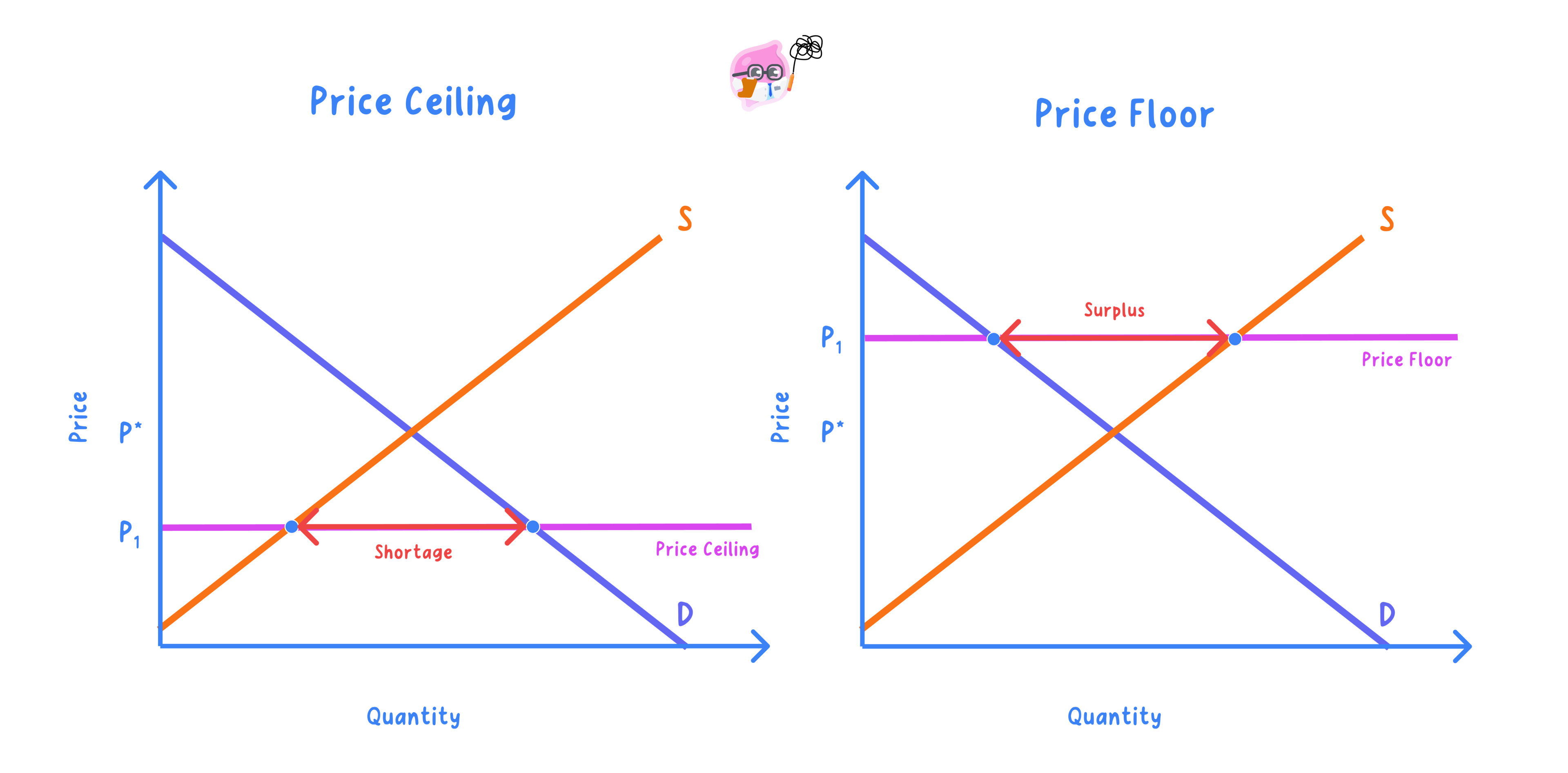
- A maximum price (ceiling) is a legal limit set below equilibrium to keep essential goods affordable.
- A minimum price (floor) is a legal limit set above equilibrium to support producers or discourage harmful consumption.
Key Idea
- A maximum price bites only when set below equilibrium, and then causes a shortage.
- A minimum price bites only when set above equilibrium, and then causes a surplus.
Maximum prices
- A maximum price aims to protect consumers when the equilibrium price is unaffordable.
- Because it sits below equilibrium, quantity demanded exceeds quantity supplied.
- The result is a shortage, or excess demand, because the low price cannot ration the good.
- Rationing, queues or black markets then emerge to allocate the scarce supply, so some consumers gain cheaper goods while others get none.
Example
- The equilibrium monthly rent for a city flat is £1,000.
- The government sets a maximum rent of £700 to keep housing affordable.
- At £700, which is 30% below equilibrium, more tenants want flats but fewer landlords are willing to let them.
- Quantity demanded now exceeds quantity supplied, creating a housing shortage.
- Waiting lists, queues and illegal side-payments appear as people compete for the scarce flats.
Minimum prices
- A minimum price aims to support producers' incomes or to discourage harmful consumption.
- Because it sits above equilibrium, quantity supplied exceeds quantity demanded.
- The result is a surplus, or excess supply, because the high price attracts output that buyers will not take.
- The government may then have to buy up and store the surplus, at a cost to taxpayers.
Example
- The equilibrium price of wheat is £200 a tonne.
- The government guarantees farmers a minimum price of £260 a tonne.
- At £260, which is 30% above equilibrium, farmers supply more wheat but buyers demand less.
- Quantity supplied now exceeds quantity demanded, creating a surplus.
- The government must buy and store the surplus wheat, adding to public spending.
Effect on the price mechanism
- Controlled prices stop the market from clearing at equilibrium.
- They distort the signalling and rationing functions of the price mechanism, so resources are no longer allocated to their highest-valued use.
- This leaves a persistent shortage or surplus rather than a one-off adjustment, so whether the control is worthwhile depends on weighing the protected group against the distortion created.
Do price controls do more harm than good?
- A binding control does protect its target group, because a rent ceiling lets low-income tenants who secure a flat pay less, and a wheat price floor gives farmers a higher, more stable income.
- However, because the price can no longer clear the market, the control leaves a persistent shortage or surplus, and a ceiling in particular breeds queues, waiting lists and black markets that can leave the poorest with nothing at all.
- The distortion is larger the further the control sits from equilibrium and the more inelastic the market, and a floor forces the government to buy and store surpluses at a taxpayer cost, so the policy carries real efficiency and fiscal costs.
- On balance, a price control can be justified where the equity gain to a protected group is large and the good is essential, but whether it does more good than harm depends on how far it lies from equilibrium, the elasticities of demand and supply, how long it stays in force, and whether a subsidy or direct provision would correct the problem with less distortion.
Exam technique
- Draw the control as a horizontal line above or below the equilibrium price.
- For a ceiling mark the shortage where demand exceeds supply, and for a floor mark the surplus where supply exceeds demand.
- Then explain the knock-on effect on the price mechanism and on economic agents.
Common Mistake
- Do not place a maximum price above equilibrium, because to bite a ceiling must be below equilibrium and a floor above it.
- Do not confuse the effects, because a ceiling causes a shortage while a floor causes a surplus.
Self review
- What is a maximum price and where must it be set to bite?
- What is a minimum price and where must it be set to bite?
- What does a price ceiling cause, and why?
- What does a price floor cause, and why?
- Give a real example of a maximum price and a minimum price.
