Subsidies
Definition
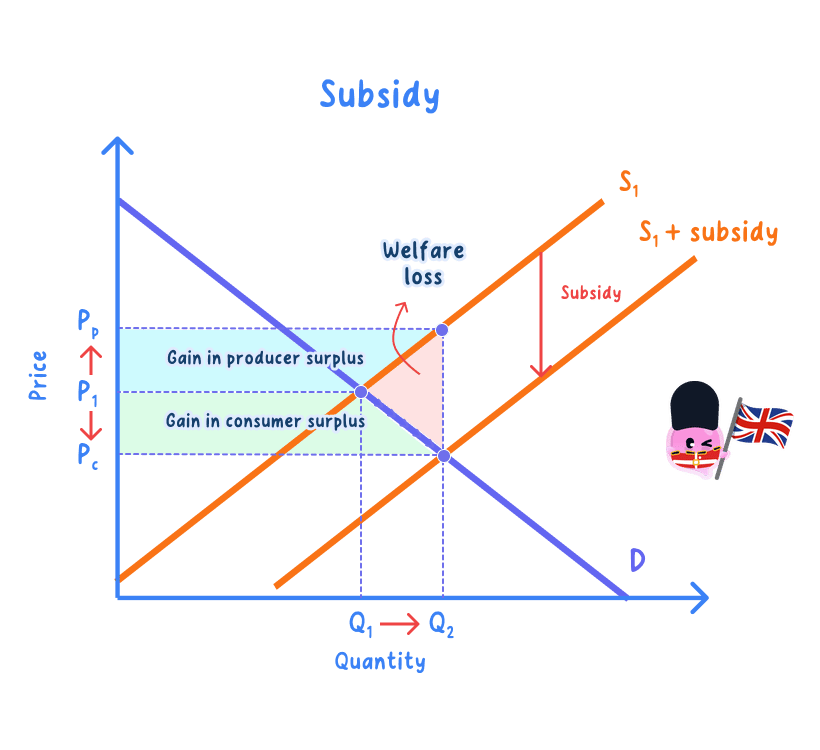
Subsidy: a government payment to producers that lowers their costs of production, encouraging them to supply more at every price.
- Because the payment lowers unit costs, the supply curve shifts vertically downwards by the amount of the subsidy per unit, the mirror image of an indirect tax.
- The new equilibrium has a lower price for consumers and a higher quantity traded.
- The effective price producers receive is the new market price + the subsidy per unit.
Key Idea
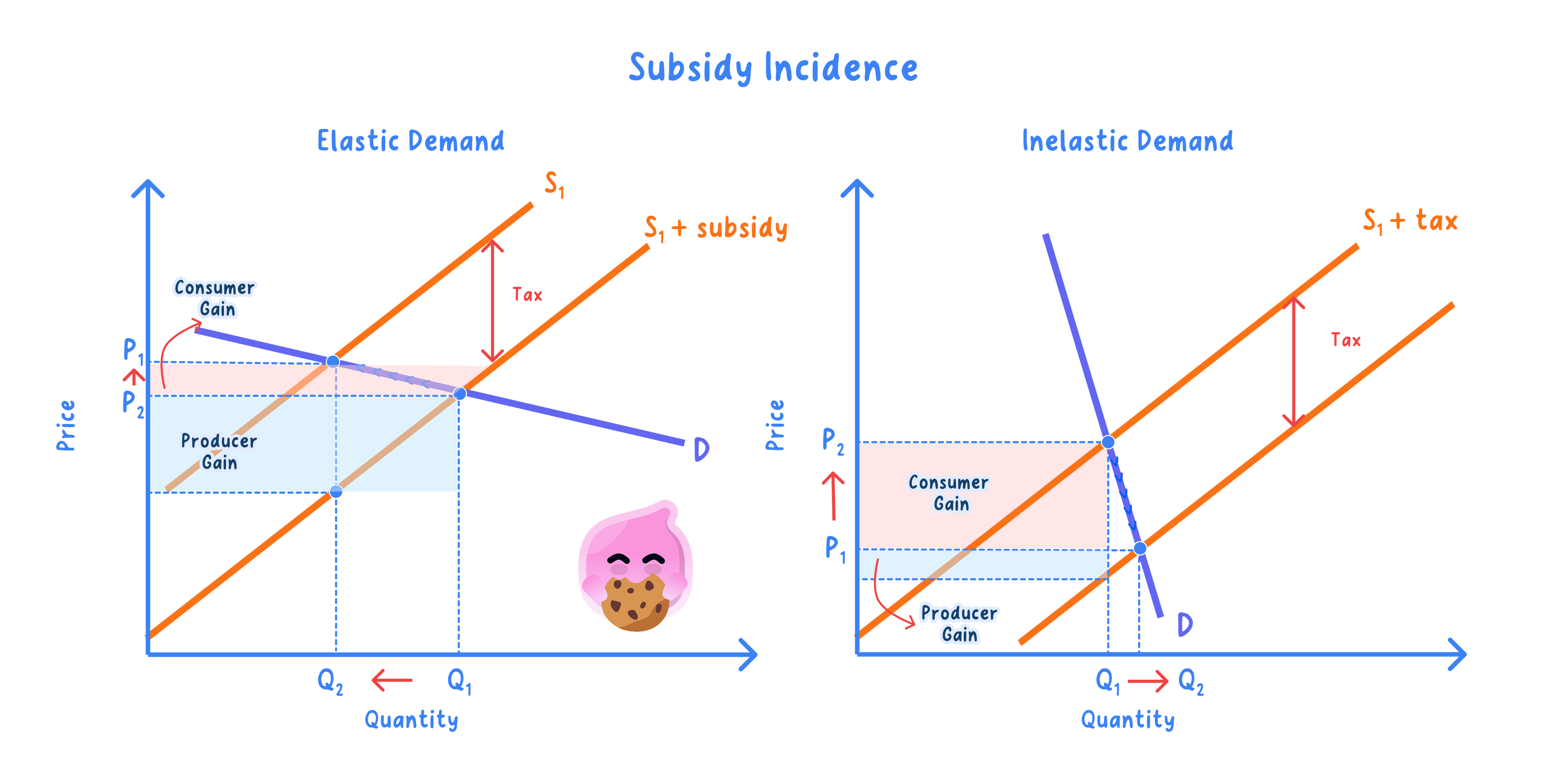
- The benefit of a subsidy is shared between consumers, who pay less, and producers, who receive more.
- The price to consumers falls by less than the subsidy whenever demand is not perfectly elastic.
Sharing the benefit
- The consumer gain is the fall (−) in the price they pay, and the producer gain is the rise (+) in the price they keep after the subsidy.
- As with a tax, the more inelastic side of the market captures the larger share of the benefit.
- The total cost to the government is the subsidy per unit multiplied by the new higher quantity.
Benefit shares
Government cost
Government cost=subsidy per unit×Q \text{Government cost}=\text{subsidy per unit}\times Q Government cost=subsidy per unit×QExample
- Before the subsidy the market clears at a price of £20 with 100 units sold.
- The government pays producers a subsidy of £4 per unit, shifting supply down by £4.
- The new equilibrium price consumers pay falls to £17 and quantity rises to 130 units.
- The consumer price falls by £20 − £17 = £3, which is less than the £4 subsidy.
- Producers now receive £17 + £4 = £21, a gain of £1 per unit.
- Because consumers capture 75% of the benefit, demand is more inelastic than supply here.
- The total cost to the government is £4 × 130 = £520.
Why governments subsidise
- Subsidies encourage consumption of goods with positive externalities, such as vaccinations or public transport, moving output towards the social optimum.
- They can make necessities more affordable and protect the incomes of key producers such as farmers.
- They can also support new or strategic industries until they become competitive.
Example
- Many governments subsidise solar panels to encourage a shift away from fossil fuels.
- The lower price raises take-up, spreading the external benefit of cleaner air.
Do subsidies work?
- A subsidy does raise output and consumption towards the social optimum, and it works best when demand is price-elastic, because then a given fall in price produces a large rise in quantity, so subsidising public transport or renewable energy can shift behaviour substantially and spread the external benefit widely.
- If demand or supply is inelastic the quantity effect is small and most of the money simply raises producer revenue or cuts the consumer price without changing behaviour, so the subsidy is poor value, and it carries an opportunity cost because the same funds could support other public spending.
- Subsidies can also keep inefficient firms in business, dull the incentive to cut costs, and are politically hard to remove once granted, so they risk becoming a permanent drain and a source of government failure.
- On balance a subsidy is justified where a good generates clear positive externalities and demand is responsive enough for the payment to change behaviour, but its net value depends on the elasticity of demand and supply, the size and accuracy of the payment, the opportunity cost of the funds, and whether it can be withdrawn once the market matures.
Exam technique
- Shift supply downwards, not the demand curve, when you draw a subsidy.
- Shade the government cost as the subsidy per unit × the new quantity.
Common Mistake
- A subsidy shifts supply, not demand, so never move the demand curve.
- The consumer price falls by less than the full subsidy unless demand is perfectly elastic.
Self review
- In which direction does a subsidy shift the supply curve, and by how much?
- If a £4 subsidy makes price fall from £20 to £17, how much does the producer gain per unit?
- How do you calculate the total cost of a subsidy to the government?
- Give one reason why the consumer price falls by less than the subsidy.
