Equilibrium and full employment
Definition
Equilibrium level of national income: the income level where aggregate demand equals aggregate supply, so planned injections equal planned withdrawals and output has no tendency to change.
Full employment level of national income: the output at which all available resources are fully employed.
- Equilibrium income is determined by the level of demand, so it can settle below, at, or beyond full employment.
- When it settles away from full employment, the distance between the two is called an output gap, measured in real output.
- A demand-side shift moves equilibrium income, whereas the full employment level is fixed by the economy's productive capacity.
Key Idea
- There is no guarantee that demand delivers exactly the full employment level of output.
- The gap between the two levels is either deflationary (too little demand) or inflationary (too much).
The deflationary gap
Definition
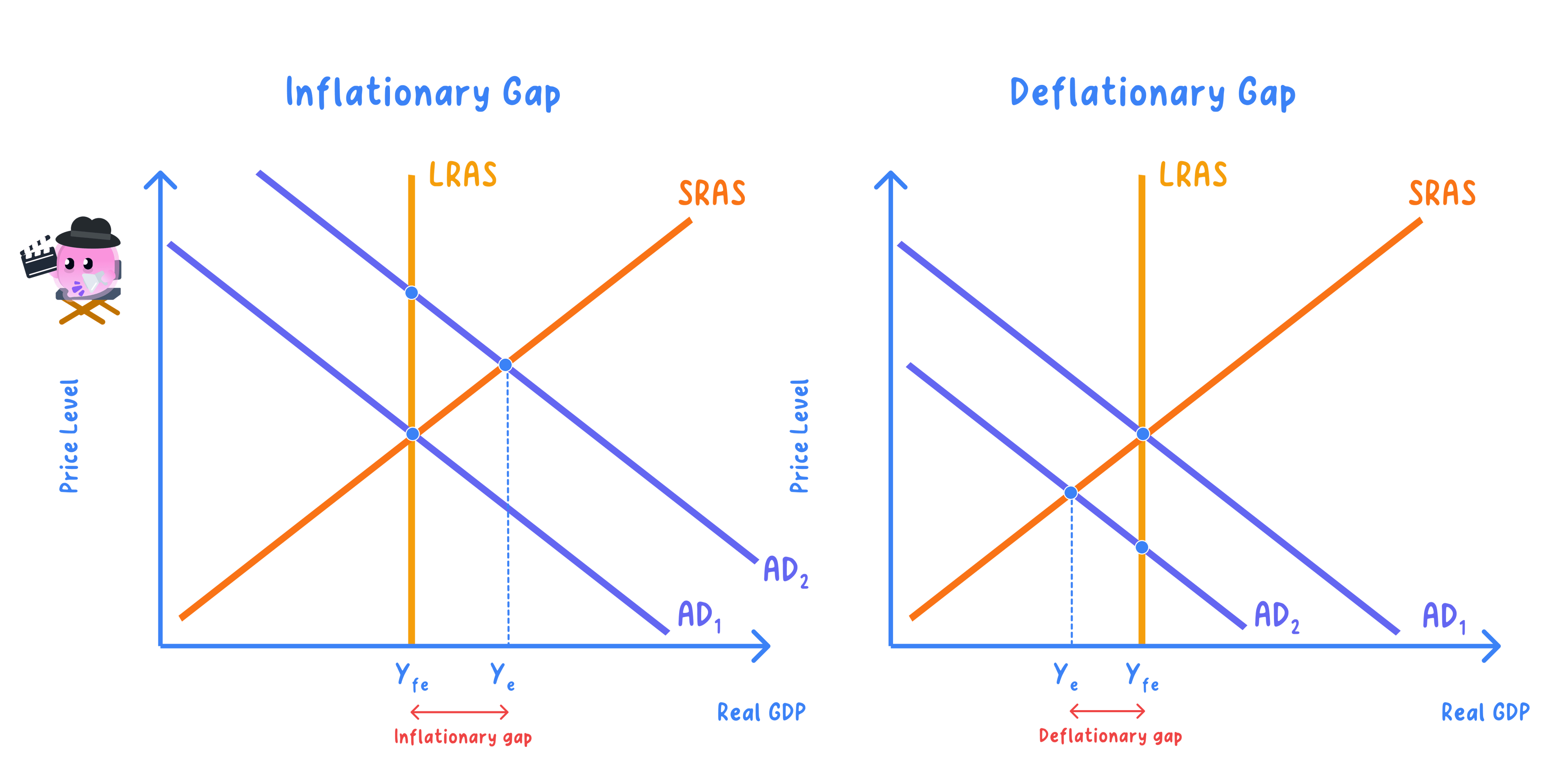
Deflationary (output) gap: the shortfall of aggregate demand below the level needed for full employment, leaving equilibrium income below capacity.
- Weak demand leaves resources unused, so unemployment rises and there is downward pressure on the price level.
- Because output is demand-determined in the short run, the economy can stay stuck below capacity without an automatic recovery.
- Expansionary fiscal or monetary policy raises AD to close the gap, as when the eurozone ran well below potential output after the 2008–09 recession.
Example
- Full employment output is £500bn but demand sustains only £460bn, a shortfall of 8%; the multiplier is 2.
- An extra £20bn of injections therefore closes the £40bn gap, because the multiplier of 2 doubles it.
The inflationary gap
Definition
Inflationary gap: the amount by which planned aggregate demand exceeds the full employment level of output.
- Output cannot rise further because resources are already fully employed, so the excess demand pulls prices up.
- The result is demand-pull inflation rather than higher real output.
- Contractionary policy reduces AD to close it, as central banks tightened after the 2021–22 surge in demand pushed inflation well above target.
Example
- Planned demand would require £540bn but capacity is £500bn, an excess of 8%; the multiplier is 2.
- Cutting demand-creating injections by £20bn removes the £40bn inflationary gap and eases the upward pressure on prices.
Note
- Closing a gap is neat in theory but harder in practice, since the injection needed depends on the true size of the multiplier, which is uncertain, and on estimating the gap correctly, which is difficult.
- Time lags mean a stimulus may arrive late, and a demand injection raises real output only while spare capacity remains; near full employment it mainly raises prices.
Exam technique
- Define equilibrium income and full employment income separately before comparing them.
- State whether the gap is inflationary or deflationary and name a policy to close it, using the multiplier to size the change.
Common Mistake
- Do not assume the equilibrium level of income is automatically the full employment level.
- Do not describe an inflationary gap as higher real output, since output is already at its full employment ceiling.
Self review
- Define the equilibrium level of national income.
- Define the full employment level of national income.
- What is a deflationary gap and what does it cause?
- What is an inflationary gap and what does it cause?
- With a multiplier of 2, how large an injection closes a £40bn deflationary gap?
