Components of aggregate demand
Definition
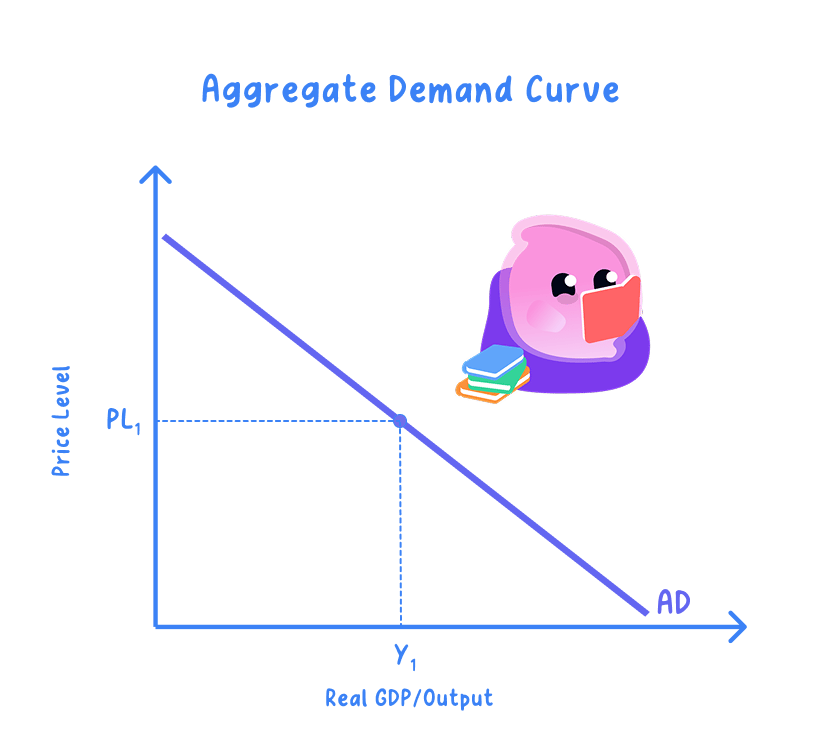
Aggregate demand (AD): total planned spending on domestic output at each price level, made up of consumption, investment, government spending and net exports.
The four components
- Aggregate demand is written AD = C + I + G + (X − M), summing the plans of every sector of the economy.
- Each component has its own determinants, so a change in any one of them shifts the whole AD curve.
- Consumption is usually the largest single component, at roughly 60% of AD in many economies, so consumer confidence matters most for the overall level of demand.
Key Idea
- Aggregate demand adds the four planned spending flows at each price level.
- Net exports are exports − imports, so a rise in imports lowers AD.
The consumption function
Definition
Consumption function: the relationship showing how planned consumption changes as income changes.
Autonomous consumption: spending that takes place even at zero income, financed by past saving or borrowing.
Induced consumption: the part of consumption that rises as income rises.
- The function is written C = a + bY, where a is autonomous spending and b is the marginal propensity to consume.
- The term a is financed by dissaving, so households spend even when income is zero.
- The term bY grows with income, so when the US Federal Reserve cut interest rates cheaper borrowing lifted b-driven spending and shifted AD right.
Example
- Autonomous consumption is £50bn, the marginal propensity to consume is 0.8 (80%) and income is £500bn.
- Planned consumption is £450bn, so the remaining £50bn of income is saved.
The savings function
Definition
Savings function: the relationship showing how planned saving, the part of disposable income not consumed, changes as income changes.
- Because saving is the mirror of consumption, the function is S = −a + (1 − b)Y.
- Autonomous saving is negative at low income because households dissave to fund their autonomous consumption.
- Induced saving rises with income as the marginal propensity to save (1 − b) takes a share of each extra pound.
Example
- With the same figures, autonomous saving is −£50bn and the marginal propensity to save is 20%.
- Saving is £50bn, confirming that planned C + S = disposable income of £500bn.
Investment and the accelerator
Definition
Accelerator: the theory that net investment depends on the rate of change of national output, not on its level.
- Investment is spending by firms on capital goods and on stocks (inventories).
- Autonomous investment does not depend on current income and reflects interest rates, business expectations and technology.
- Induced investment rises when output and demand are growing, linking investment to the state of the economy.
- Under the accelerator, net investment equals the capital-output ratio multiplied by the change in output, so faster growth triggers a sharp rise in orders for machinery.
- If output grows more slowly, less new capital is needed, so investment can fall even while output still rises; combined with the multiplier this amplifies booms and slumps.
Example
- A carmaker needs £2 of capital for every £1 of output (a capital-output ratio of 2) and demand rises by £10bn.
- Net investment jumps by £20bn, so if growth then merely slows, orders for new machinery are cut even though sales are still rising.
Government spending and net exports
- Government spending on goods and services is set by fiscal policy and is largely independent of current income.
- Net exports (X − M) depend on incomes at home and abroad, competitiveness and the exchange rate.
- Exports inject demand while imports leak it out, so a depreciation of the Indian rupee made India's exports cheaper abroad, raising net exports and shifting AD right.
Exam technique
- Name the determinants of the relevant component when explaining a shift in AD.
- Tie investment to the rate of change of output when the question is about the accelerator.
Common Mistake
- Do not confuse the accelerator, which drives investment, with the multiplier, which drives income.
- Do not treat all investment as autonomous, since induced investment responds to output growth.
Self review
- State the four components of aggregate demand.
- Distinguish autonomous from induced consumption.
- Why is autonomous saving negative at low income?
- What does the accelerator link net investment to, and how is it calculated?
- How do net exports affect aggregate demand?
