Movement Along Versus Shift
Definition
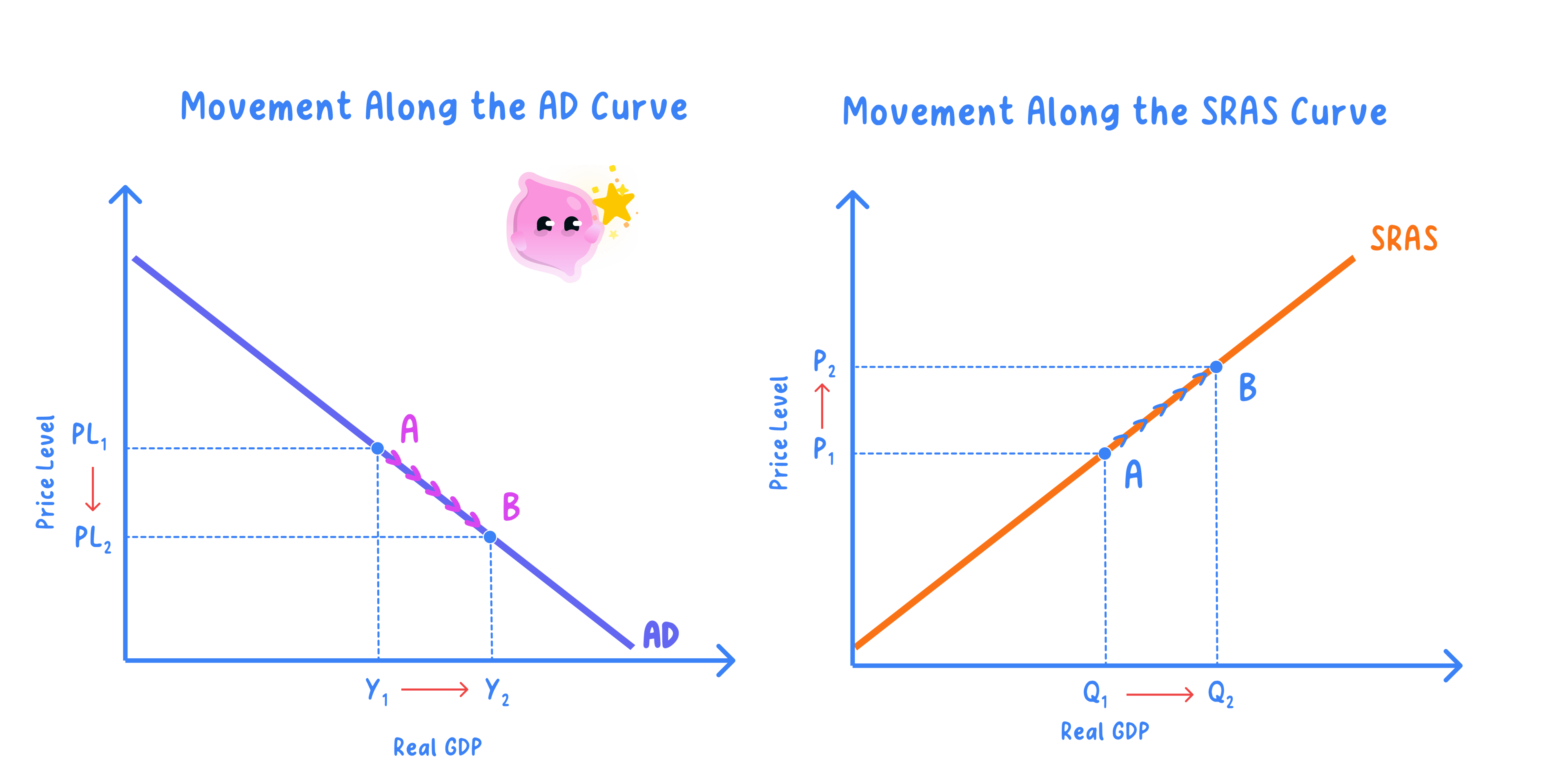
Movement along a curve: a change in the average price level moving to a new point on the same AD or AS curve.
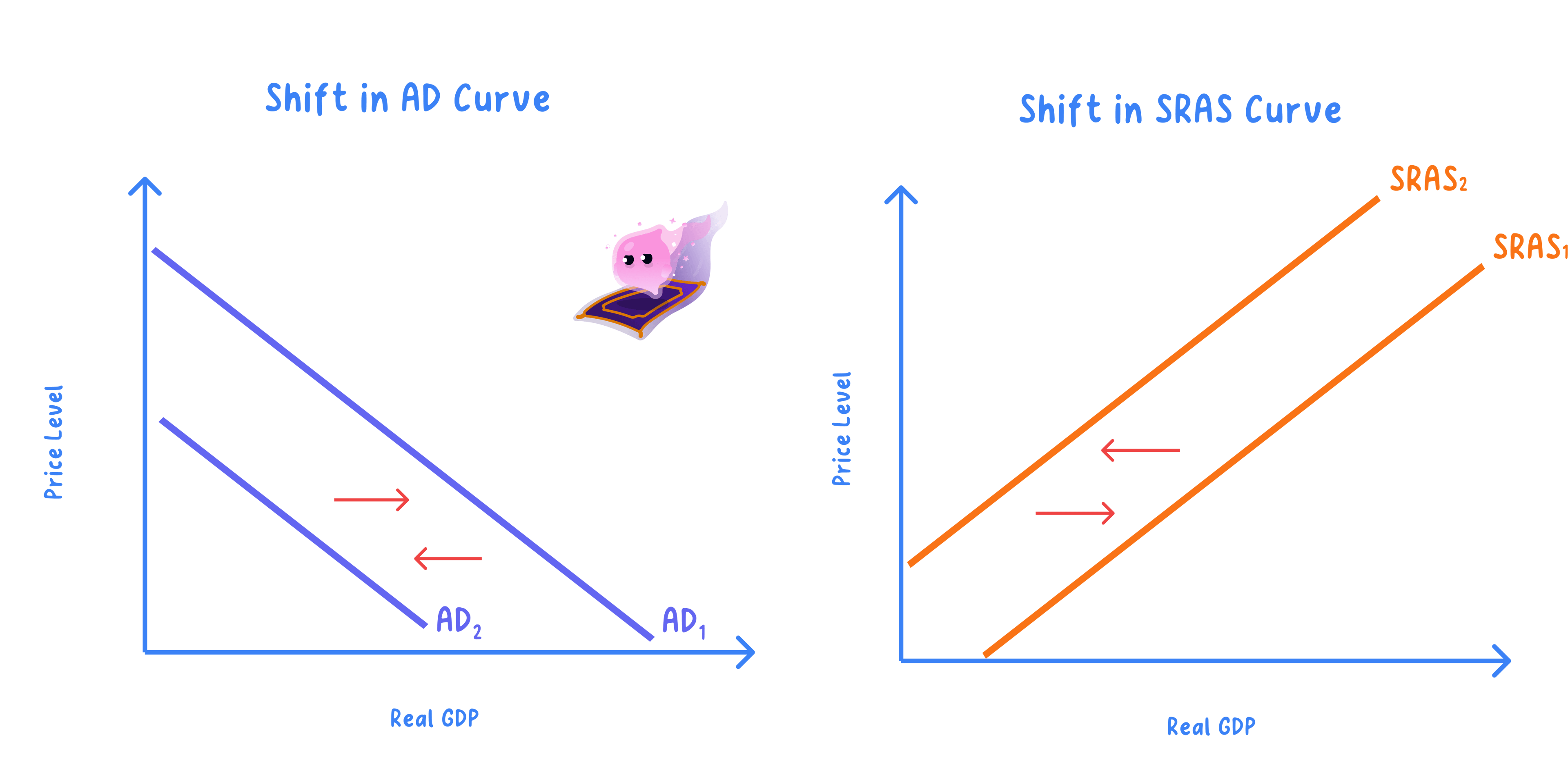
Shift of a curve: a change in a non-price determinant that redraws the whole AD or AS curve at a new position.
- Any non-price determinant redraws the whole curve, so real output changes at every price level.
- This price-versus-determinant rule applies to both AD and AS.
Key Idea
- A change in the price level causes a movement along AD or AS.
- A change in any other determinant shifts the whole curve.
AD: Movement and Shift
- A change in the price level causes a movement along the AD curve, because real wealth and competitiveness change while the curve stays put.
- A change in consumption, investment, government spending or net exports shifts AD, because a component of AD = C + I + G + (X − M) has changed.
- So only a non-price determinant shifts the AD curve.
Example
- Case A: the average price level falls by −2%, so the real value of cash and savings rises.
- Households can buy more, shown as a movement down along a fixed AD curve.
- Case B: the central bank cuts the interest rate from 5% to 4% while the price level is unchanged.
- Interest on a £200,000 mortgage falls by about £2,000 a year, so consumption and investment rise and the whole AD curve shifts right.
AS: Movement and Shift
- A change in the price level causes a movement along the AS curve, because margins change while costs are momentarily fixed.
- A change in costs or in productive capacity shifts AS, because supply conditions have altered at every price level.
- So the same price-versus-determinant rule applies to AS.
Example
- Case A: the price level rises by +3% while wage contracts are fixed for the year.
- Wider margins lead firms to raise output, shown as a movement up along a fixed SRAS curve.
- Case B: oil rises from $70 to $110 a barrel while the price level is unchanged.
- Energy and transport costs rise at every output, so the whole SRAS curve shifts left.
A Simple Test
- Ask whether the average price level itself is the trigger for the change.
- If it is, the effect is a movement along the existing curve.
- If any other determinant has changed, the effect is a shift of the curve.
Exam technique
- Use a movement along the curve for a price-level change.
- Use a shift for a change in any other determinant of AD or AS.
- Label the axes as the average price level and real output.
Common Mistake
- Do not treat a price-level change as a shift of the curve.
- A price-level change is a movement along the existing curve.
Self review
- What causes a movement along AD or AS?
- What causes a shift in AD?
- What causes a shift in AS?
- How can you tell a movement from a shift?
