Causes of AS Shifts
Definition
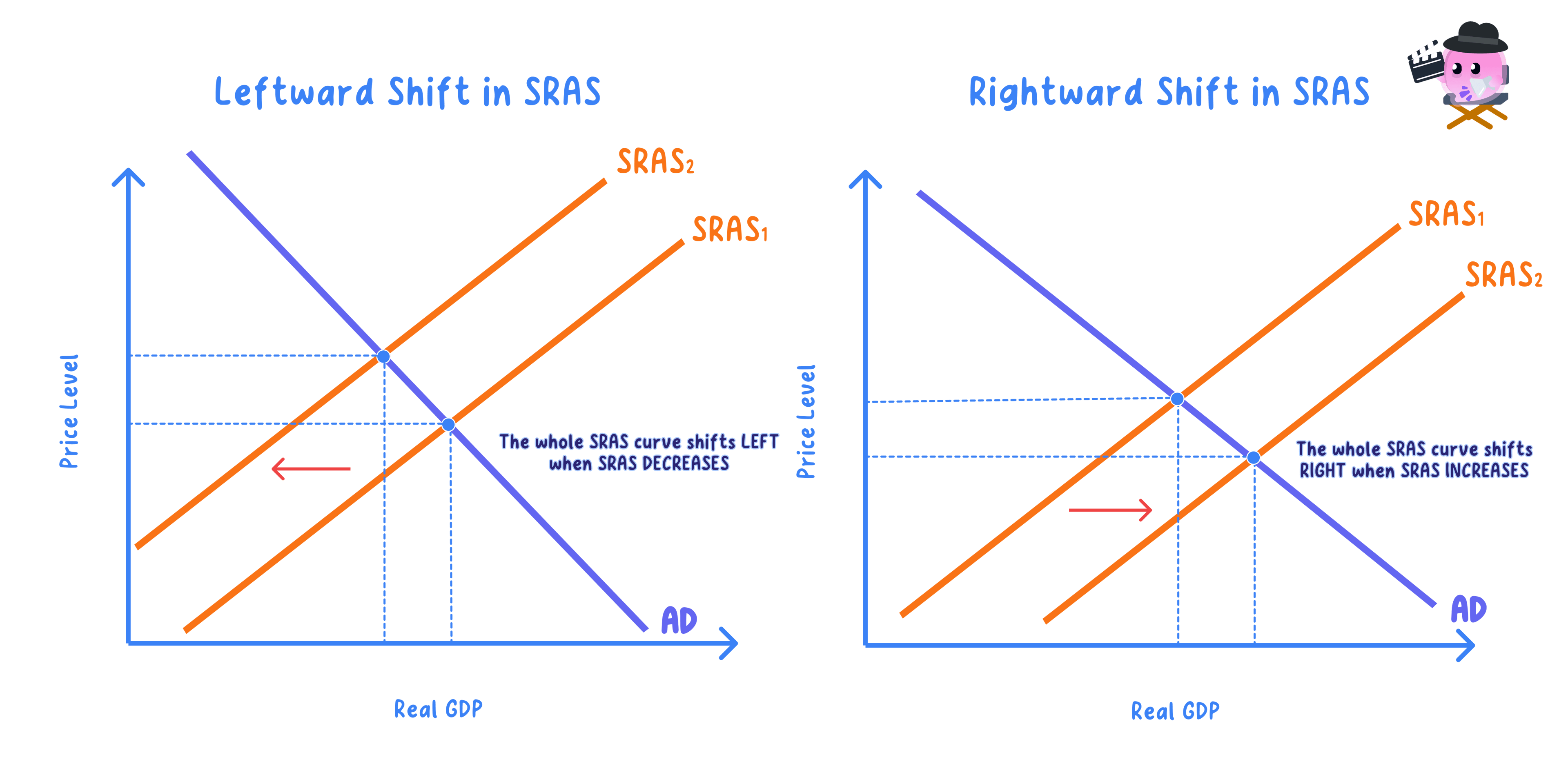
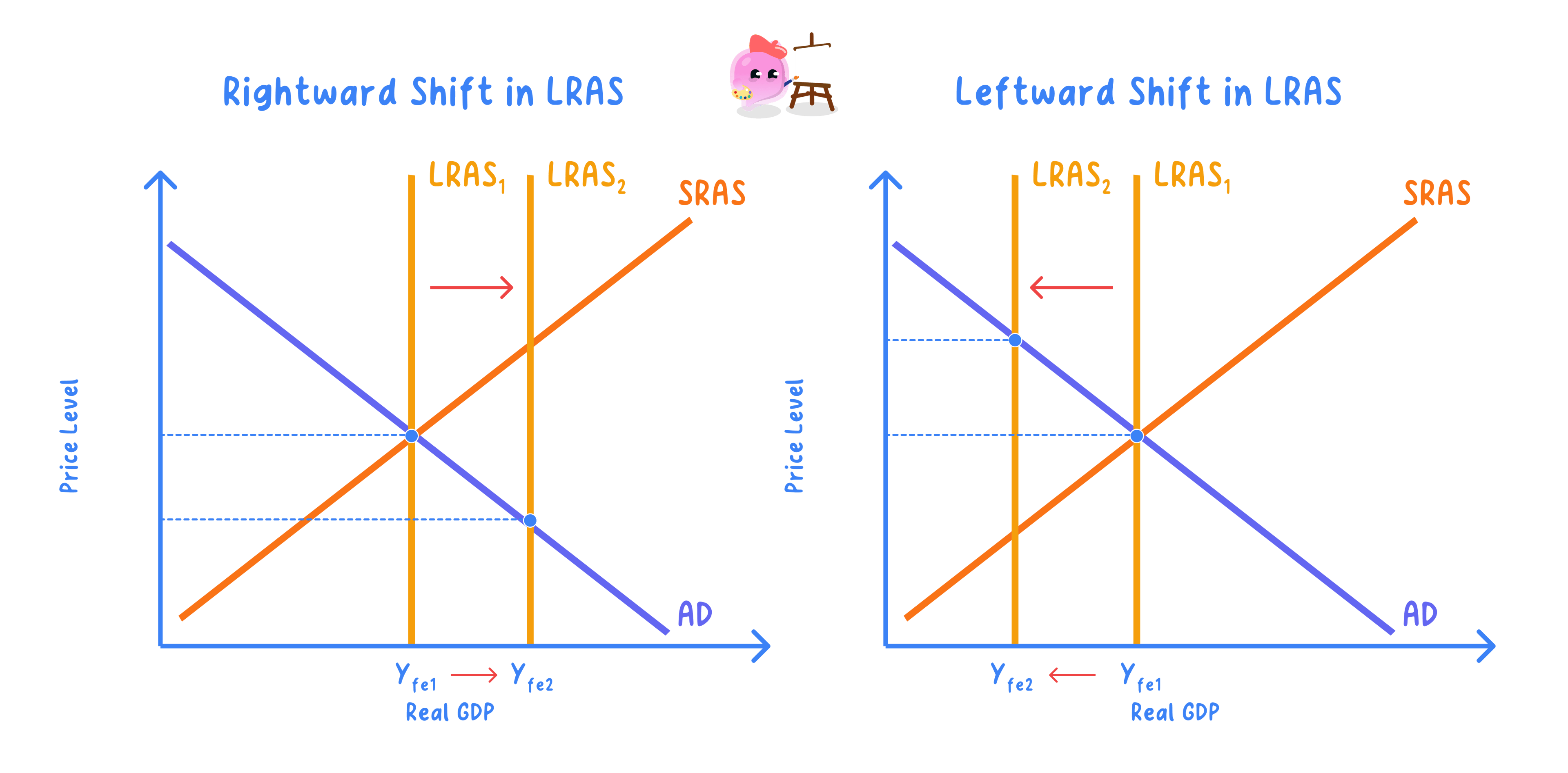
Shift in aggregate supply: a movement of the whole AS curve to a new position at every price level, driven by a change in production costs (SRAS) or in productive capacity (LRAS).
- Short-run shifts come from changes in the costs of production, so SRAS moves before capacity does.
- Long-run shifts come from changes in productive capacity, so LRAS moves only when the economy can produce more.
- A leftward shift means less supply at every price level; a rightward shift means more.
Key Idea
- SRAS shifts when production costs change, so a cost rise moves it left.
- LRAS shifts when the quantity or quality of factors of production changes.
Shifts in SRAS
- Money wage rates: a nationwide pay settlement of +6% raises unit labour costs, so SRAS shifts left.
- Raw material and energy prices: an oil price jump raises input costs at every output, so SRAS shifts left.
- The exchange rate: a depreciation raises the domestic price of imported inputs, so SRAS shifts left.
- Indirect taxes and subsidies: a higher tax on production shifts SRAS left, while a new subsidy shifts it right.
Example
- A manufacturer imports components billed at €10,000 per batch.
- The pound depreciates from £1 = €1.20 to £1 = €1.08, a fall of −10%.
- The batch now costs £9,259 instead of £8,333, so input costs rise by +£926 at every output.
- Dearer inputs raise costs across import-reliant firms, so SRAS shifts left: price level ↑ and real output ↓.
Shifts in LRAS
Definition
Productivity: output produced per unit of input, most often measured as output per worker per hour.
- The quantity of factors of production, such as net migration adding workers, expands capacity, so LRAS shifts right.
- The quality of factors, raised by education and training, lifts productivity, so LRAS shifts right.
- Technology and productivity let the same resources produce more output, so LRAS shifts right.
- Investment in new capital enlarges the stock of productive equipment, so LRAS shifts right.
Example
- Firms invest £50bn in automation and worker retraining across industry.
- Output per worker rises by +8%, so the same labour force produces more.
- The maximum output achievable at full employment increases, so productive capacity grows.
- LRAS shifts right, which represents potential (long-run) economic growth.
Note
- A rightward LRAS shift matches an outward shift of the production possibility frontier.
- Some causes, such as investment, raise both SRAS and LRAS over time.
Keeping SRAS and LRAS Apart
- A temporary cost change shifts SRAS but leaves LRAS unchanged, because capacity has not moved.
- LRAS moves only when the quantity or quality of factors changes, so capacity itself must alter.
- The two curves therefore respond to different triggers, so it depends on whether the shock hits costs or capacity.
Can we always tell whether an AS shift is short-run or long-run?
- For most shocks the trigger reveals the horizon cleanly: a cost change such as an oil-price spike or a pay settlement shifts SRAS, while a change in the quantity or quality of factors shifts LRAS, so the categorisation is a reliable working guide.
- But the line often blurs: investment lowers costs now, shifting SRAS right, and enlarges capacity later, shifting LRAS right, so a single cause moves both curves over different time frames.
- A cost shock is also only temporary if it reverses: if a prolonged downturn destroys skills and scraps capital through hysteresis, what began as an SRAS shift hardens into a leftward LRAS shift, so the label depends on how long the shock lasts.
- On balance the SRAS/LRAS split predicts real outcomes well for one-off cost shocks, but for investment-driven or long-lasting changes it depends on the time horizon and on whether the shock feeds through to capacity, so the safest approach is to state the horizon assumed rather than treat the two curves as watertight.
Exam technique
- Shift SRAS for a change in production costs.
- Shift LRAS only for a change in productive capacity.
- Present a rightward LRAS shift as potential growth.
Common Mistake
- Do not treat a temporary cost change as a shift in LRAS.
- A cost change shifts SRAS, while a capacity change shifts LRAS.
Self review
- Name three causes of a shift in SRAS.
- How does a depreciation of the currency affect SRAS, and why?
- Name three causes of a shift in LRAS.
- Why is a temporary cost change not a shift in LRAS?
