A Nurture Account of Language
- The learning theory argues you are not born knowing language, you pick it up from the people around you.
- It treats talking as ordinary learned behaviour, acquired through the same rules as any other habit.
- Two processes do the work: imitation and reinforcement.
- That places it firmly on the nurture side of the debate, opposite Chomsky's idea of an inborn language faculty.
Key Idea
- Language is learned behaviour, shaped by copying others and by the rewards that follow speech.
- The two engines that drive it are imitation and reinforcement.
Imitation
- You listen to the people around you, hold on to the words and patterns they use, then reproduce them yourself.
- This is why a child raised in Cardiff grows up speaking English with a local accent, rather than Australian.
- Children often copy whole chunks, such as "all gone" or "night night", before they understand every part.
Reinforcement
Definition
Reinforcement
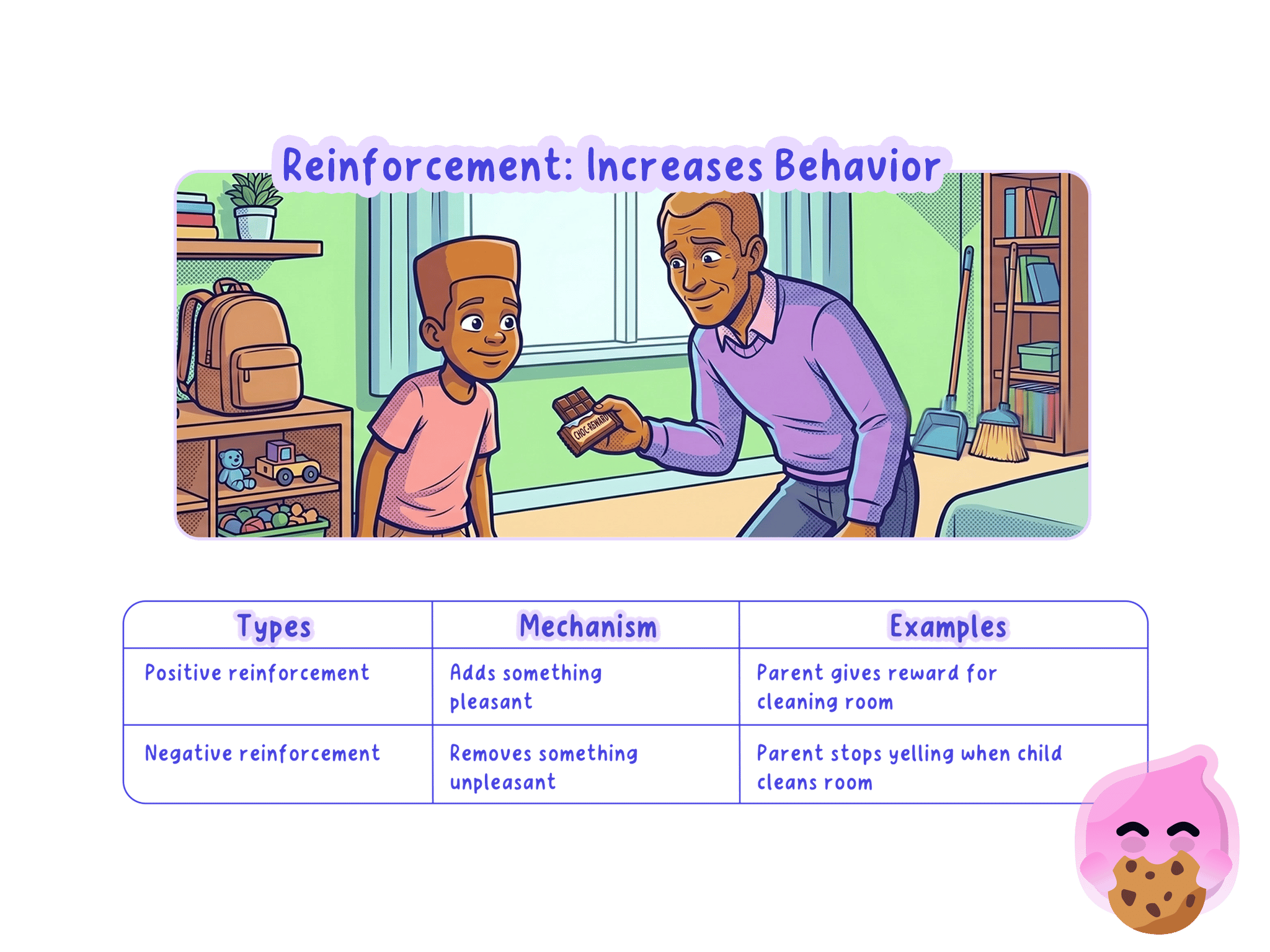
Anything that follows a behaviour and makes that behaviour more likely to happen again. Positive reinforcement adds something pleasant, such as praise, while negative reinforcement removes something unpleasant.
- Positive reinforcement
- Say a word and get praise, a smile or the thing you asked for, and you are more likely to say it again.
- Negative reinforcement
- When saying the right word removes something unpleasant, such as the frustration of not being understood, that word is strengthened too.
- Operant conditioning
- Skinner argued speech is shaped exactly like this, one rewarded response at a time.
Example
- A toddler in the queue at supermarket points and says "milk".
- A parent hands over the carton and beams, so the word pays off.
- Reinforced, the child reaches for "milk" again next time, and soon "more milk".
Shaping
- Caregivers reward closer and closer attempts, so "ba" earns a smile, then only "bot", then only "bottle".
- This gradual rewarding of near-misses is called shaping by successive approximations.
- Over time the rewarded sounds sharpen into clear words, which is why the environment, not biology, decides which language and which words you end up with.
Common Mistake
- Do not treat negative reinforcement as punishment.
- Punishment adds something unpleasant to stop a behaviour.
- Negative reinforcement removes something unpleasant to increase a behaviour.
The Theory in the Exam
- Name both mechanisms and keep them apart: imitation is copying, reinforcement is the reward that follows.
- Back each one with a quick example of speech being copied or rewarded.
- The mark most people miss is blurring negative reinforcement with punishment, so define it precisely.
Self review
- What does the learning theory claim about where language comes from?
- How does imitation help a child acquire language?
- What is the difference between positive and negative reinforcement?
- Why is negative reinforcement not the same as punishment?
