What Aphasia Is
- Aphasia is a language impairment caused by damage to the brain's language centres.
- That damage usually follows a head injury, a stroke or an illness that affects the brain.
- The type of aphasia you see depends on which area is affected.
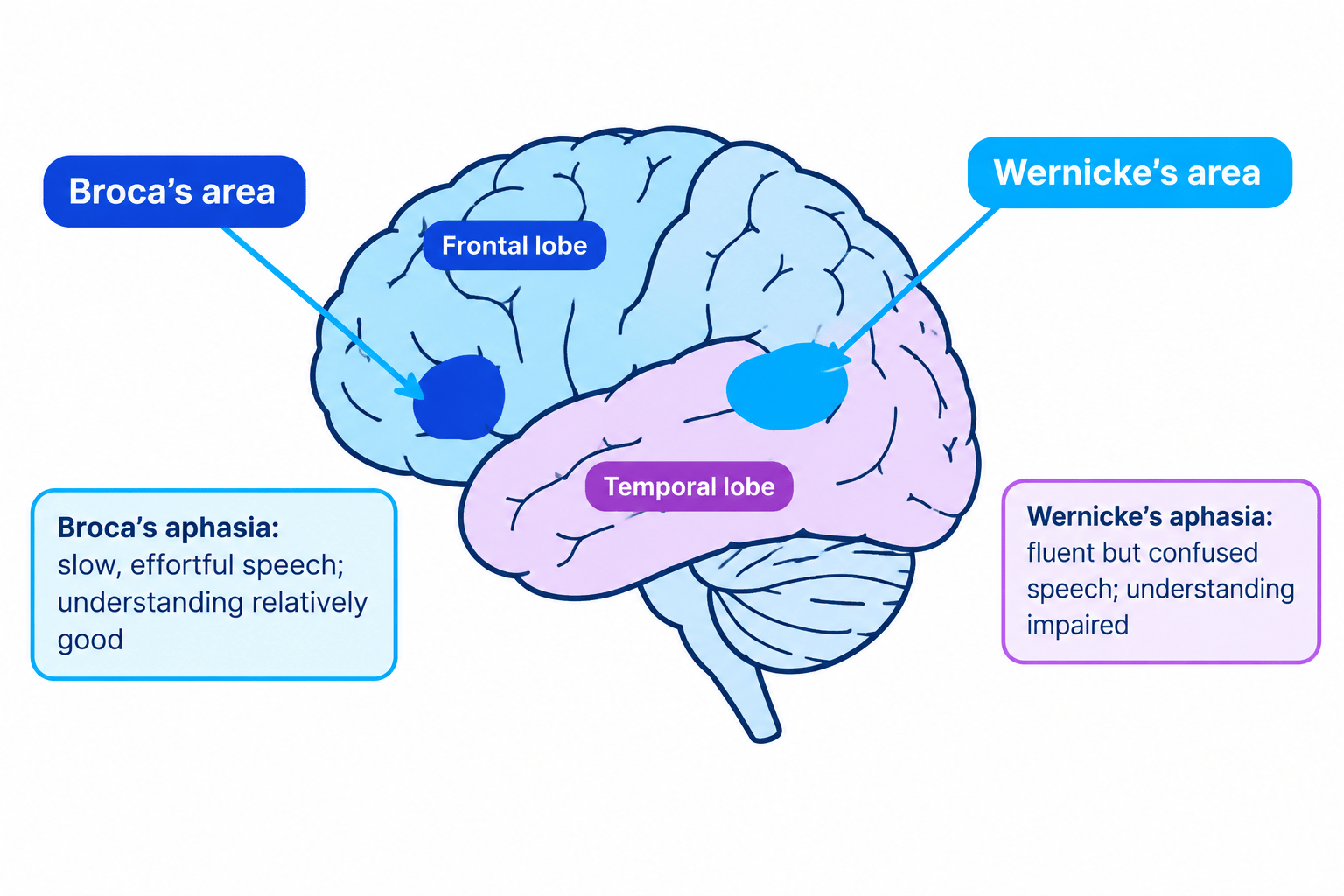
- The two main types are Broca's aphasia and Wernicke's aphasia.
Key Idea
- Broca's aphasia disrupts producing speech.
- Wernicke's aphasia disrupts understanding speech.
Broca's Aphasia
- It follows damage to Broca's area in the frontal lobe.
- Speech becomes slow, halting and effortful, produced only a few words at a time.
- Small grammatical words such as "the", "is" and "and" are often left out, so the speech sounds clipped.
- Understanding stays relatively good, and the person is usually aware of the difficulty, which can be frustrating.
Example
- Asked about their morning, a person with Broca's aphasia might say "walk... dog" instead of "I took the dog for a walk".
- They know exactly what they mean, but finding and forming the words is a real effort.
Wernicke's Aphasia
- It follows damage to Wernicke's area in the temporal lobe.
- Speech stays fluent and flows at a normal pace, but the meaning is jumbled.
- The person may use wrong or made-up words, so sentences sound grammatical yet make little sense.
- Comprehension is impaired, so following others is hard, and the person is often unaware of the errors.
Common Mistake
- Do not mix the two types up.
- Broca's aphasia is halting, while Wernicke's aphasia is fluent but confused, and each traces back to a different damaged area.
Telling the Two Apart in the Exam
- For Broca's aphasia, stress the effortful, broken speech with understanding mostly intact.
- For Wernicke's aphasia, stress the fluent but meaningless speech with poor understanding, and always name the damaged area.
Self review
- What is aphasia, and what causes it?
- What are the symptoms of Broca's aphasia?
- What are the symptoms of Wernicke's aphasia?
- Which brain area is damaged in each type?