Chomsky's Innate View of Language
- Chomsky argued that language is innate, meaning you are born ready to learn it.
- The ability is built into the brain from birth rather than taught from scratch.
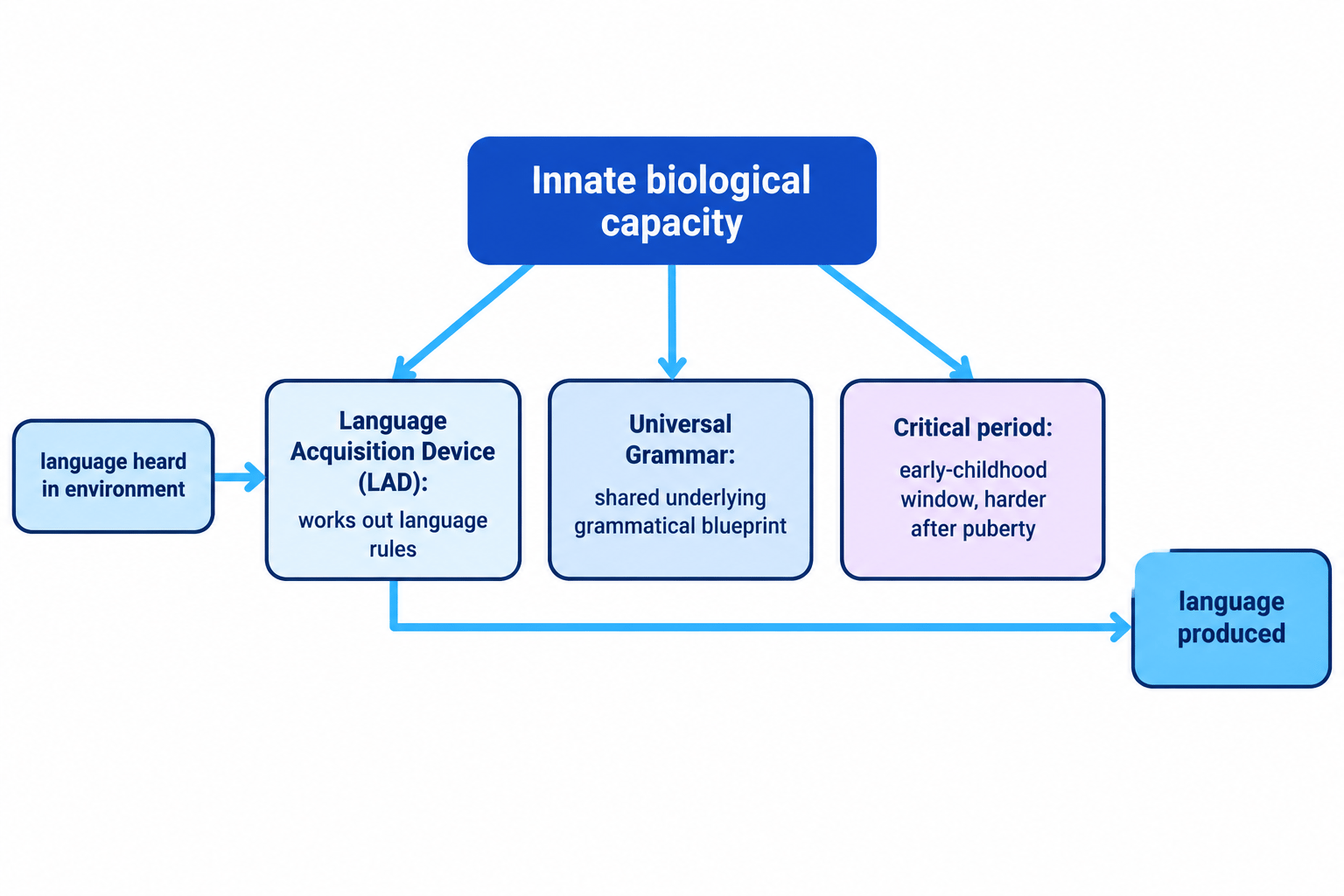
- Three ideas make up the theory: the language acquisition device, universal grammar and the critical period.
Key Idea
- Children learn language too fast, and too accurately, for imitation alone to explain it.
- Chomsky took this as evidence of an innate, biological basis for language.
The Language Acquisition Device
Definition
Language acquisition device
An innate mechanism proposed by Chomsky that lets children work out the rules of any language they are exposed to.
- The language acquisition device (LAD) is an inborn mechanism every child is born with.
- It lets a child work out the rules of whatever language they hear, without being formally taught them.
- This explains why children pick up grammar so quickly and make neat rule errors, saying "goed" instead of "went" because they have applied a rule nobody taught them.
Universal Grammar
- Universal grammar is a set of grammatical rules Chomsky said all human languages share.
- Features such as nouns, verbs and a system of word order turn up in every language, which suggests a common underlying structure.
- Because this blueprint is already built in, the LAD only has to fine-tune it to the particular language around the child.
Example
- A three-year-old in Cardiff who has never heard the sentence says "I sawed two sheeps".
- Nobody taught her that exact phrase, so she must be applying grammar rules of her own, just as an innate blueprint predicts.
The Critical Period
Definition
Critical period
A limited window in early childhood during which the brain learns language especially easily; after it closes, learning a first language becomes much harder.
- The critical period is a limited window in early childhood when the brain learns language especially easily.
- During this window the LAD works at full strength, so a first language is picked up almost effortlessly.
- After it closes, usually around puberty, learning a first language becomes much harder, which fits a biological timetable set by brain development.
Why the Theory Is Biological
- The LAD is something you are born with, not something you are taught.
- Universal grammar is shared by all humans, which points to biology rather than the particular culture a child grows up in.
- The critical period is set by brain development, giving language a fixed maturational timetable.
Note
- This is a nature explanation of language.
- It sits opposite the learning theory, which says language is shaped by the environment through imitation and reinforcement.
Outlining Chomsky in the Exam
- Name all three parts, the LAD, universal grammar and the critical period, and say what each one is.
- The mark most people miss is the "why innate" link, so tie each part back to language being built in rather than learned.
Self review
- What is the language acquisition device?
- What is universal grammar?
- What is the critical period, and what happens after it?
- Why is Chomsky's theory described as a nature explanation?