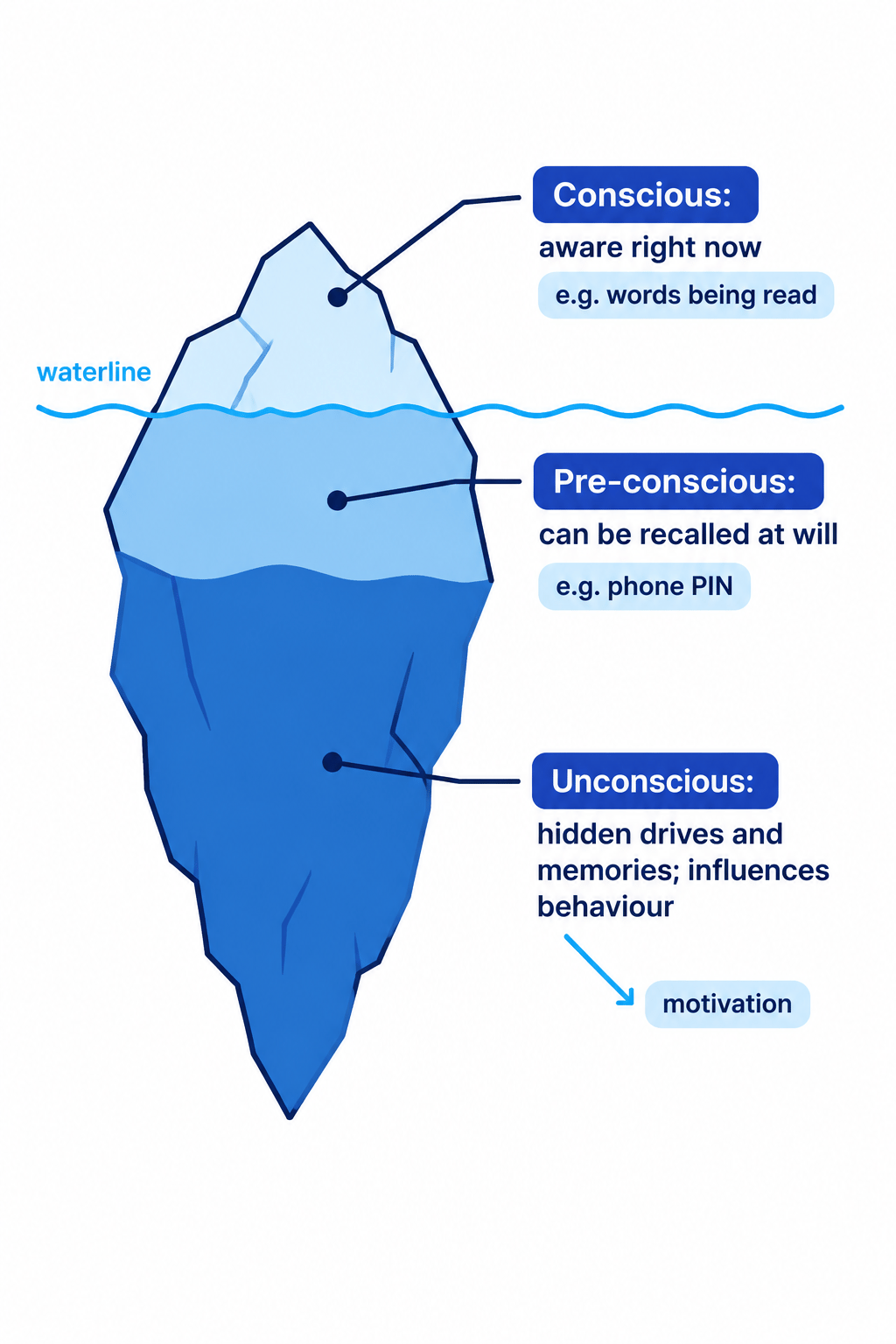
- The psychodynamic approach pictures the mind on three levels.
- They are the conscious, the pre-conscious and the unconscious.
- Each level differs in how easily you can reach what it holds.
Key Idea
- The unconscious drives much of what motivates you, without your awareness.
- That hidden layer sets up the id, ego and super-ego you meet next.
The Three Levels, Top to Bottom
- The conscious
- Everything you are aware of right now, such as the words you are reading.
- The pre-conscious
- Thoughts just out of view that you can call up when you choose, like your phone PIN.
- The unconscious
- Hidden drives and memories you cannot easily reach, yet which still tug at your behaviour.
Example
- Think of the mind as an iceberg floating in the North Sea.
- The tip above the water is the conscious, the waterline is the pre-conscious, and the huge bulk hidden below is the unconscious.
The Unconscious and Motivation
- The unconscious can push you towards a choice without you knowing why.
- This hidden drive is central to the psychodynamic view of motivation.
- It also lays the ground for the id, ego and super-ego.
Common Mistake
- Do not muddle the pre-conscious with the unconscious.
- Pre-conscious thoughts can be recalled at will, but unconscious ones cannot.
Explaining the Levels in the Exam
- Name the three levels of awareness.
- Say what each level holds, with a quick example.
- Link the unconscious to motivation.
Self review
- Name the three parts of the mind.
- What is held in the conscious mind?
- What is the unconscious?
- Why does the unconscious matter for motivation?