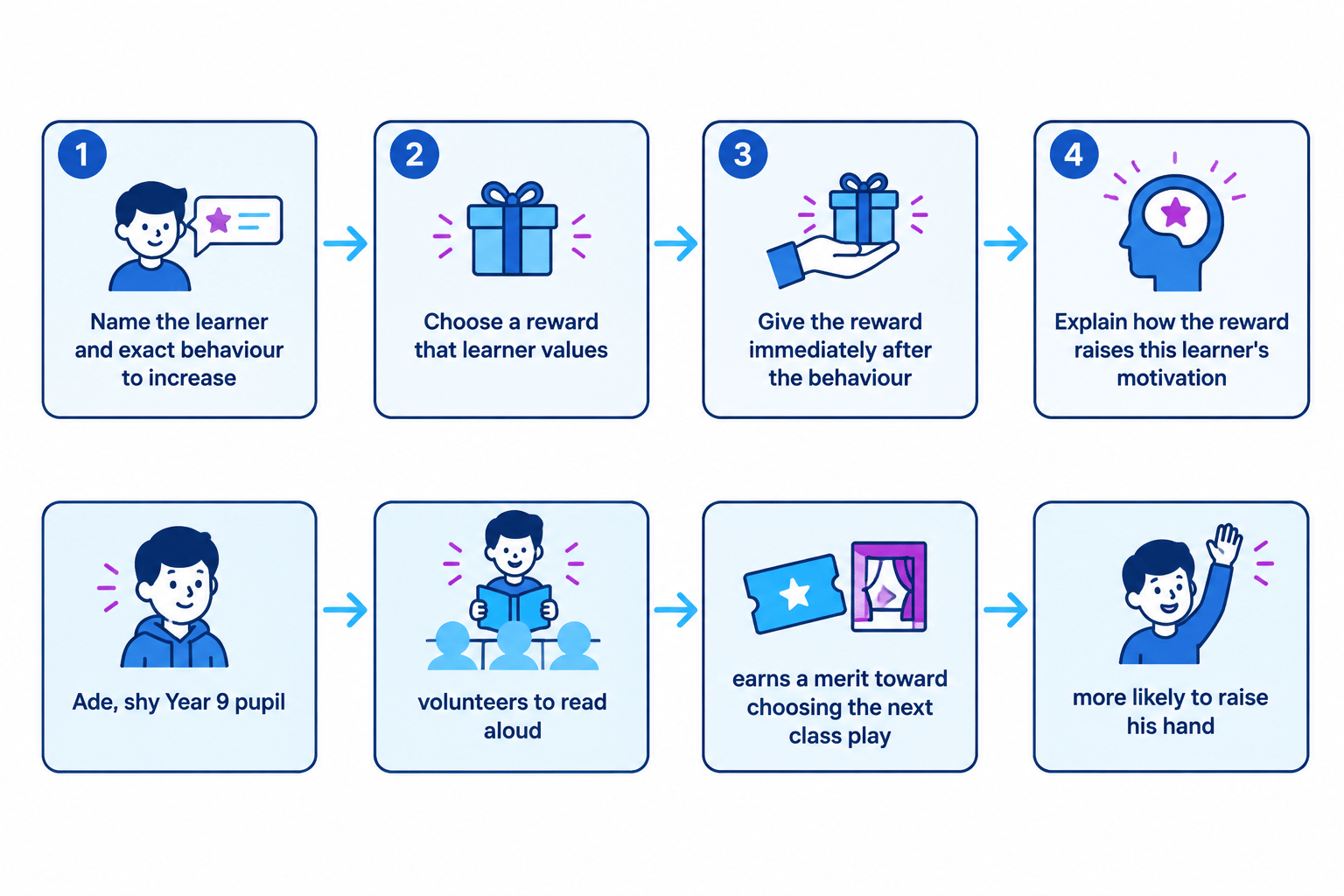
Applying Reinforcement
- An application question hands you a fresh classroom problem to solve.
- You pick the behaviour to increase, then choose a reward for it.
- Your job is to explain how that reward raises motivation for that particular learner.
Key Idea
- Choose a reward for the exact behaviour you want to increase.
- Then explain how it raises that learner's motivation.
Choosing and Timing the Reward
- Decide exactly which behaviour you want more of.
- Pick a reward the learner values, from a token to a word of praise.
- Deliver it straight after the behaviour, so the link between the two stays strong.
Example
- A drama teacher wants Ade, a shy Year 9 pupil, to volunteer to read parts aloud.
- Each time Ade offers to read, they earn a merit towards choosing the next class play, so they raise their hand more often.
Matching the Technique to the Learner
- Check the reward fits the learner, since not everyone is moved by the same thing.
- Use praise for a pupil who lights up at recognition, or tokens for one who likes collecting points.
- Keep the reward tied to the exact behaviour named in the scenario.
Common Mistake
- Do not just describe reinforcement in general.
- Name the scenario's learner and behaviour, or you lose the application marks.
Writing a Strong Application Answer
- Name the behaviour to increase and the learner from the scenario.
- Choose a reinforcement technique and a reward.
- Explain how the reward increases that learner's motivation.
Self review
- How would you use a token economy in a new scenario?
- When should the reward be given?
- Why should the reward match the individual learner?
- Why must you refer to the scenario details?