Skip to content

Course home

Revision guides·5.2.4 Biological arousal
Sign up

5.2.4 Biological arousal

  1. Biological arousal is a state of physiological activation in the body.
  2. When arousal is high, the heart races, breathing quickens and you feel alert.
  3. When arousal is low, the heart slows, breathing eases and you feel calm.
Key Idea
  • Arousal is simply how activated the body is at a given moment.
  • The two branches of the autonomic nervous system set that level.

High Arousal and Low Arousal

  1. High arousal
    1. Produced by the sympathetic branch, giving a fast heart rate and sharp alertness.
  2. Low arousal
    1. Produced by the parasympathetic branch, giving a slow heart rate and a calm body.
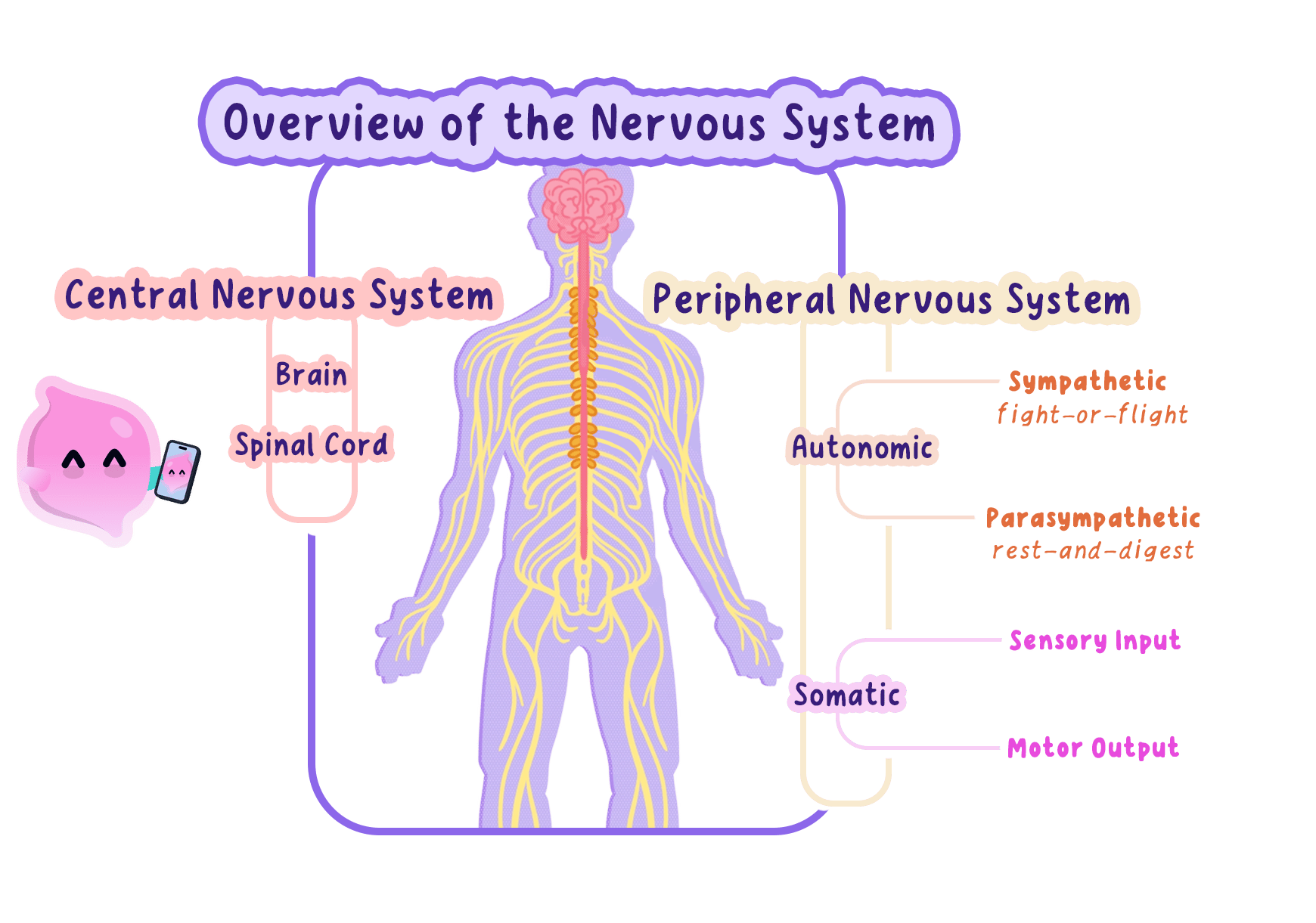
The nervous system hierarchy: CNS and PNS branching to the sympathetic and parasympathetic systems that set arousal

Example
  • Waiting to take a penalty in a school football match, your arousal is high and your heart hammers.
  • Later, slumped on the sofa watching telly, your arousal is low and your body is relaxed.
  • Same body, two very different levels of activation.

How Arousal Connects to Motivation and Drive

  1. An unmet need raises a drive, and that drive pushes your arousal upward.
  2. The raised arousal energises you to act until the need is satisfied.
  3. Once the need is met, arousal falls back towards its calm baseline.
Note
  • Performance is usually best at a middle level of arousal, not the very top or bottom.
  • Hull's drive reduction theory develops this idea of optimal arousal later in the topic.

Reading Arousal From the Nervous System

  1. If a scenario describes a racing heart, think high arousal and the sympathetic branch.
  2. If it describes a slowing, settled body, think low arousal and the parasympathetic branch.
Self review
  • What is biological arousal?
  • What causes high arousal?
  • What causes low arousal?
  • How does arousal link to motivation and drive?

PreviousNext

How was this guide?

Teach Genie

Review 5.2.4 Biological arousal by teaching Genie

Teach it back in your own words, spot gaps, and remember it better.

Start teaching
Genie and Baby Genie

Lesson

Recap your knowledge with an interactive lesson

7 minute activity

Start lesson

Biological arousal is the level of physiological activation in the body at a particular moment. High arousal means the body is highly activated, while low arousal means the body is calm and less activated.

High arousal may involve a racing heart, faster breathing and increased alertness. Low arousal may involve a slower heart rate, relaxed breathing and a calm bodily state.

Questions

Put it into practice with exam-style questions

14 exam-style questions

Practice questions

Question 1

4 marks

A loose dog runs towards Jaya in the park. Her heart rate and breathing rate rise as she hurries away. Once the dog's owner has put it on a lead, Jaya sits down on a bench. Her heart rate slows and her digestion starts again.

Explain the change in Jaya's nervous system activity across the two stages.

Flashcards

Remember key concepts with flashcards

20 flashcards

Practice flashcards

What does biological arousal describe about the body?

5.2.4 Biological arousal Revision Guide

  1. IGCSE
  2. /Psychology
  3. /5.2.4 Biological arousal

Revision notes for CIE IGCSE Psychology 5.2.4 Biological arousal: explanations and worked examples.

More revision guides