Biological Instincts
- A biological instinct is an inborn behaviour that motivates you without any learning.
- It is set off by a specific cue in the environment.
- Many instincts exist because they help the animal survive.
Key Idea
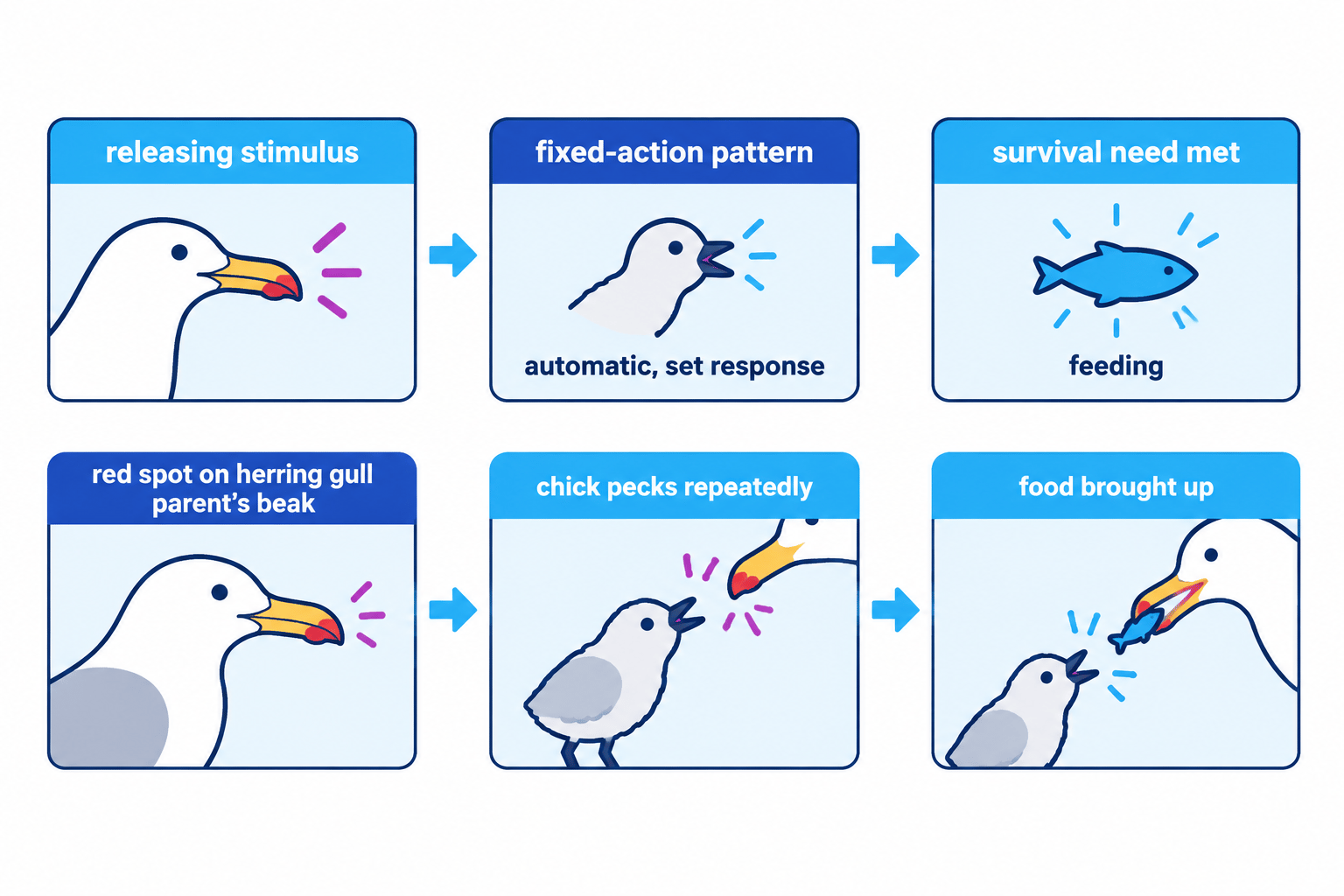
- An instinct is triggered by a cue, then runs as a set response.
- The cue is the releasing stimulus; the response is the fixed-action pattern.
How an Instinct Is Triggered
- Releasing stimulus
- The environmental cue that switches the instinct on.
- Fixed-action pattern
- The same automatic sequence that follows, running to completion once it starts.
Example
- A herring gull chick sees the red spot on its parent's beak, which is the releasing stimulus.
- This sets off a fixed-action pattern: the chick pecks at the spot every time.
- The parent then brings up food, so the instinct feeds the chick without either bird learning it.
Instincts as Survival Behaviour
- Instincts push behaviour towards meeting a survival need, such as being fed.
- Because they are inborn, they work from birth without any practice.
- This makes instincts part of the biological account of motivation.
Common Mistake
- Do not mix up the cue with the response.
- The releasing stimulus is the trigger; the fixed-action pattern is what the animal then does.
Spotting an Instinct in a Scenario
- Look for a set behaviour that appears without ever being taught.
- Then identify the cue that set it off and the fixed response that followed.
Self review
- What is a biological instinct?
- What is a releasing stimulus?
- What is a fixed-action pattern?
- How do instincts link to survival?