The Bremner et al. Study
- The claim is that culture shapes how strongly you experience a visual illusion.
- If perception were purely innate, everyone should be fooled by the same illusion to the same degree.
- Bremner et al. tested this by comparing Himba people from rural Namibia with people from the UK on the Ebbinghaus illusion, so this is the named study you use to argue for cultural influence.
Key Idea
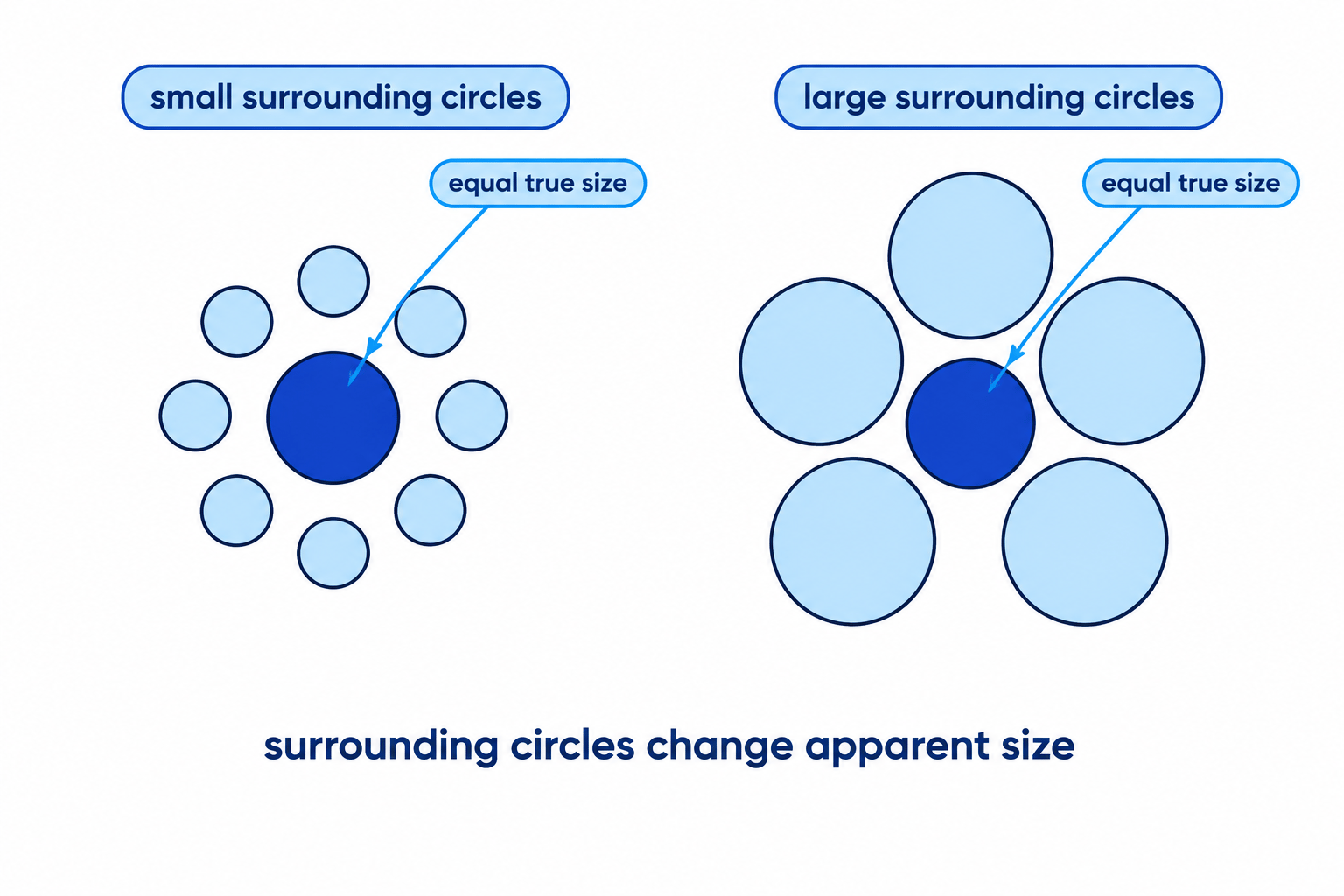
- In the Ebbinghaus illusion, a central circle looks larger or smaller depending on the size of the circles around it.
- Whether two very different cultural groups are fooled to different degrees is the whole point.
What Bremner et al. Found
- Himba participants were more accurate at choosing the larger central circle, across all age groups.
- This means the UK participants experienced the illusion more strongly, and were fooled more often.
- The Himba's limited traditional use of 2D pictures and print appeared to reduce how much they experienced the illusion.
Example
- The same central circle is ringed once by small circles and once by large circles, which makes it look bigger then smaller.
- The UK group was pulled in by the surrounding circles, while the Himba group judged the true size more accurately.
What It Shows
- Bremner et al. concluded that differences in how people experience visual illusions are influenced by culture.
- They argued that findings from one culture may not represent how perception develops worldwide.
- Because the difference tracks cultural experience rather than biology, the study supports the view that culture shapes perception.
Note
- A named study is examined on its results and its conclusion, never its aim or procedure.
- Here that means the Himba being less fooled than the UK group (result) and culture shaping illusion experience (conclusion).
Structuring the Argument
- State the prediction: if culture shapes perception, different cultural groups should experience the same illusion differently.
- Give the result: Himba participants were less fooled by the Ebbinghaus illusion than UK participants.
- Land the link: that difference tracks cultural experience, so it supports the influence of culture on perception.
Self review
- Which two cultural groups did Bremner et al. compare, and on which illusion?
- Which group experienced the illusion more strongly?
- What did they conclude about culture and illusions?
- How do these findings support the influence of culture on perception?