The Structure of Personality
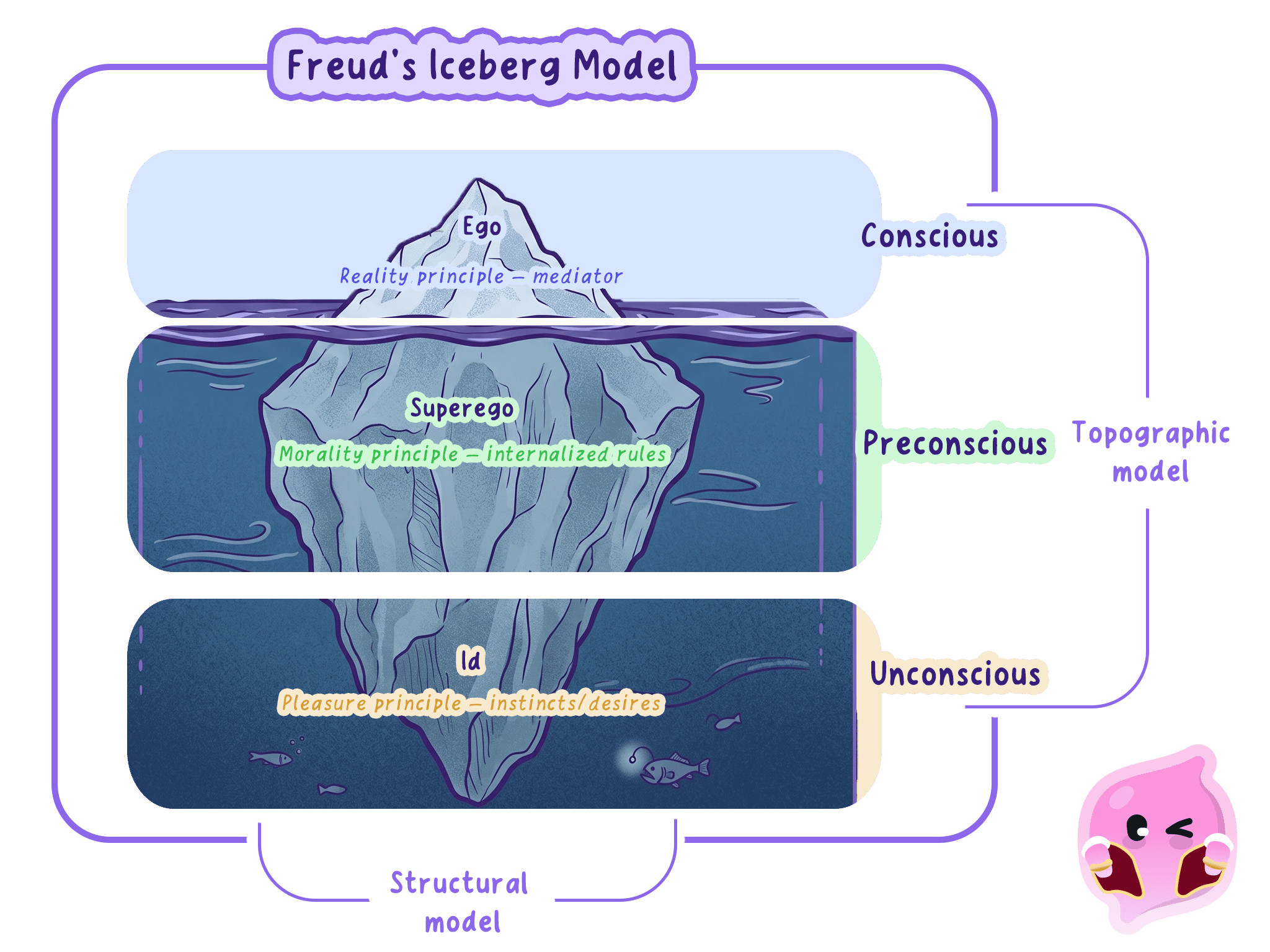
- The psychodynamic approach says your personality is made of three parts.
- They are the id, the ego and the super-ego.
- These three often pull in different directions, and that tension is what matters for forgetting.
Key Idea
- The id wants, the super-ego judges, and the ego keeps the peace between them.
- When they clash, the conflict creates anxiety.
- To ease that anxiety, a distressing memory can be pushed out of awareness.
The Three Parts
- Id
- It is present from birth and is driven purely by desire.
- It wants its needs met straight away, without waiting or weighing up the consequences.
- Ego
- It is the realistic, balancing part that develops as you learn to deal with the real world.
- It works out sensible ways to satisfy the id without breaking the super-ego's rules.
- Super-ego
- It holds your moral and social standards, learned from parents and society.
- It acts like a conscience, judging your thoughts and actions as right or wrong.
Example
- You spot a £20 note dropped on the pavement outside Greggs with nobody around.
- Your id wants to pocket it for lunch, while your super-ego insists you hand it in.
- Your ego finds the realistic path, taking it to the counter so it can be handed in.
How Conflict Between the Parts Drives Forgetting
- When the id and super-ego pull hard in opposite directions, the clash creates anxiety.
- The ego's job is to protect you from being overwhelmed by that anxiety.
- One way it does this is to push the distressing memory or urge out of conscious awareness.
- This links the structure of personality directly to motivated forgetting.
Common Mistake
- The id and the super-ego are opposites, so keep desire with the id and morals with the super-ego.
- It is the ego, not the id or super-ego, that manages the conflict and does the pushing away.
Using the Terms in an Answer
- Name the part behind the described urge or judgement, quoting the detail: the wanting is the id, the moral rule is the super-ego.
- Show the ego as the realistic part that finds a workable path between the two.
- If a memory is forgotten, link the anxiety from that clash to the ego pushing it out of awareness, tying it to the scenario, since that link is a separate mark.
Self review
- What are the three parts of personality?
- What drives the id?
- What is the role of the ego?
- How can conflict between the parts lead to forgetting?
