The Mind on Three Levels of Awareness
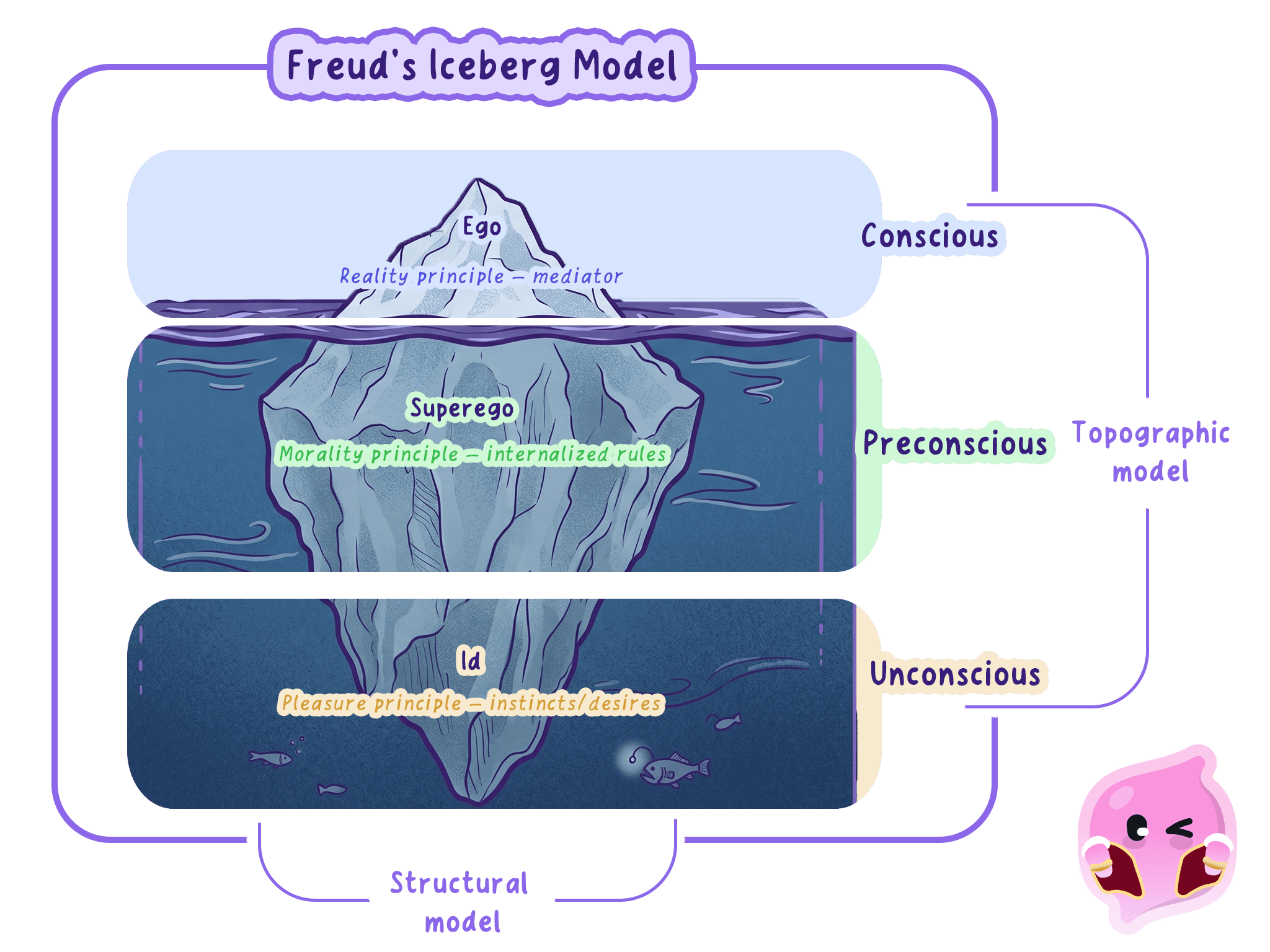
- The psychodynamic approach describes the mind on three levels.
- They are the conscious, the pre-conscious and the unconscious.
- The levels differ in how easily you can reach the thoughts stored in them.
Key Idea
- Picture an iceberg: a small conscious tip above the water and a vast unconscious below.
- The pre-conscious sits just under the surface, close enough to reach.
- The unconscious is the deep part where distressing memories can be kept hidden.
The Three Levels
- Conscious
- It holds whatever you are aware of at this very moment, such as the words you are reading now.
- Pre-conscious
- It holds thoughts that are not in mind now but can be pulled up when you need them.
- A quick prompt is usually enough to bring them into the conscious.
- Unconscious
- It holds thoughts and memories that cannot normally be reached at all.
- It is the largest level, and it stores material kept out of awareness.
Example
- The word you are reading right now sits in your conscious.
- Your home postcode is pre-conscious until someone asks for it, then it pops straight up.
- A memory the mind has repressed stays down in the unconscious, out of your reach.
The Unconscious and Forgetting
Definition
Unconscious
The level of the mind that holds thoughts and memories which cannot normally be brought to awareness, including distressing material that has been repressed.
- A distressing memory can be pushed down into the unconscious.
- Once it is there, it is out of reach, so you cannot recall it even if you try.
- This is how the unconscious links directly to motivated forgetting.
Common Mistake
- The pre-conscious is reachable and the unconscious is not, so do not muddle the two.
- An unconscious memory is hidden, not lost, so avoid saying it is gone.
Placing a Thought at the Right Level
- If the scenario says the thought is in mind right now, place it in the conscious.
- If it is not in mind but comes back with a quick prompt, place it in the pre-conscious, not the unconscious.
- If it cannot normally be reached, place it in the unconscious, where a repressed memory sits; quoting that detail is what earns the application mark.
Self review
- Name the three levels of the mind.
- What is the difference between the pre-conscious and the unconscious?
- Which level is linked to motivated forgetting?
- At which level is your phone number when you are not thinking of it?
