An engineering student wants to determine the refractive index of a transparent liquid sample contained within a thin-walled, semicircular plastic dish using the critical angle method.
Describe how the student should align the light source and the semicircular dish, explaining specifically how the incident ray must be directed relative to the curved and flat faces of the dish.
State the specific angle of incidence that the student must measure and explain how they can identify that this boundary angle corresponds exactly to the critical angle.
Show how the refractive index of the liquid sample is calculated from this measured angle.
The diagram shows a cross-section of a right-angled glass prism with interior angles of 90∘,60∘, and 30∘90^\circ, 60^\circ, \text{ and } 30^\circ90∘,60∘, and 30∘. A horizontal monochromatic ray of light is incident normally on the vertical face of the prism.
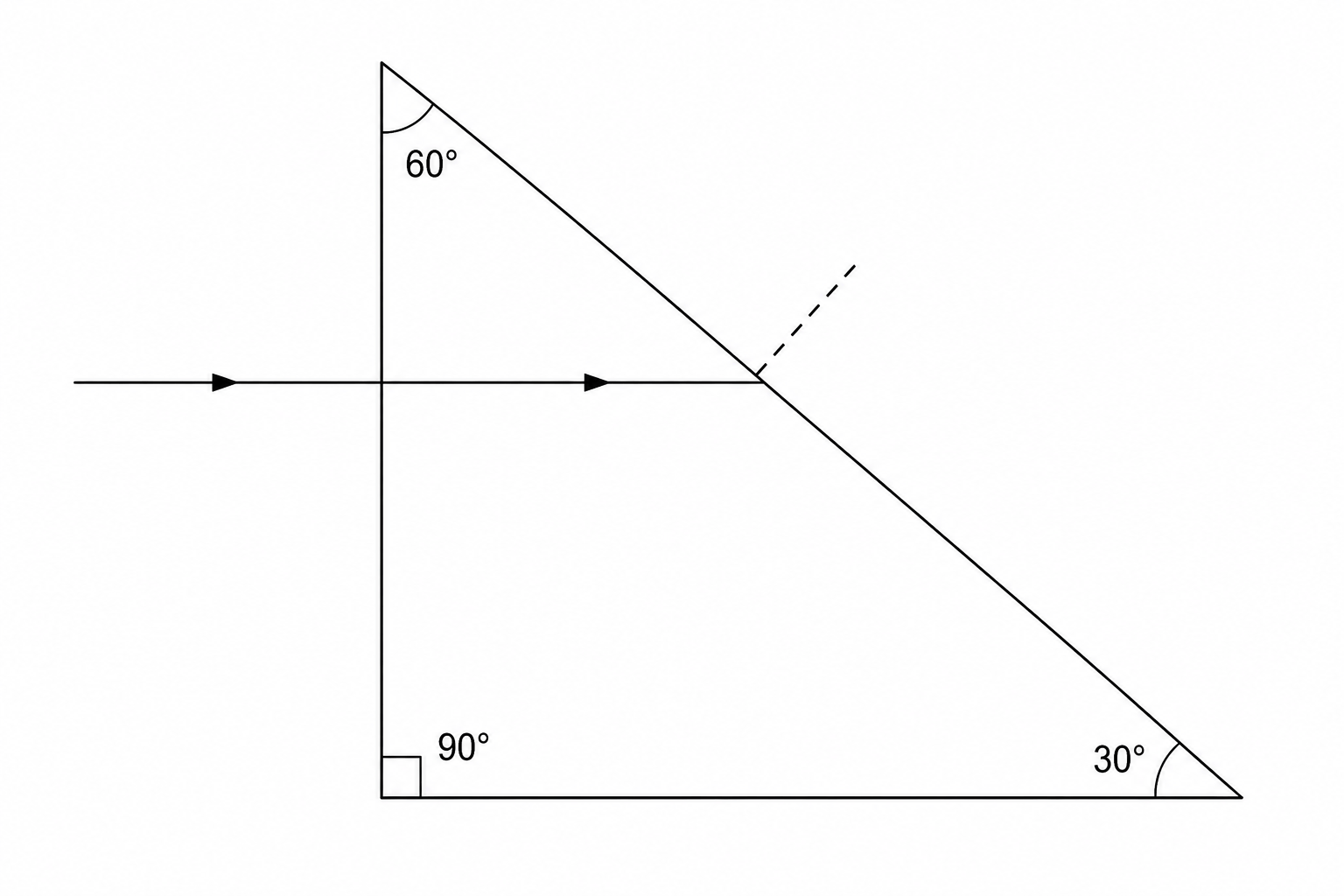
The critical angle for this specific type of glass is 41.8∘41.8^\circ41.8∘. Fully describe the subsequent path of the light ray after it strikes the slanted hypotenuse face, calculating all relevant angles at each boundary, and explain where and at what angle it eventually emerges from the prism into the surrounding air.
State and explain what happens to the speed of the light ray as it transitions from the air into the glass prism.

