A research submarine is floating on the surface of the sea and is stationary.
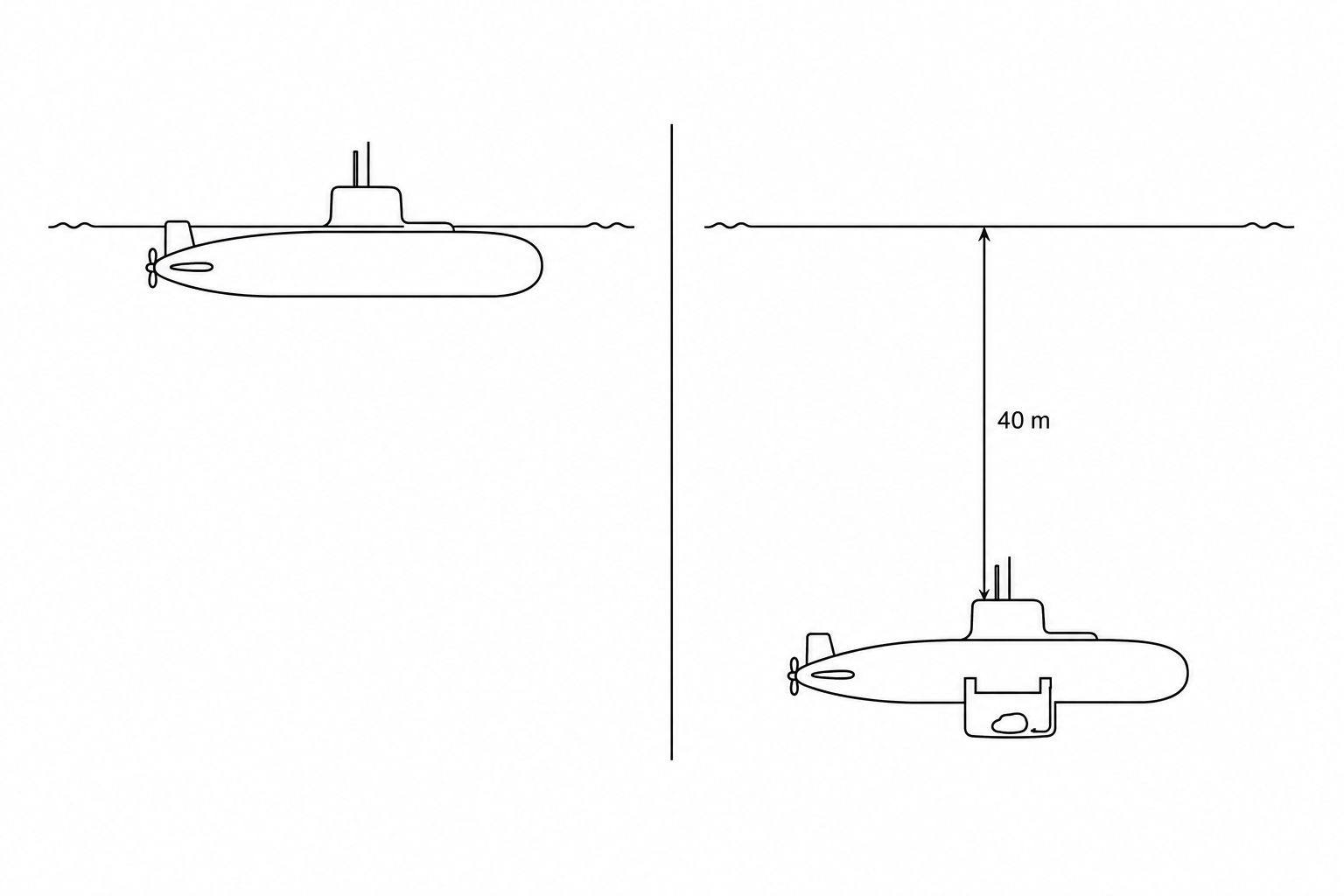
Add two labelled arrows to the diagram to show the vertical forces acting on the submarine.
The submarine then dives to perform a scientific mission. It descends to a depth of 40 m below the surface of the sea.
State the equation linking pressure difference, depth (height), density and ggg.
The density of seawater is 1025 kg/m3. Show that the pressure difference from the surface is about 410 kPa when the submarine is at a depth of 40 m (use g=10 N/kgg = 10\text{ N/kg}g=10 N/kg).
A small pocket of air is trapped inside an open exterior compartment of the submarine as it dives.
Air at the surface of the sea has a pressure of 100 kPa.
Calculate the total pressure of the trapped air at a depth of 40 m below the surface.
The volume of the trapped air is 15.3 m3 when the submarine is at the surface of the sea.
Calculate the volume of the trapped air at a depth of 40 m below the surface, assuming the temperature of the air remains constant.

