Work done is just another name for energy transferred
Definition
Work done
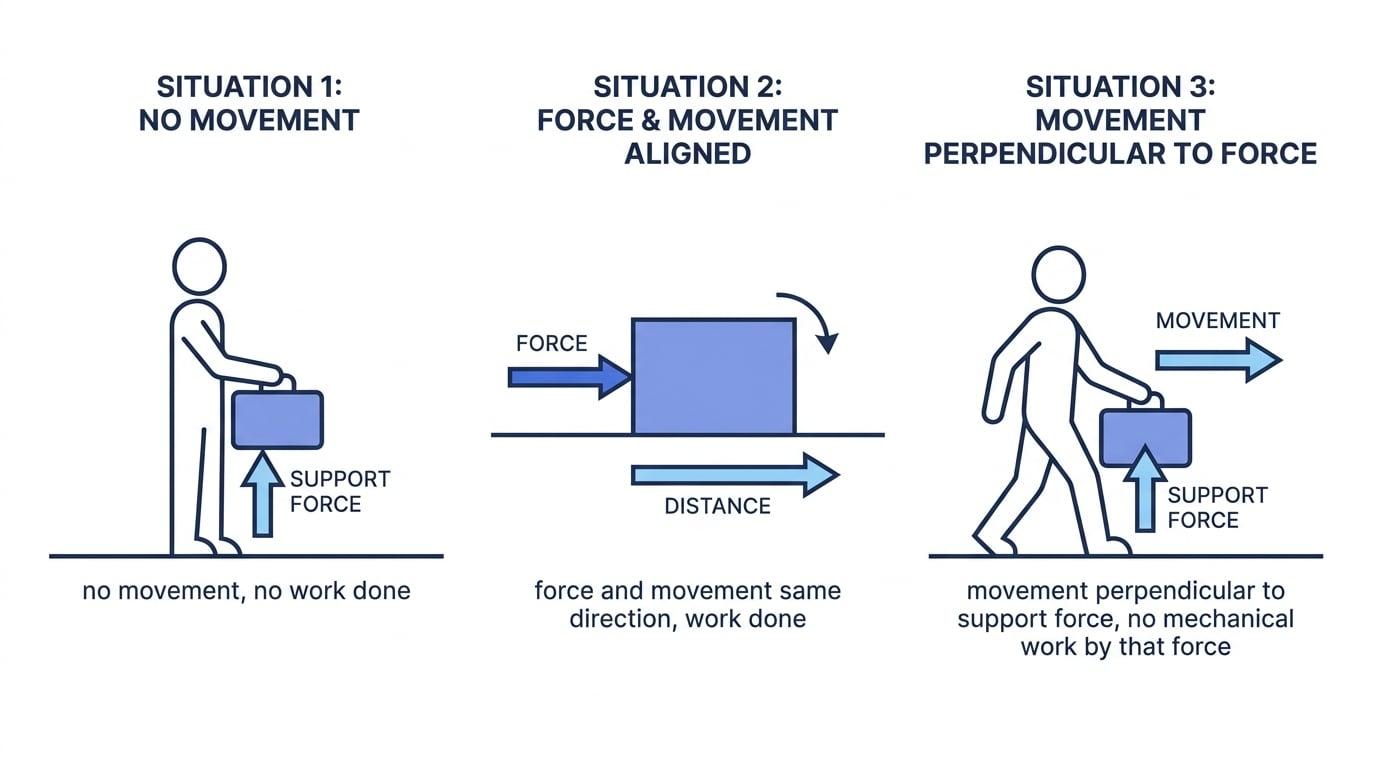
The energy transferred when a force moves an object through a distance in the direction of the force.
W=Fd=ΔE W = Fd = \Delta E W=Fd=ΔEwhere WWW is work done in J\text{J}J, FFF is the force in N\text{N}N, ddd is the distance moved in the direction of the force in m\text{m}m, and ΔE\Delta EΔE is the energy transferred in J\text{J}J.
- Work and energy are measured in the same unit, the joule, because they are the same quantity looked at from two sides. Saying "200 J200\ \text{J}200 J of work was done" and "200 J200\ \text{J}200 J of energy was transferred" are identical statements.
- One joule is the work done when a force of one newton moves an object one metre in the direction of that force.
- Work can be done mechanically, by a force pushing, pulling or lifting, or electrically, by a current driven round a circuit. Either way, the work done equals the energy shifted from one store to another.
- The distance must be measured in the direction of the force. Carrying a suitcase horizontally along a platform does no work against its weight, because the weight acts downwards while the suitcase moves sideways.
- If nothing moves, no work is done, no matter how hard the force pushes. Straining against a wall that will not budge transfers energy inside your muscles, but does no work on the wall.
- Against gravity, the force needed to lift something steadily is its weight, F=mgF = mgF=mg, and the distance is the vertical height, so W=mgΔhW = mg\Delta hW=mgΔh. That is exactly the gravitational potential energy equation, arrived at from work.
Common Mistake
- Work is not force. Force is measured in newtons, work in joules. An answer such as "the work done is 45 N45\ \text{N}45 N" scores nothing.
- Use the distance moved in the direction of the force. For lifting, that is the vertical height, not the length of a ramp or a staircase.
- No movement means no work done, however large the force.
- Weight is mgmgmg in newtons. Substituting a mass in kilograms straight into W=FdW = FdW=Fd is a common slip.
Exam technique
- State the equation before substituting. Even a wrong final answer usually keeps the method mark when W=FdW = FdW=Fd appears on the page.
- Ask yourself which force the question means: the applied force, the weight, or the friction force. Choosing the wrong one is the main source of lost marks here.
- When a question links work to energy, say which store the energy came from and which store it went to, rather than just quoting a number.
- Convert any distance given in centimetres or kilometres to metres before substituting.
Self review
- Define work done and give its equation.
- State the unit of work and explain why it is the same as the unit of energy.
- A force of 60 N60\ \text{N}60 N moves a crate 4.5 m4.5\ \text{m}4.5 m in the direction of the force. Calculate the work done.
- Explain why no work is done on a suitcase carried horizontally at constant speed.
- A 15 kg15\ \text{kg}15 kg box is lifted 2.0 m2.0\ \text{m}2.0 m. Calculate the work done against gravity, taking g=9.8 N/kgg = 9.8\ \text{N/kg}g=9.8 N/kg.