Kinetic energy depends on the square of the speed
Definition
Kinetic energy
The energy an object has because of its motion.
Ek=12mv2 E_k = \frac{1}{2}mv^2 Ek=21mv2where EkE_kEk is kinetic energy in J\text{J}J, mmm is mass in kg\text{kg}kg and vvv is speed in m/s\text{m/s}m/s.
- The v2v^2v2 is the part that matters. Doubling the speed does not double the kinetic energy, it makes it four times larger; tripling the speed makes it nine times larger.
- That is the physics behind stopping distances. A car at 60 km/h60\ \text{km/h}60 km/h carries four times the kinetic energy of the same car at 30 km/h30\ \text{km/h}30 km/h, so its brakes have four times as much energy to remove.
- Kinetic energy is a scalar. It has no direction, and it is never negative, because squaring the speed removes any minus sign.
- Mass appears only to the first power, so doubling the mass merely doubles the kinetic energy. Speed is by far the more powerful variable.
- Only the speed goes into the equation, so a rearrangement gives v=2Ekmv = \sqrt{\dfrac{2E_k}{m}}v=m2Ek when you need to work backwards to a speed.
Gravitational potential energy depends on height
Definition
Change in gravitational potential energy
The energy transferred to or from an object's gravitational store when its height in a gravitational field changes.
ΔEp=mgΔh \Delta E_p = mg\Delta h ΔEp=mgΔhwhere ΔEp\Delta E_pΔEp is the change in energy in J\text{J}J, mmm is mass in kg\text{kg}kg, ggg is the gravitational field strength in N/kg\text{N/kg}N/kg and Δh\Delta hΔh is the change in height in m\text{m}m.
- The equation gives a change, not a total. There is no absolute zero of height, so you always measure Δh\Delta hΔh from a level you have chosen and stated.
- Δh\Delta hΔh is the vertical height gained or lost. Walking 50 m50\ \text{m}50 m up a gentle slope that rises 8 m8\ \text{m}8 m counts as Δh=8 m\Delta h = 8\ \text{m}Δh=8 m, not 50 m50\ \text{m}50 m.
- Take g=9.8 N/kgg = 9.8\ \text{N/kg}g=9.8 N/kg near the surface of the Earth unless a question tells you to use a different value.
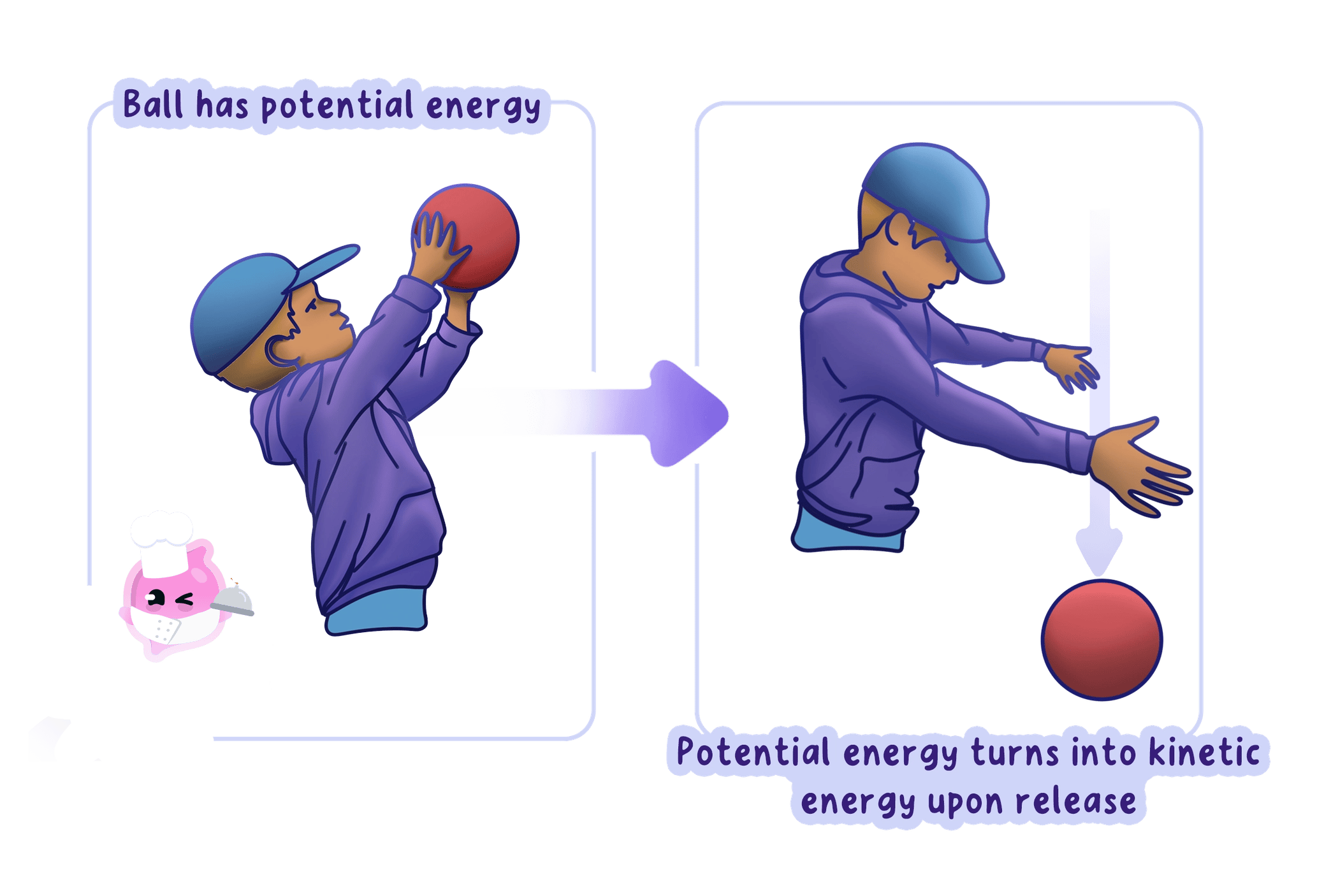
- Lifting an object increases its gravitational potential store; letting it fall decreases the store and increases the kinetic store instead.
- The same object on the Moon, where ggg is about 1.6 N/kg1.6\ \text{N/kg}1.6 N/kg, gains far less gravitational potential energy for the same lift, because ggg is much smaller there.
Putting the two equations together
- In a fall with no air resistance, every joule leaving the gravitational potential store arrives in the kinetic store, so mgΔh=12mv2mg\Delta h = \frac{1}{2}mv^2mgΔh=21mv2.
- Cancelling the mass gives v=2gΔhv = \sqrt{2g\Delta h}v=2gΔh, which is why, in the absence of air resistance, all objects reach the same speed after falling the same height, whatever their mass.
- Run the argument backwards for an object thrown upwards: the kinetic store empties into the gravitational store, and the object stops when it is all transferred.
- With air resistance included the sums no longer balance exactly, because some energy is transferred to the internal energy store of the air.
Common Mistake
- Square the speed before you multiply. Working out 12×1200×25\frac{1}{2} \times 1200 \times 2521×1200×25 and then squaring is the most frequent arithmetic error in this topic.
- Use vertical height only in ΔEp=mgΔh\Delta E_p = mg\Delta hΔEp=mgΔh, never the distance travelled along a slope or a staircase.
- ggg is the gravitational field strength in N/kg\text{N/kg}N/kg, not the acceleration you might read from a graph, and it is not 101010 unless you are told to use 101010.
- Kinetic energy uses speed, not velocity, and can never come out negative.
Exam technique
- Write the equation first, then substitute, then evaluate. Splitting the working like this earns the method marks even if the final number is wrong.
- Check the power of ten on your answer. Kinetic energies of vehicles run to hundreds of kilojoules, so an answer of 375 J375\ \text{J}375 J for a car is a signal that you forgot to square.
- In an energy-conversion question, say the words "assuming no energy is transferred to the surroundings" before equating the two stores. That assumption is often worth a mark on its own.
- Always finish with the unit J\text{J}J, and give a sensible number of significant figures, usually two or three.
Self review
- Write the equation for kinetic energy and state the unit of each quantity.
- A 70 kg70\ \text{kg}70 kg runner moves at 4.0 m/s4.0\ \text{m/s}4.0 m/s. Calculate the kinetic energy.
- By what factor does kinetic energy change if the speed is trebled?
- Write the equation for the change in gravitational potential energy, and say which height must be used.
- A 2.0 kg2.0\ \text{kg}2.0 kg book falls from a shelf 1.5 m1.5\ \text{m}1.5 m high. Calculate its speed on landing, taking g=9.8 N/kgg = 9.8\ \text{N/kg}g=9.8 N/kg.
